AI Agents vs. Virtual Assistants: The 2026 SMB Owner's Guide
Key Takeaways
- AI agents and virtual assistants serve different roles in SMB operations.
- AI agents can automate high-volume, repetitive tasks, but still require human oversight.
- Offshore VAs provide judgment, relationship management, and exception handling.
- The true cost of AI and VAs includes monitoring, management, and maintenance.
- The right solution depends on capability, cost, failure risk, and compliance.
- A hybrid AI + offshore VA model can handle both volume and exceptions more effectively.
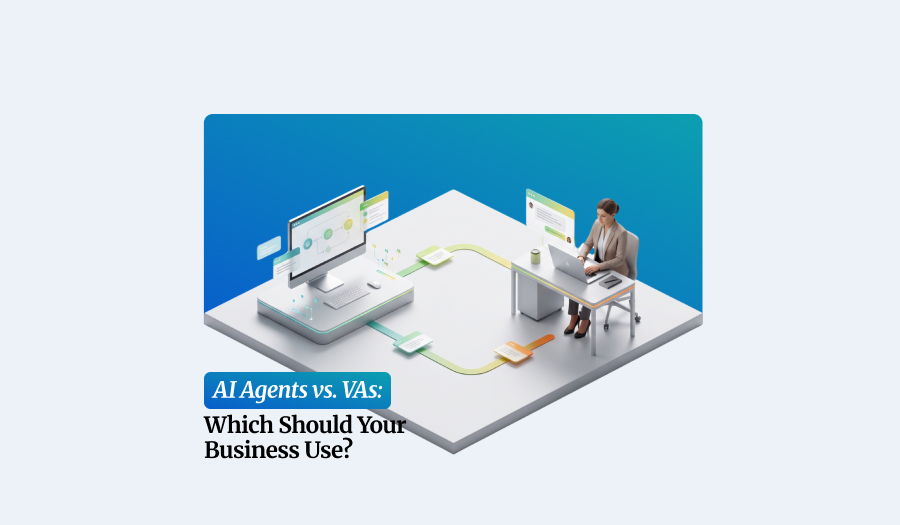
If you run a US small business with 1 to 10 employees, the 2026 hiring landscape handed you the most consequential version of the AI agents vs virtual assistants question most owners have ever faced, and the sales pages of either may be misleading regarding one aspect or another. The AI agent vendor promises $20 per month. The offshore VA platform promises $8 per hour. However, these are not the final costs of deploying either for your business.
The 2026 reality for a Tier 1 small-medium business (SMB) is that AI agents carry a 30% to 45% human-review rate in live deployments — meaning this is not just a set-it-and-forget-it solution, it requires constant monitoring. On the other hand, offshore virtual assistants (VAs) carry a management overhead that turns a $400 monthly invoice into $600 to $800 in true cost once you count your own time. Regardless, it is critical for anyone running their own business to understand that these are not interchangeable options and to recognize which to use and when.
The 2026 Picture: What AI Agents and Offshore VAs Actually Do for a Small Business
The vocabulary we use to discuss these two pathways matters before the cost analysis can be useful, and the words most SMB owners use to describe AI agents and VAs in 2026 are wrong. Four dimensions structure the rest of the comparison: capability, cost, failure mode, and compliance. Each section that follows isolates one or more of these axes, and the framework at the end of the article is the intersection of all four.
AI Agents Are Not Chatbots: What "Autonomous" Actually Means in 2026
An "AI agent" is not a chatbot. A 2026 agent is a stateful, tool-using, multi-step workflow that reads your CRM, drafts an email, posts to your accounting system, and updates your project tracker, often without a human in the loop between the first prompt and the final state change. There are four dominant framework families in production use:
- OpenAI's GPT-5.5 and GPT-5.3-Codex,
- Anthropic's Claude Opus 4.8 and Sonnet 5,
- Google and Microsoft's enterprise stacks, and
- The open-source ecosystem of LangGraph, CrewAI, AutoGen, and OpenHands.
They share an architectural pattern: a model that picks a tool, calls and uses it, evaluates the result, and iterates until the task is done or its retry budget is exhausted. This is the source of both the productivity gain and the failure surface. Regardless, even though these tools share the same behavioral patterns, they are not interchangeable. Independent benchmark data tracks the capability gap between vendor claims and real-world performance across these frameworks.
The capability ceiling of each framework differs sharply in production. For example, an open-source framework comparison from 2026 shows LangGraph at 94% accuracy on multi-step tasks with 4.2 LLM calls per task, CrewAI at 87% with 6.1 calls, and AutoGen at 91% with 22.7 calls. Translated, the same workflow costs 5.6x more in API fees on AutoGen (22.7 LLM calls) than on LangGraph (4.2 calls), even though the per-task success rate is lower. Anthropic's Claude Opus 4.7 reaches 73% on AgentBench for general reasoning; OpenAI's GPT-5.5 reaches 88.7% on SWE-bench Verified for code completion.
The numbers may be initially difficult to understand for the average business owner, yet launching a model in production may have a profound impact on your operations and customers. For a small business owner, "AI agent" is not one capability. It is a category of tools that look identical from a landing page and behave like five different products in production, and the choice between them ought not be taken lightly when business survival is on the line.
Offshore VAs in 2026 Are Not "Cheap Labor": What the Modern Managed Model Delivers
The other worker in this comparison is the offshore virtual assistant, and the term "offshore VA" in 2026 does not mean what it meant in 2015. The 2015 version was a freelancer on a marketplace, paid by the hour, with a vague portfolio and no compliance layer between the SMB and the worker. The optimized 2026 version, delivered through a managed employer-of-record platform, is a pre-vetted operator with verified credentials, working under a US-compliant employment contract, on a payroll and tax arrangement the SMB never has to administer. The structural shift is what makes the comparison fair. You are not comparing a US employee to a freelancer. You are comparing two employment models, both of which handle the legal layer for you.
The cost spread in 2026 reflects the new model. A Filipino VA on a managed platform runs $5 to $12 per hour, an Indian VA $4 to $8, a Latin American nearshore VA $11 to $18, a South African VA $8 to $15, and a Ukrainian VA $10 to $18 — versus a US contractor at $25 to $60 per hour. The headline saving is real (50% to 85% per hour), but the structural point is what changed. The SMB owner in 2026 is not managing an international contractor, they are paying one line item on one invoice, with a managed service-level expectation, and that difference is what makes the offshore route viable for a Tier 1 owner-operator who cannot afford a full-time US hire but cannot afford to manage an international engagement either.
The Four Dimensions That Actually Matter: Capability, Cost, Failure Mode, Compliance
Every decision an SMB owner makes between AI agents and offshore VAs in 2026 reduces to four dimensions:
- Capability - what each can do, in what task category, with what reliability ceiling),
- Cost - what each runs in dollars per task or per hour, plus the hidden cost of the management overhead,
- Failure Mode - how each one fails, how often, and what the failure cascades into, and
- Compliance - what 2026 regulations apply, what state laws apply, and what the SMB's exposure looks like if a system fails in a way that touches a protected class or a regulated transaction.
As we have shown with AI agents, capability varies according to the framework family and provider selected. Similarly, Offshore VA relies on the individual skills and characteristics of the VA selected, the philosophy, integrity, and practices of the platform through which they are hired, and the support they receive to increase their chances of success in their role.
In contrast, compliance standards apply to all businesses within the US jurisdiction uniformly, regardless of which model they select or where they sourced their VAs (although local regional variations may apply for offshore VAs). As such, the critical factors in making a decision for your business are to be found under the cost and failure Mode dimensions.
The Real Cost — What AI Agents and Offshore VAs Actually Run You in 2026
The first thing a small business owner gets wrong about both workers is the cost model. AI agents are not per-seat subscriptions in any meaningful sense, and offshore VAs are not per-hour labor once the management overhead is counted. The actual cost of each one is a different number, and the actual cost of combining them is the number that matters most for a Tier 1 SMB.
AI Agent Costs Are Not Per-Seat, They're Per-Task and Per-Reasoning-Step
A 2026 AI agent deployment runs on consumption pricing — per task, per LLM call, per reasoning step — and the per-task cost varies by an order of magnitude depending on the model selected, the framework's call efficiency, and the complexity of the task. A standard workflow using GPT-5 Mini or Claude Sonnet lands around $0.08 per task. A complex reasoning task on GPT-5.5 Pro lands at $0.45. A pipeline of 1,000 monthly tasks on the standard end runs $80 a month in API fees alone; the same 1,000 tasks on the complex end runs $450.
And how many tasks does an “average” business need to do “normal regular operations”? We don't know. No one knows. However, we do know that many individuals and businesses have received unpleasant surprises at the end of a billing month. The only way to truly understand the final cost of deploying an AI agents is to trial it on a well-defined task run and use the findings to estimate the average monthly cost.
As previously discussed, the framework choice compounds the model choice. Different models have different costs for the same tasks. Layer the platform subscription ($49 to $299 per month for a managed agent platform, $0 to $120 for n8n low-code, $10 to $50 per month for LangSmith monitoring) and the maintenance overhead ($100 to $300 per month amortized for pipeline updates, model retraining, and integration upkeep), and a Tier 1 SMB's realistic AI agent spend in 2026 lands in the $300 to $800 per month range before any human-in-the-loop labor is added. The "$20 per month" AI subscription is the price of the front door, not the cost of the building.
Offshore VA Costs Are Not Per-Hour, They're Per-Verifiable Work Product
The other side of the cost comparison is the offshore VA, and the per-hour headline number hides three cost components the SMB owner is rarely in a position to estimate before they hire. The headline is real and the 50% to 85% per-hour saving is what every offshore staffing sales page leads with. It is not wrong, but it is incomplete.
The full cost of a 2026 offshore VA on a managed platform includes the verification overhead (the SMB owner still has to review work product on the exception tier), the management time (a part-time VA on a 160-hour month is roughly 4 to 6 hours of owner-operator review and direction), and the failure cost on ambiguous tasks (the same failure-cost problem AI agents have, but priced at human-hour rates). A $10-per-hour Filipino VA on a 40-hour month is $400 in headline cost plus $200 to $400 in owner-operator time, depending on the complexity of the work. The realistic 2026 cost is $600 to $800 per month for a part-time managed VA, $1,400 to $1,800 for a full-time one, before the exception-tier work the AI does not do.
The Hybrid 80/20 Economics: Why the Combined Model Beats Either Alone
The third cost line is the one that does not appear on either vendor's sales page but is the actual answer for a Tier 1 SMB. A combined deployment — an AI agent platform at $149 per month, plus a part-time offshore VA at $320 per month, integrated so the AI handles the 80% of high-volume repetitive work and the human handles the 20% of exceptions that drive customer experience — runs $469 per month. The same workload handled by a full-time US VA at $1,800 per month is a 74% saving. The same workload handled by an AI agent alone is structurally incomplete, because AI agents in 2026 do not handle the exception tier, and the exception tier is where the SMB owner's reputation is built or lost.
The 80/20 split is the structural insight. The AI absorbs the transactional layer — first-pass customer email triage, invoice data entry, calendar scheduling, basic research, draft generation, code completion, appointment confirmations. The offshore VA absorbs the relational and exception layer — customer escalations, vendor negotiations, multi-stakeholder coordination, ambiguous work that requires judgment. The SMB owner's role is the integration, not the execution.
What Each One Breaks: Failure Modes, Human-in-the-Loop Reality, and the Klarna Reversal
The cost savings are real, but they are conditional on understanding the failure surfaces of each worker. The vendor-claimed 99% autonomy rate for AI agents and the assumed reliability of a human operator both collapse in production.
The Sequential Failure Math: 95% Per Step Is 77% End-to-End
The single most important number a small business owner needs to know about AI agents in 2026 is this: a 5-step workflow with 95% per-step reliability completes successfully only 77.4% of the time (0.95⁵).
The probability of end-to-end success collapses multiplicatively with every step in the workflow. A 5-step customer onboarding flow at 95% per step leaves 1 in 4 onboardings with at least one silent failure — a wrong field, a missed confirmation, a downstream action that never fires. The 95% per-step figure is itself a vendor-claimed ceiling. Real-world reliability in production environments is closer to 85% to 90% per step on the open-source frameworks (LangGraph 96% error recovery, CrewAI 72%, AutoGen 68%), which means a 5-step workflow in production is closer to 60% to 70% end-to-end reliable, not 77%.
Imagine losing 3 in every 10 customers due to a silent AI error. That's a catastrophic margin that could be the difference between business viability and dissolution. Hence the 30% to 45% real-world human-review rate in live deployments. Real-world AI autonomy in a 2026 enterprise survey was between 55% and 70% — the share of agent outputs that ship without human review or correction. The long tail of edge cases requires human handling on the rest. The "completely hands-free" promise on the AI vendor's landing page is an aspiration, not a production reality, and the hidden cost of the human review is what the per-task price does not capture.
Klarna's $152 Million Lesson: What Happens When Cost Becomes the Only Metric
The most expensive case study on AI agent deployment in 2026 is Klarna. In early 2024, the buy-now-pay-later leader deployed an OpenAI assistant across 23 markets and 35 languages, absorbing 2.3 million customer conversations per month — the equivalent of 700 full-time customer service agents. Resolution times fell from 11 minutes to under 2 minutes, and Klarna's workforce shrank from 5,000 to 3,500 through natural attrition. The financial press called it the moment AI replaced white-collar work. Then the friction arrived. The post-mortem framework maps neatly to the AI customer-service trap most AI vendors will not name in their sales decks.
By the first half of 2025, Klarna's net loss had ballooned to $152 million, up from $31 million the prior year. The IPO at $15 billion in September 2025 valued the company at 33% of its 2021 peak of $45.6 billion. Klarna's CEO publicly admitted that "cost had been a too predominant evaluation factor," customer service quality had dropped, and the assistant had been rolled back to a hybrid model with human agents handling the complex escalations. The lesson is structural: an AI agent deployment optimized solely for cost will save money on the transactional layer and lose it on the relational layer, and the relational layer is where the customer decides whether they buy from you again.
What Offshore VAs Break That AI Agents Cannot: The Exception Tier
The failure surfaces of an AI agent and an offshore VA in 2026 are different, and the difference is what makes the hybrid work. An AI agent fails on the exception tier: a customer escalation where the buyer is angry, the situation is unusual, and the resolution requires a judgment call. An offshore VA fails on the volume tier: the 80% of high-repetition work where the same question comes in 200 times a day and the bottleneck is throughput, not judgment.
The two failure surfaces are complementary, and the four sub-mechanisms that make the exception tier specifically human are:
- Emotional customer rapport (the angry buyer who needs to be heard before they can be helped),
- Bespoke exception handling (the contract negotiation that does not match any prior pattern),
- Multi-stakeholder coordination across time zones (the vendor call where three people in three regions need to land on one decision), and
- Any zero-shot scenario outside the agent's training distribution (the situation the model has never seen).
Conversely, the volume tier includes first-pass email triage, invoice data entry, calendar scheduling, basic research, appointment confirmations, draft generation, and code completion. An SMB owner who tries to cover the exception tier with an AI agent will eventually lose a customer they did not know they were about to lose. An SMB owner who tries to cover the volume tier with a human VA will burn out the human on the 80% of work that does not require their judgment. The architecture that works in 2026 routes each tier to the worker that handles it best.
The Decision Framework: When to Use Which (and Why the Hybrid Wins)
The framework is the intersection of cost, failure mode, and the 2026 compliance overlay, mapped to company tier and vertical function. The result is a decision rule an SMB owner can apply in an afternoon, and the architecture the rule points to is the managed hybrid.
By Company Tier: Solo / Micro / Mid-SMB — The Matching Architecture
The decision framework for a US SMB in 2026 maps directly to headcount and revenue, and the right architecture for a Tier 1 owner-operator is not the right architecture for a mid-market company with a 50-person operations team.
Tier 1 (under 10 FTE, under $1M in revenue) should run AI-first with a part-time offshore reviewer catching the exception tier. The owner's role is the integration — defining what the AI handles, what the human handles, and what the handoff looks like — and the monthly spend is in the $400 to $800 range.
Tier 2 (10 to 50 FTE, $1M to $5M revenue) should run a hybrid nearshore + stateful-agent stack. A nearshore VA in Latin America at $11 to $18 per hour gives the 0-to-3-hour time-zone overlap with US clients, the stateful agents (LangGraph or Claude Sonnet on a managed platform) handle the volume layer, and a part-time operations manager routes the work between them. The monthly spend is in the $5,000 to $15,000 range, and the architecture supports the throughput of a Tier 1 deployment at half the per-employee cost.
Tier 3 (50+ FTE, $5M+ revenue) requires managed cohorts and a dedicated compliance function and is out of scope for a Tier 1 owner-operator, but acknowledging it is what makes the framework honest.
By Vertical Function: The Six Use Cases and What Each One Wants
The same architecture decision breaks differently by vertical function, and the SMB owner who picks the architecture by company size alone is making the decision at the wrong altitude. Six functions cover most of what a Tier 1 or Tier 2 SMB pays people to do: customer support, bookkeeping, sales development, content production, executive assistance, and recruiting. Each one has a different optimal architecture, and the SMB owner who treats them as the same question is over-spending on the wrong workers.
Customer support, bookkeeping, and sales development are AI-first with human review on the exception tier — the 80/20 split lands here naturally.
Content production is AI-structural with human creative — the AI outlines and drafts, the human edits and ships, and the speed multiplier is the win.
Executive assistance and recruiting are human-led with AI augmentation — the relational layer is non-negotiable, the AI accelerates but does not replace, and the compliance exposure in recruiting (EEOC, state AI laws) makes the human gate mandatory.
The structural lesson is the same one as in our zombie-hire offshore guide, but from the other direction: the wrong worker in the wrong slot costs the company more than the right worker in the wrong slot.
The decision rule: match the architecture to the function, not to the company size, and the same SMB can run different architectures for different functions without conflict.
By 2026 Compliance Pressure: What the EU AI Act and State Laws Change
The third layer of the decision framework is 2026 compliance pressure, and it is the one that changes the architecture for any SMB with cross-border exposure. The EU AI Act's high-risk provisions become enforceable on August 2, 2026, and the law applies extraterritorially to any US SMB whose AI systems process data of EU individuals, with penalties up to €15 million or 3% of global turnover for non-compliance. For an SMB serving EU clients through an AI-driven support agent, the architecture decision is not a productivity question anymore. It is a liability question.
The US state-level overlay is also active in 2026. Illinois HB 3773, effective January 1, 2026, treats AI in employment decisions as a civil rights violation. California SB 942, effective August 2, 2026, requires AI watermarking. California's SB 53 imposes $1 million per-violation penalties for frontier-model transparency failures. Texas's TRAIGA bans social scoring and biometric categorization. Colorado's SB 26-189 (effective January 1, 2027) regulates automated decision-making technology. An SMB serving Illinois-based candidates through an AI resume parser, or California-based customers through an AI support agent, has a materially different architecture decision than one whose entire customer base is domestic and unregulated.
Frequently Asked Questions
- What is the difference between an AI agent and a virtual assistant? AI agents automate multi-step, repetitive workflows using software and connected tools, while virtual assistants provide human judgment, communication, and support for tasks that require flexibility or decision-making.
- Should a small business use an AI agent or a virtual assistant? It depends on the task. AI agents are well suited for high-volume, repetitive work, while virtual assistants are better for customer escalations, coordination, and tasks requiring human judgment.
- How much does an AI agent cost for a small business in 2026? The blog estimates that a realistic AI agent deployment can cost around $300 to $800 per month, including platform fees, API usage, monitoring, and maintenance, before human-review costs.
- How much does an offshore virtual assistant cost in 2026? According to the blog, a managed offshore VA can cost approximately $600 to $800 per month part-time or $1,400 to $1,800 per month full-time, when management and review time are included.
- Can AI agents replace virtual assistants? Not completely. AI agents can handle repetitive, high-volume tasks, but virtual assistants remain valuable for exceptions, customer relationships, coordination, and situations requiring human judgment.
- What is the hybrid AI and virtual assistant model? A hybrid model combines AI automation for repetitive tasks with a virtual assistant who reviews outputs and handles complex or exceptional situations. The blog describes this as an 80/20 model, with AI handling the volume layer and humans handling the exception layer.
- What tasks are best for AI agents? AI agents are well suited for tasks such as email triage, invoice data entry, calendar scheduling, basic research, appointment confirmations, drafting, and code completion.
- What tasks are best for virtual assistants? Virtual assistants are particularly useful for customer escalations, vendor negotiations, multi-stakeholder coordination, ambiguous tasks, and other situations requiring judgment or relationship management.
- What should small businesses consider when choosing AI vs. a virtual assistant? The blog recommends evaluating four factors: capability, cost, failure mode, and compliance. These factors help determine which model is appropriate for a specific business function.
- Why is a hybrid model better than using AI or a VA alone? A hybrid model allows businesses to automate high-volume work while keeping human oversight for exceptions and complex situations. This can improve efficiency without sacrificing the judgment and flexibility that automation alone may lack.
The Earned Resolution: What the Hybrid Model Actually Looks Like in Production
The architecture that absorbs the 2026 cost, failure, and compliance landscape without forcing the SMB owner to choose between AI agents and offshore VAs is the managed hybrid — a single employment and tooling relationship in which an AI agent stack and a vetted offshore team sit on the same platform, billed as one monthly line item, audited for compliance as one relationship, and structured so the exception tier routes to the human and the transactional tier routes to the agent. The 80/20 economics, the failure mode analysis, and the company-tier and compliance mapping all converge on the same architecture.
The decision a Tier 1 SMB owner is actually making in 2026 is not "AI agents vs virtual assistants" as a binary — it is how to structure a single operational relationship that handles both, on one contract, with one compliance layer, and gives the volume of the agent plus the judgment of the human, for less than either alone. The 80% saving over a US full-time VA, the 30% to 45% real-world human-review rate absorbed cleanly by the human tier, the company-tier and compliance mapping all point to the same answer. The managed-hybrid model is what that answer looks like in production.