AbroadWorks vs Magic: Best Offshore Staffing Comparison

Key Takeaways
- Dedicated offshore teams and task-based assistants solve different business needs.
- Pricing alone shouldn't determine your offshore hiring decision.
- Structured onboarding can improve long-term employee success.
- Specialized roles require deeper vetting than general administrative tasks.
- Subscription models work best for flexible, short-term workloads.
- Align your hiring model with your long-term business growth strategy.
When choosing an offshore staffing provider, it’s best to take your time and make a well-informed decision.
It’s like choosing a long-term business partner. The right choice can streamline your operations and accelerate growth, while the wrong one can have the opposite effect and drain your momentum.
Offshore hiring today is more than just reducing payroll costs.
Yes, savings do matter. However, most companies hire overseas talent as it allows them to build systems that scale, strengthen their existing workflows, and gain access to talent pools in places like the Philippines and Latin America.
In this article, we’ll break down AbroadWorks and Magic across the areas that actually matter, such as pricing, vetting, onboarding, scalability, transparency, and long-term value so you can make an informed decision.
Overview of AbroadWorks & Magic
AbroadWorks
AbroadWorks operates as a structured offshore staffing partner for companies that are looking for long-term team members rather than temporary help.
The company connects businesses with professionals in operations, accounting, executive assistance, marketing, customer support, and administrative support.
Instead of simply assigning an assistant, AbroadWorks builds dedicated offshore teams that plug into your existing systems. Structured onboarding is part of this process, clients interview candidates, and account managers stay involved.
Pros
- Focus on long-term team development
- Multi-stage screening and vetting
- Dedicated account management
- Strong fit for specialized roles
- Flexible part-time and full-time options
Potential Limitations
- Pricing requires consultation
- Not ideal for quick one-off tasks
- Upfront planning takes time
Magic
Magic is positioned as a flexible subscription-based virtual assistant platform. You purchase a set amount of hours, and you then send through tasks on the platform, and assistants from the Philippines and Latin America will assist with them.
The types of tasks vary from scheduling, inbox cleanup, research, travel booking, data entry, and other administrative tasks. Magic focuses on execution instead of building departments.
Pros
- Clear subscription pricing
- Fast task delegation
- 24/7 availability
- No long-term commitment
Potential Limitations
- Limited specialization for technical roles
- No structured onboarding system
- Minimal involvement in candidate selection
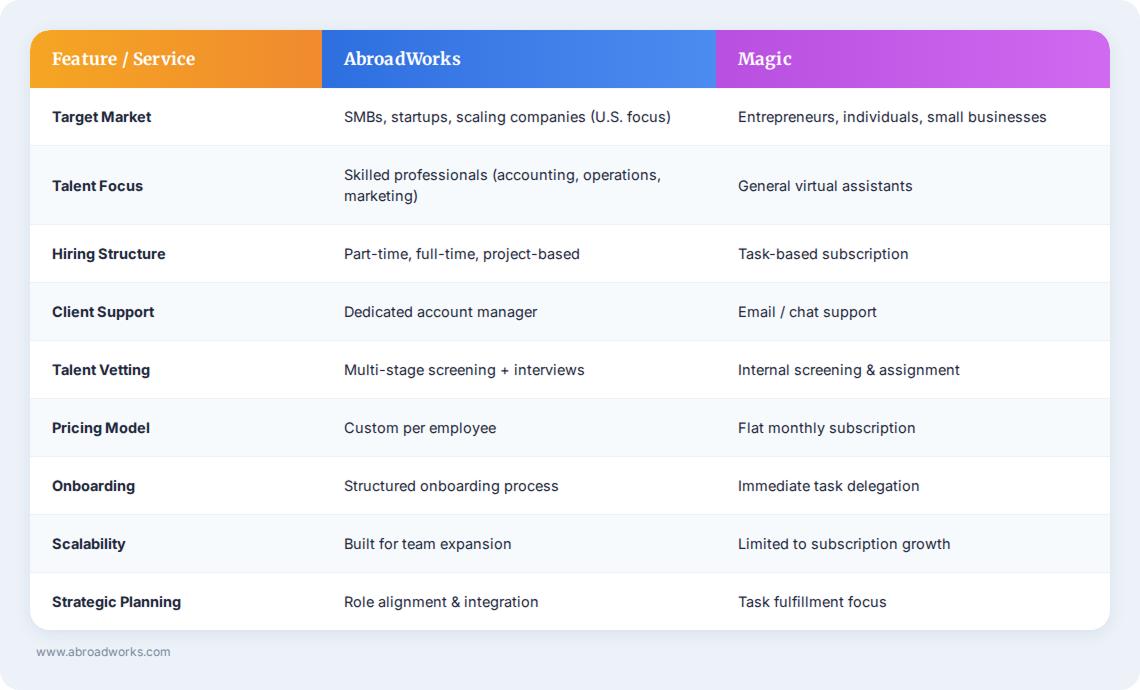
Quick Comparison Table
Pricing Comparison: Detailed Cost Breakdown
Cost will always be the main topic of conversation, as it should be. However, overall pricing doesn’t paint the full picture.
Disclaimer: Pricing examples in this article reflect general industry ranges and are provided for illustrative purposes only. Actual rates may vary. Always consult each company directly for current pricing details.
AbroadWorks Pricing Model
AbroadWorks customizes pricing based on:
- Role type
- Experience level
- Hours required
- Geographic sourcing
Here are a few common scenarios:
- Full-time accounting specialist: $1,800-$2,500 p/month
- Full-time executive assistant: $1,500-$2,200 p/month
- Part-time marketing coordinator: $900–$1,300 p/month
In some cases, these rates include the recruitment process, vetting, onboarding support, and account management.
Magic Pricing Model
Magic uses subscription tiers that are linked to monthly hours.
For example:
- 40 hours per month: $400–$500
- 100 hours per month: $1,000+
- Higher tiers increase proportionally
This structure works well when workload fluctuates from month to month. However, once they start matching or exceeding full-time hours, this no longer becomes cost-effective for your business.
Cost Insight
If you know for sure that you need help that equates to around 140-160 hours per month, a dedicated offshore hire would be more suitable in the long-run. Stacking subscription hours could end up costing more than hiring one professional.
Comparison of Hiring & Vetting Process
At the end of the day, the quality of the talent does truly matter and make a difference.
AbroadWorks Vetting Framework
Candidates go through a series of interviews, skills assessments, reference checks, and background screenings. Clients usually join interviews before final decisions, and this allows them to assess communication style, technical ability, and cultural fit firsthand before making their decision.
The company also emphasizes role clarity before placement, as clear KPIs reduce possible friction later.
Magic Vetting Framework
Magic screens assistants internally. The platform handles matching, and they consistently train your assigned assistant.
Training happens within their system to ensure assistants can complete common administrative tasks.
Quality Consideration
For specialized functions such as accounting reconciliation or marketing analytics, deeper vetting often produces better alignment. For lighter admin tasks, internal screening may be enough.
Onboarding & Integration
Many companies underestimate onboarding and that is a terrible mistake to make.
AbroadWorks Onboarding
Structured onboarding includes:
- Clear role expectations
- Documentation of workflow
- Performance tracking
- Regular check-ins
- Replacement support if necessary
This process ensures that new hires are onboarded efficiently and that there’s minimal confusion on expectations and responsibilities.
Magic Onboarding
There isn’t a formal onboarding structure: you submit tasks, and the assistant executes them. That simplicity speeds up delegation, and it’s what Magic prides itself on - removing the admin of hiring someone temporarily.
Scalability & Long-Term Growth
If you plan to grow from one assistant to a full team, build SOPs, conduct quarterly reviews, assign leadership to offshore employees, etc. Structured staffing models are more suitable as they provide stronger infrastructure.
On the other hand, if your workload feels unpredictable or project-based, subscription support may suffice.
Use Case Examples
Case Study 1: E-commerce Brand Scaling Operations
A Shopify brand needed daily support for customer service, inventory reconciliation, accounts payable, and returns processing.
A workload like that required multiple structured roles and ongoing coordination. A model like AbroadWorks better fits that structure.
Case Study 2: SaaS Founder Managing Solo
A SaaS founder needed inbox cleanup, data entry, competitor research, and travel coordination.
Those tasks aren’t consistent. Subscription-based support like Magic works well here.
Case Study 3: Accounting Firm Expanding Capacity
A CPA firm required junior bookkeepers, payroll specialists, and tax prep support.
In this scenario, confidentiality, compliance, and consistent hours mattered. Structured offshore staffing is better suited for this.
Geographic Talent Considerations
Philippines
The Philippines remains a top offshore destination because of:
- English fluency
- Familiarity with Western business culture
- Competitive salary expectations
- Large experienced workforce
Latin America
Latin America appeals to companies that are looking for:
- Employees with time zone overlap with North America
- Bilingual professionals
- Growing digital and technical talent
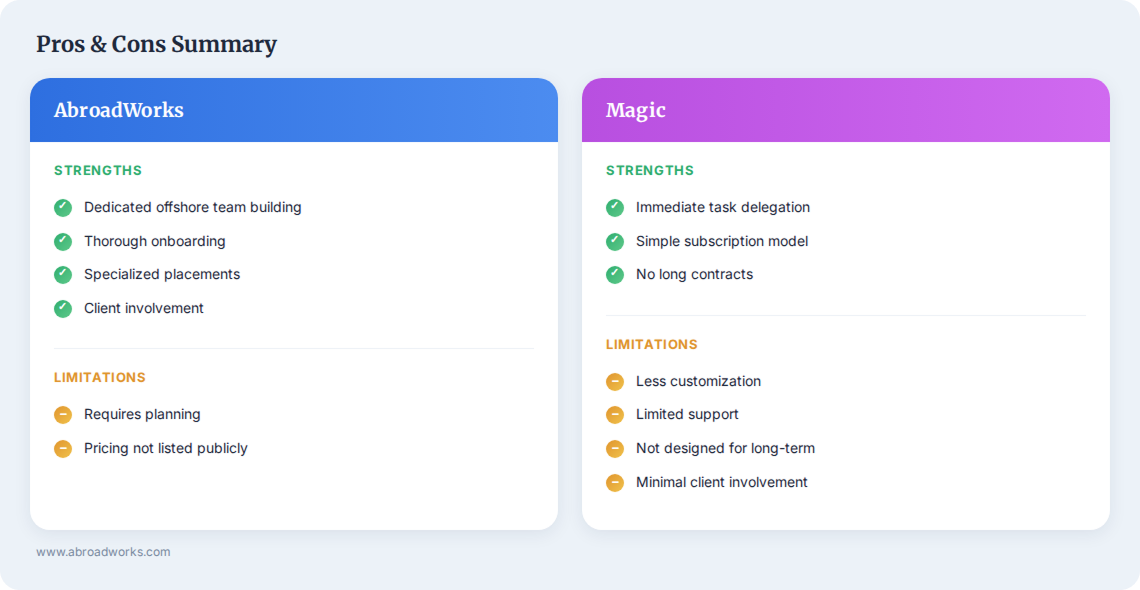
Pros & Cons Summary
Common Mistakes When Choosing Offshore Staffing
- Hiring Based on Hourly Rates
It’s never a good idea to solely focus on rates. Subscription pricing may seem cheaper at first; however, onboarding time, training, and communication alignment carry real costs.
If you constantly have to retrain assistants due to task switching, managerial oversight eats into savings. Overall efficiency should always matter more than monthly fees.
- Failing to Outline Job Expectations
When responsibilities and KPIs are not clearly outlined, offshore hires’ performance may drop.
Structured staffing helps define expectations early, whereas task-based platforms place more responsibility on you to outline expectations. Without documentation, even capable assistants can make mistakes.
- Overlooking Privacy & Security Requirements
Certain industries require a certain level of confidentiality. Dedicated offshore staffing providers often require staff to sign NDAs. Subscription models may not emphasize formal documentation like this.
Performance Management & Retention
Retention plays a huge role in productivity. When offshore professionals feel included in the company and its goals, they engage more and are more interested in their work and the company. Models that prioritise permanent hires support stability through consistent hours and career growth opportunities.
Subscription platforms prioritize flexibility - which works best for workloads that are constantly changing.
Performance tracking is different too - structured staffing partners may conduct periodic reviews, while task platforms focus primarily on whether or not you’re completing assigned tasks.
Offshore Staffing Market Trends in 2026
The normalization of remote work continues to grow on a global scale. More businesses hire Philippine virtual assistants, Latin American marketing specialists, and offshore accounting teams to reduce operational costs.
Companies have also ramped up on building hybrid workforce models, combining in-house leadership with offshore execution teams.
At the same time, demand remains strong for platforms like Magic and Abroadworks as entrepreneurs gravitate towards lean operations that don’t require payroll commitments.
Final Verdict
The choice between AbroadWorks and Magic depends on what you’re building.
If you want structured offshore teams, specialized professionals, department growth, and long-term integration, AbroadWorks may align better.
If you need flexible administrative support, variable workload coverage, and minimal commitment, Magic may be more appropriate.
The real question is whether your business needs task execution or workforce integration, and only you would be able to determine what’s more appropriate for your business.
When you match hiring models to operational goals, long-term returns follow.