SMB Life Hacks: Outsourcing versus Offshoring — Finding the Shortcut to a Leaner Business

Key Takeaways:
- Most SMB founders hit a “Hiring Wall.” Around $250K in revenue or five employees, operational tasks begin to overwhelm the founder’s time.
- Outsourcing buys guaranteed results. You hire an agency that manages the process, training, and compliance, which removes operational responsibility from the founder.
- Offshoring reduces payroll costs dramatically. Global talent hubs can reduce labor costs by 60 to 80 percent, but founders must manage the team directly.
- The hidden cost of offshoring is the Instruction Tax. Founders managing offshore hires themselves can lose up to 13 hours a week to training and supervision.
- Compliance and liability risks matter. Improper contractor classification and global tax exposure can create significant financial risk for small businesses.
- The managed hybrid model combines the best of both approaches. A managed offshore specialist delivers global cost savings while removing the founder’s management burden.
Growth is the ultimate validation of your vision, and for most founders, seeing revenue climb and the customer base expand is the clearest sign that they are winning. This progress is the engine of any healthy venture, proving that your market has finally found you and your product is hitting its mark. However, that very success often has a way of outrunning your personal systems. Most business owners hit an operational wall much faster than they anticipated — typically around $250,000 in annual revenue or upon reaching five employees — where the momentum that fuels the company suddenly turns into a manual bottleneck. At this stage, staying on the path of progress requires navigating the trade-offs of outsourcing versus offshoring to delegate what we call shadow work—those invisible, repetitive administrative tasks like chasing invoices, cleaning data, and hunting for contact history—that now consume 10 to 13 hours of your week.
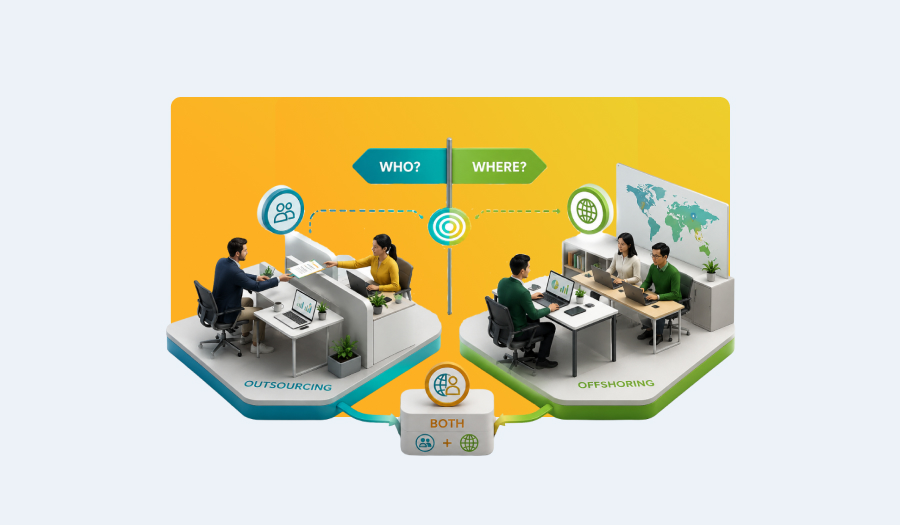
While you could certainly hire and train a local employee to handle these tasks, the desk next door often comes with a level of overhead and management friction that microbusinesses aren't yet ready to absorb. For founders who want to keep their operations lean while scaling their impact, the real debate moves toward external help. To bridge this gap effectively, you must understand the critical trade-offs between outsourcing versus offshoring. While most people use these terms interchangeably, mixing them up is an expensive mistake that can lead to legal liabilities and stalled growth. Understanding the difference is the ultimate life hack for maintaining your operational freedom as you scale.
Outsourcing versus Offshoring: Paying for a Guaranteed Result
Outsourcing is a strategic move where a business hires an external company to take full responsibility for a specific function. For the US microbusiness, this is most common in highly specialized or regulated areas where errors are costly. According to recent research, the roles most frequently outsourced by firms with 1–10 employees include Bookkeeping and Accounting, Payroll, and HR Compliance. These are tasks where "good enough" isn't an option, and owners prefer to pay for a guaranteed result rather than managing the step-by-step process themselves. Making this decision requires a clear understanding of the specific processes and trade-offs involved in the outsourcing model.
Defining the Specialist: Buying Expertise Instead of Time
In an outsourcing model, you are not hiring a person; you are hiring a department with its own management and standards. Business owners who have reached a level of complexity where they can no longer keep up with US tax codes or employment laws are the primary users of this model. They utilize domestic agencies to handle back-office hygiene so they can focus on their own specialized work. This is the set it and forget it approach to business operations, used primarily by founders who value their time over their profit margins in low-error-tolerance categories.
When you outsource, the responsibility for quality control lies entirely with the agency you hired. You don't have to worry about the person doing the work getting sick or needing training because the agency provides the backup and the expertise. This model is ideal for functions like bookkeeping, where the cost of an error is far higher than the cost of the agency's fee. It transforms a complex, high-stakes chore into a simple line item on your monthly expenses. By paying for a result, you remove a massive cognitive burden from your daily schedule.
Notable Pros and Cons: Convenience vs. The Agency Markup
The primary advantage of outsourcing is Administrative Distance, meaning the problem is truly off your plate. You don't have to train the staff, provide the software, or manage the daily output — the agency handles every detail of the execution. This provides a clean break from the clerical weeds that usually stall a founder’s progress. However, the drawback is the Agency Markup, which typically ranges from 2x to 3.5x the specialist's actual salary. You are paying a high premium for the agency's overhead, insurance, and profit, which can be a significant drain on a microbusiness's cash flow.
Furthermore, outsourcing can sometimes lead to Brand Dilution if the agency doesn't fully understand your unique company culture. Since you are not managing the individual doing the work, you have less direct influence over the voice used in your communications. This model works best for back-office tasks where the process is standardized across the industry, rather than front-office tasks that require your personal touch. Founders must weigh the total cost of the markup against the value of the time they reclaim. While expensive, the reliability of a professional agency is often the only way to ensure 100% compliance.
The Hidden Math: The $100,000 Liability Shield
Forensic data shows that specialized agencies are 2.5x to 6x faster at completing complex tasks than a generalist internal hire. However, the real math for a US founder is the Liability Shield that an agency provides. By using a domestic agency, the founder avoids the $100,000 average penalty risk associated with misclassifying employees as contractors. With data privacy and compliance laws tightening in 2025, unmanaged hiring is becoming a massive regulatory risk for small firms.
Because the agency acts as the Employer of Record, they absorb the legal and insurance liabilities that a solo owner would otherwise carry. This includes everything from workers' compensation to errors and omissions insurance, which can be difficult for a microbusiness to manage alone. This protection allows a small firm to operate with the technical precision of a much larger corporation without the overhead of a full legal department. Paying the agency markup is often a cheaper alternative than facing a single US labor audit. For many owners, this shield is the most valuable part of the outsourcing contract.
"Outsourcing is a defensive strategy: you aren't paying for labor, you are paying for the legal distance between your business and a hundred thousand dollars in potential audit penalties."
Offshoring: Hiring for Location (The "Direct-Hire" Model)
Offshoring is the practice of moving specific roles to a global hub to capture a lower cost of living and a higher concentration of talent. For US founders, this is the primary tool for scaling high-volume but repeatable roles like Virtual Assistants, Lead Generation, and Social Media Management. While the hourly rates in hubs like the Philippines or Latin America offer a 60% to 80% savings compared to US rates, the Where of the hire is only half the story. The success of this model depends entirely on the founder’s ability to manage a remote worker directly. Navigating the global seat model requires a deep dive into the practical realities of direct-hire management.
Defining the Global Seat: Finding Talent Across Borders
Offshoring is essentially buying a seat in a global office and filling it with a person you manage. It is used by founders who have clear, documented processes and need a dedicated person to execute them every single day. Unlike outsourcing, you are hiring a specific individual who becomes an integrated part of your daily team. This model is most popular with high-growth startups and digital agencies that need to scale their production capacity without the overhead of a US-based office. It allows the business to stay lean while maintaining a constant presence in the market.
This direct-hire approach requires the founder to act as the primary recruiter, trainer, and supervisor. You are responsible for setting the standards and ensuring the work is completed correctly every morning. While this gives you total control over the culture and the output, it also means you are the one who has to answer every question. The global seat model is perfect for tasks that are core to your business but don't require a specialized US-based license. The impact of the US tax code on offshoring remains a critical factor for firms transitioning to international talent. It turns a local job into a global opportunity, significantly reducing your payroll expenses.
Notable Pros and Cons: Radical Savings vs. The Management Burden
The most obvious advantage of offshoring is Salary Arbitrage—getting high-level talent for a fraction of the domestic cost. This allows a microbusiness to hire two or three global specialists for the price of one entry-level US hire. This massive reduction in payroll can be the difference between a business that is struggling to survive and one that has the cash to innovate. The significant drawback, however, is the Management Burden. Because you are direct-hiring a person rather than buying a managed result, the founder must personally handle all daily supervision and quality control.
This setup often turns the owner into a full-time handler, trading their high-value strategic time for low-value administrative management. If you don't have a solid management system in place, your global hire will likely struggle to stay productive without your constant input. Furthermore, communication challenges can arise if there isn't a shared understanding of project nuances and deadlines. Founders often find themselves working late nights or early mornings just to sync up with their remote team. Without a managed layer, the savings you see on paper can quickly be eaten away by the friction of manual oversight.
The Hidden Math: The $78,000 "Instruction Tax"
Data reveals that founders who manage solo offshore contractors lose between 4.8 and 13 hours per week to manual oversight. If a founder values their time at a conservative $150/hr, a 10-hour management week represents a $78,000 annual opportunity cost. This Instruction Tax is the hidden reason why many offshoring attempts fail to deliver a real return on investment. Furthermore, solo workers are 2,300% more likely to make errors in complex data tasks compared to those working within a managed team environment.
Research also highlights the Permanent Establishment risk, where hiring solo international contractors can accidentally create a taxable legal entity for your business in a foreign country. This can lead to unexpected tax bills and legal fees that far outweigh the initial salary savings. Navigating global privacy and security trends also becomes much harder when you are the only one responsible for your team's data hygiene. For many microbusinesses, the cheap direct-hire model ends up being the most expensive path they can take. The true cost of labor must always include the cost of the owner's time.
"The direct-hire offshore model is a bandwidth trap; every dollar you save on the hourly rate is eventually paid back through the founder's own wasted management hours."
The Managed Hybrid: The Best of Both Outsourcing and Offshoring
The SMB Life Hack for true scaling is the Managed Hybrid Model. This approach combines the cost-efficiency of offshoring with the off-your-plate management of outsourcing. By partnering with a firm like AbroadWorks, you get a dedicated specialist in a global hub, but they are backed by a management layer that handles the training and oversight. This allows you to capture global savings without paying the Instruction Tax with your own time or energy. Evaluating this hybrid model reveals how it effectively bridges the gap between hiring for a seat and hiring for a result.
The Life Hack: Sourcing "Operational Owners"
In this model, you transition from hiring a helper who needs directions to hiring an Operational Owner. AbroadWorks identifies the top 1% of global talent and plugs them into a managed system that enforces your workflows automatically. This kills the need for baby-sitting, allowing the founder to focus on the work they actually enjoy. Instead of answering a hundred small questions, you manage by exception, only stepping in when a major decision is needed. You get the stability of a domestic agency with the competitive pricing of a global team.
This hybrid model ensures that your business knowledge stays within the company, rather than living in the head of a single freelancer. By professionalizing the Where and the Who simultaneously, you create a department that can scale as fast as your sales do. The managed specialist becomes a strategic representative for your brand, handling the daily grind with surgical precision. This is the only way to build a company that doesn't rely on your personal presence for every minor task. It is the ultimate shortcut to a business that actually runs itself.
The "Cheat Code": Solving Ghosting and the Nuance Gap
The biggest fear founders have with global hiring is the Nuance Gap—the feeling that a remote hire will never truly get the business. AbroadWorks solves this by providing a management layer that acts as a translator for your SOPs (Standard Operating Procedures). We ensure that every task is documented and understood, so you don't have to explain the same process five times. This systemization closes the communication loop and ensures that your brand’s voice remains consistent across every interaction. It removes the guesswork that usually leads to project failure.
Additionally, our managed model provides a permanent fix for the common Ghosting risk found in the freelance market. Because your specialist is part of a managed firm, there is built-in accountability and a backup system if an individual is ever unavailable. You no longer have to worry about a Key Man or Founder Dependency leaving and taking your entire process with them. VC due diligence frequently highlights this Relational Stability as a core requirement for a healthy, scalable business. AbroadWorks ghost-proofs your operations, giving you the peace of mind that your business will be running perfectly every morning.
The AbroadWorks Solution: Reclaiming Your Time for What Matters
Reclaiming the 10 to 13 hours currently lost to managing staff is the only way a microbusiness grows into a mid-sized firm. The AbroadWorks solution provides Process Persistence, ensuring that your business hygiene continues to run even when you are on vacation or focusing on a new product launch. This move transforms your operations from a recurring headache into a high-performance engine that creates value while you sleep. You stop being the operator of your own systems and start being the architect of your future.
Ultimately, building a scalable business is not about a rigid choice between outsourcing versus offshoring, but about creating an execution bridge that connects your vision to daily results. By using this managed hybrid model, you bypass the friction that keeps most founders trapped in the manual hustle. You get a professional global team that is vetted, trained, and managed for you, allowing you to stay focused on the high-level strategy that actually builds wealth. Stop the shadow work today and activate the operational shortcut that leads to true freedom. Reclaiming your strategic bandwidth is not a matter of working harder; it is a matter of hiring the execution required to make your systems work for you through AbroadWorks.
"A business is only truly scalable when its operations are driven by a system that functions independently of the founder’s willpower."
FAQ Section
- What is the "Hiring Wall" for small businesses? The Hiring Wall typically occurs when a business reaches $250,000 in revenue or five employees. At this point, the complexity of managing operations manually exceeds the founder's time, resulting in significant potential revenue loss due to invisible leaks caused by owner dependence.
- How does a managed hybrid model stop "ghosting"? Unlike a solo freelancer who answers only to themselves, an AbroadWorks specialist is part of a managed firm with professional oversight. This provides a layer of accountability and a backup system that ensures your work continues even if an individual is unavailable, making your business ghost-proof.
- What is the real cost of "Instruction Tax"? The Instruction Tax is the time a founder wastes on daily supervision and training. On average, this consumes 13 hours a week for direct-hire models. For a founder valuing their time at $150/hr, this results in a $78,000 annual opportunity cost, making cheap solo offshoring far more expensive than it appears.