Top Customer Care Outsourcing Services 2026


Key Takeaways
- Outsourcing customer care is now a growth strategy, not just a cost-cutting move
- Fast response times and 24/7 support are key drivers of customer satisfaction
- The right provider depends on your business size, goals, and support volume
- Dedicated teams offer consistency, while shared teams are more cost-effective
- Strong onboarding, clear metrics, and cultural fit determine success
- Combining human support with AI tools creates faster and more scalable service
Customer expectations have changed drastically. One slow reply or robotic answer can push someone straight to your competitor. That’s why more businesses are turning to a customer care outsourcing service to stay responsive, consistent, and human at scale.
But outsourcing isn’t just about cutting costs anymore. It’s about building a support system that feels seamless to your customers while giving your internal team room to breathe. Done right, it can feel like an extension of your brand, but if it’s done poorly, it feels like talking to a wall.
So how do you get it right? Let’s unpack everything you need to know.
What Is a Customer Care Outsourcing Service?
A customer care outsourcing service means hiring an external team to handle your customer interactions.
That includes:
- Email and live chat support
- Phone support and call centers
- Social media responses
- Technical troubleshooting
- Order management and complaints
Instead of building a full in-house team, you partner with specialists who already have the tools and talent in place.
It’s like hiring a pit crew instead of building your own. You still get to drive the car - they just make sure it performs well.
Why Businesses Are Moving Toward Outsourcing
If you’re still managing everything in-house, you’ve probably felt the pressure as your business has grown. More tickets keep coming, customers expect faster replies, and your team starts to struggle to keep up with the workload.
Outsourcing solves several of those pain points in one move.
Cost Efficiency Without Cutting Corners
Hiring, training, and retaining a full support team adds up quickly. Salaries, benefits, software, and infrastructure all stack on top of each other.
Outsourcing converts those costs into a set monthly expense, and enables you to hire skilled agents without the overhead.
24/7 Availability
Customers don’t care about business hours, they message at midnight and expect answers by morning, if not immediately.
An outsourced team can cover multiple time zones without burning out your staff, which can boost retention.
Faster Response Times
Speed might be the most important factor, customers expect quick responses across channels. According to HubSpot, response speed directly impacts satisfaction.
Outsourcing providers are built for speed. Structured workflows and trained agents keep things moving.
Access to Trained Experts
You’re not just hiring people. You’re tapping into experience.
Outsourcing companies train their teams continuously. They handle different industries and scenarios daily, and that exposure sharpens their instincts.
Top Customer Care Outsourcing Service Providers (And How to Choose the Right One)
Most “top 10” lists throw names at you and leave you guessing. That doesn’t help when you’re trying to make a real business decision.
Instead, here’s a clearer breakdown of leading providers and what they’re actually good at:
1. Accenture
A global outsourcing powerhouse with deep enterprise capabilities
- Best for: Large corporations
- Strength: Advanced analytics and tech integration
- Shortfall: A bit expensive and less flexible
2. Teleperformance
One of the largest customer support providers in the world
- Best for: Operations with high volumes
- Strength: Multilingual and global coverage
- Shortfall: Can feel less personalized
3. Concentrix
They have a strong focus on customer experience and digital transformation
- Best for: Tech companies
- Strength: Data-driven support strategies
- Shortfall: Complex onboarding, learning curve for some users
4. Alorica
Offers scalable support across an array of industries
- Best for: Medium to large businesses
- Strength: Flexibility
- Shortfall: Quality may vary by region
5. Foundever (formerly Sitel Group)
Blends human agents with AI support tools
- Best for: Omnichannel support
- Strength: Global presence
- Shortfall: Less niche specialization
6. TTEC
Combines customer support with CX consulting
- Best for: Customer journey optimization
- Strength: Strategic insights
- Shortfall: Higher price point than others
7. SupportYourApp
A fast growing provider popular with startups
- Best for: SaaS and growing businesses
- Strength: Personalized service
- Shortfall: Smaller scale
8. Helpware
A modern, people-first outsourcing company
- Best for: Brand-focused support
- Strength: Strong training culture
- Shortfall: Limited enterprise infrastructure
9. TaskUs
Known for supporting fast scaling tech companies
- Best for: High-growth startups
- Strength: Digital-first approach
- Shortfall: Premium pricing
10. Simply Contact
A flexible, multilingual support provider
- Best for: European and global businesses
- Strength: Adaptability
- Shortfall: Less established reputation than other companies
How to Compare These Providers (Quick Decision Table)
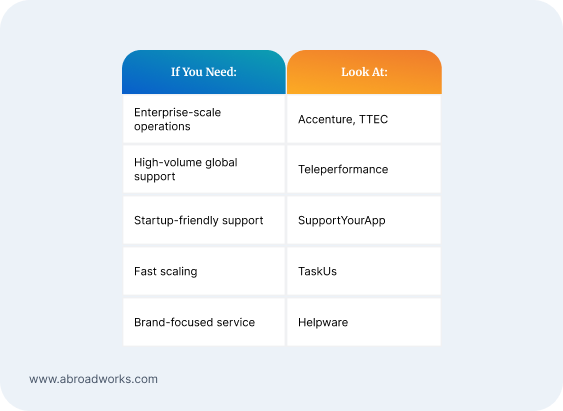
The truth is that there isn’t a single “best” provider.
The right choice depends on your size, budget, and customer expectations. A startup doesn’t need enterprise-level complexity. A global brand can’t rely on a small team.
The Different Types of Customer Care Outsourcing
Not all outsourcing models work the same way and you need to make sure you’re choosing the right one as it changes everything.
Dedicated Teams
Agents work exclusively on your account, they learn your tone and processes deeply. This is best for growing businesses that want consistency.
Shared Teams
Agents handle multiple clients at once. It’s more affordable but less tailored and best for startups with lower ticket volumes.
Project-Based Support
Short-term outsourcing for busy periods or launches. This is best for seasonal spikes or campaigns.
Channels You Can Outsource
Customer care now spans multiple platforms and your support needs to keep up.
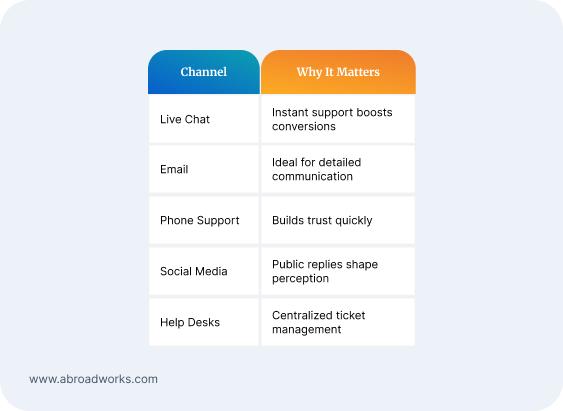
Customers don’t think in channels, they think in experiences. Ensure you have multiple support channels and that they’re easy to reach.
The Hidden Benefits Most Companies Miss
Everyone talks about saving money, but that’s just scratching the surface. There are plenty of hidden benefits.
It Frees Up Your Core Team
Your internal team shouldn’t drown in repetitive work and queries, by outsourcing you free your team from redundant work so that they can focus on growth.
It Improves Consistency
A structured outsourced team delivers more predictable support, which builds trust over time.
It Helps You Scale Faster
Growth doesn’t wait until you’re prepared for it. Outsourcing allows you to scale support channels without long hiring cycles.
How to Choose the Right Customer Care Outsourcing Service
This decision shapes your customer experience so it’s best to choose carefully.
Industry Experience
Look for providers who understand your space as it shortens ramp-up time.
Training Systems
Strong providers don’t just allocate spend to scripts, they invest in communication and problem-solving skills.
Technology Stack
Modern tools matter as they can streamline your operations significantly. Do research and utilize free trials to determine what customer service software is appropriate for your business.
Performance Metrics
Track what matters:
- First response time
- Resolution time
- Customer satisfaction
- Retention rates
If they don’t measure it, they can’t improve it. Utilize metrics like this to hold team members accountable and to recognize good work.
Cultural Fit
Your support team represents your brand so make sure that their tone matches yours.
A Simple Framework for Getting Started
If you’re new to outsourcing, take it step by step.
- Identify repetitive tasks
- Start with one support channel
- Set clear guidelines
- Monitor weekly performance
- Scale gradually
It’s always better to build slowly, and make adjustments as you go along, than rush into scaling and have big mistakes to fix at a later stage.
Real-World Example
Picture this: an Ecommerce brand during peak season. Orders start to increase steadily, messages start streaming in, and customers ask the same questions over-and-over again.
Without a proper support team, response times are bad, and customers get frustrated.
Now if you added an outsourced team, they handle common queries instantly, your internal team focuses on complex issues, customers stay happy, and your team stays focused.
That’s the difference that outsourced support makes.
The Role of Technology in Outsourced Support
Outsourcing works best when paired with the right tools.
AI and Automation
AI handles simple questions, while humans handle nuance. AI support is on the rise and definitely a trend you should adopt.
CRM Integration
A good partner integrates with your systems, and ensures customers don’t need to repeat themselves. That small detail makes a big difference.
Measuring Success
You need clear data to track performance.
Focus on:
- Customer satisfaction scores
- Response times
- Resolution rates
- Customer retention
Numbers tell part of the story, and customer feedback fills in the gaps.
Mistakes to Avoid
Even strong strategies can fail with poor execution.
Doing Too Much Too Soon
Start small and then scale with confidence.
Weak Onboarding
Give your outsourcing partner the context they need.
Ignoring Feedback
Your customers will tell you what’s working you just need to pay attention to feedback.
The Future of Customer Care Outsourcing
Outsourcing continues to evolve as time goes on. You can expect more AI support, deeper personalization, and better integration across channels. The focus is shifting from efficiency to experience, which is where real competitive advantage lies.
Final Thoughts
A customer care outsourcing service isn’t just a cost-saving tactic, it’s a growth strategy.
If you implement it correctly it becomes an extension of your brand. It improves customer experience while freeing your team to focus on what matters most.
And in today’s market that balance is essential to remain competitive.