Tariff Refunds: A Small Business Owner's Guide for the Rest of 2026

Key Takeaways:
- "On February 20, 2026 the Supreme Court ruled 6-3 in Learning Resources, Inc. v. Trump that IEEPA does not authorize the President to impose tariffs, and the Court of International Trade has since issued orders directing CBP to refund all paid IEEPA duties, with disbursements and queued claims together covering roughly $135 billion of the $166 billion collected."
- "Three practical pathways exist for small business importers: a Post-Summary Correction for unliquidated entries, an administrative protest under 19 U.S.C. § 1514 for recently liquidated entries, and a protective federal lawsuit under 28 U.S.C. § 1581(i) for older finally liquidated entries, each with different cost, speed, and security tradeoffs."
- "Coordinated multi-plaintiff consortium filings have lowered the per-importer cost of preserving a § 1581(i) claim, while a parallel wave of consumer class actions in domestic courts now creates a downstream unjust-enrichment liability risk for small retailers and distributors that passed IEEPA costs to end users."
- "The DOJ filed its appeal of the universal refund order on June 3, 2026 in Euro-Notions Florida, Inc. v. United States, putting the broader refund framework back in play at the Federal Circuit and leaving the $30 billion in finally liquidated non-plaintiff entries exposed until that appeal resolves."
In February 2026, the Supreme Court ruled that the President has no authority to implement tariffs. The duties collected under the 2025 emergency tariffs were unconstitutional from the start. Some small business importers reasonably concluded a refund was on its way, because a refund is what usually follows when courts void a tax. Less well known is that the Supreme Court (SCOTUS) did not write a check, did not order a refund, and did not address the $166 billion already collected. Rather, orders for refunds came from a different court (the Court of International Trade) weeks later. By the time those orders landed, the situation had morphed into a procedural fight that is still going on. As we covered in our Tariffs and Recession article, the broader cost environment was already reshaping small business cash flow long before any refund was in sight.
Currently, refund orders exist on paper, and the U.S. Customs and Border Protection (CBP) has built a new automated platform to process them. As of late June 2026, an estimated $40 billion of the $166 billion collected has reached importers, with another $95 billion queued behind three rolling deployment phases not scheduled to finish until late July 2026. Roughly $39 billion sits in entries the framework cannot reach, because those entries are finalized and the importer missed either the 180-day administrative protest window or the chance to file a protective court action. Regardless, the government appealed the universal refund order on June 3, 2026. None of this means refunds are not coming; it means the disbursement timeline does not match the ruling timeline.
The Court Rulings and the Current Refund Status
For a small business owner who has watched a year of tariff headlines without following every procedural turn, it is useful to walk through what the courts actually ordered and where the money currently sits. Two court actions did the work: a SCOTUS ruling that closed the legal authority behind the tariffs, and a series of orders from the Court of International Trade that turned that ruling into actual refund mechanisms.
The ruling that ended the President's emergency tariff power
On February 20, 2026, the Supreme Court ruled 6-3 in Learning Resources, Inc. v. Trump that the International Emergency Economic Powers Act, or IEEPA, does not authorize the President to impose tariffs. The opinion is published in full through Cornell LII. The majority opinion, written by Chief Justice Roberts and supported by five separate concurring writings, held that Article I, Section 8 of the Constitution vests exclusive taxing and tariff-laying authority in Congress, a structural limit the executive branch cannot circumvent by declaring a national emergency. The ruling invalidated the "fentanyl-related" tariffs of February 4, 2025, and the "reciprocal" tariffs of April 2, 2025, in their entirety.
What made the ruling consequential for small businesses was not just the invalidation. The Court also established that exclusive jurisdiction over IEEPA tariff disputes resides with the U.S. Court of International Trade, the specialized federal court that handles tariff cases. Routing every IEEPA claim to a single specialized docket gave the trade court the authority to issue nationwide remedies without waiting for parallel district court rulings to accumulate. That is why the refunds are now moving through a single consolidated channel rather than scattered across the federal judiciary.
Even so, the Supreme Court does not distribute refunds itself. Invalidating a tariff is not the same mechanism as returning money already collected, and what actually put refunds in motion was the trade court's orders in the weeks that followed.
The trade court orders that put refunds in motion
On March 4, 2026, Senior Judge Richard K. Eaton of the Court of International Trade issued the first order in Atmus Filtration, Inc. v. United States, directing U.S. Customs and Border Protection (CBP) to liquidate, or finalize, the tariff bills for any shipments yet to be processed, and to recalculate the tariff bills for shipments finalized but still within the 180-day protest window, without the unconstitutional IEEPA duties.
Three weeks later, on March 27, 2026, Judge Eaton issued an amended order extending the refund mandate to "finally liquidated" entries, those that had already completed both the standard 314-day liquidation cycle and the 180-day protest window. That expanded the refund framework to cover older IEEPA charges, and where the normal administrative remedies would otherwise be foreclosed.
Then, on April 17, 2026, the trade court issued a universal injunction ordering CBP to refund all paid IEEPA duties to every importer of record, whether or not they were active litigants. In parallel, on March 2, 2026, the Federal Circuit denied the government's stay request in V.O.S. Selections, Inc. v. Trump and remanded the case back to the trade court, clearing thousands of paused refund lawsuits to resume. The combined effect of those rulings is the legal architecture the refund process now runs on, and the calendar it runs against starts with the $166 billion question: where the money actually sits right now.
The current state: $40 billion paid out, $95 billion queued, and the $39 billion gap
Between February 2025 and February 2026, the federal government collected approximately $166 billion in IEEPA duties that have now been declared unconstitutional. Of that total:
- Approximately $40 billion is projected to be disbursed to importers by the end of June 2026,
- Another $95 billion is queued for processing through CBP's automated CAPE platform (the Consolidated Administration and Processing of Entries system), inside the Automated Commercial Environment (ACE) Portal,
- And roughly $39 billion sits in tariff revenue that the current system cannot reach, with an estimated $30 billion of that gap held in finally liquidated entries belonging to importers who are not active litigants.
Meanwhile, of the 157,402 automated refund declarations received in early phases, about 70% cleared initial validation, while the rest required manual intervention, slowing payouts across the board.
Read together, those three numbers describe a refund landscape in which a small business is more likely than not to fall into one of three operational buckets: already paid, queued behind a processing bottleneck, or holding an older, finally liquidated entry inside the $30 billion gap. The bucket an importer falls into determines which of the recovery pathways in the next section is actually available, and the cheaper routes only work for the first two.
Pathways Available to a Small Business Importer
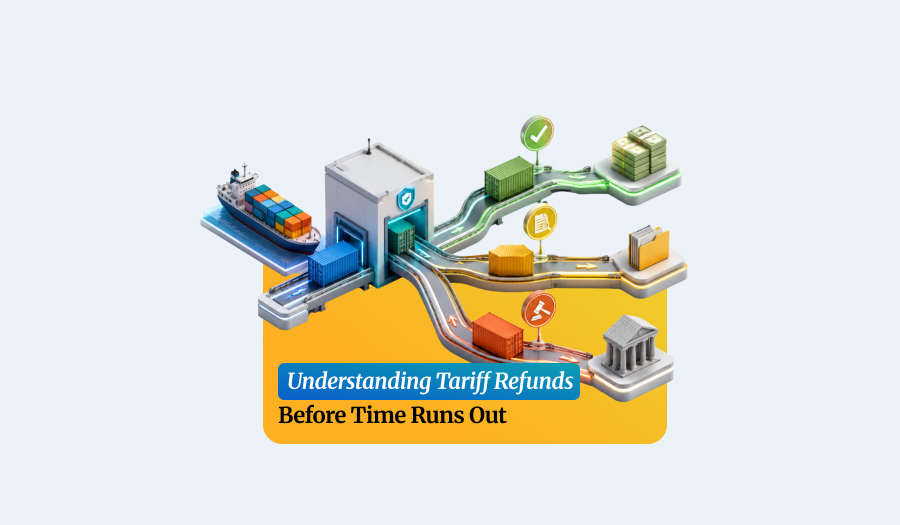
The court orders establish the right to a refund. The pathways establish how a small business actually gets one, and the three practical routes differ in cost, speed, and security depending on where each importer's entries sit in the liquidation timeline. The cheap routes depend on the entry still being inside its administrative window. The expensive route depends on the importer still being inside a two-year clock. Both windows are running. For most tariff refunds for small businesses that fall outside CAPE's automatic disbursement, the path forward is one of these three.
Two cheap options: a correction on a pending entry, a protest on a closed one
For entries that remain unliquidated (unprocessed), the cheapest and fastest route is the Post-Summary Correction (PSC). It is an electronic adjustment filed through the ACE Portal that allows the importer of record or its customs broker to remove the IEEPA tariff codes before the entry finalizes. PSCs are a low-cost, automated mechanism that requires no litigation or legal retainer, and they close the moment the entry liquidates, which typically happens within the standard 314-day cycle from entry.
For entries that have already been liquidated, the standard administrative remedy is a protest filed under 19 U.S.C. § 1514, the trade-law provision that gives importers 180 days after liquidation to challenge the duty assessment. If the protest window closes without a filing, the liquidation becomes "final and conclusive" under the statute and normally bars any subsequent administrative refund.
Consequently, the trade bar, the specialized group of attorneys and customs brokers who practice regularly before the Court of International Trade and CBP, is currently using the protest route as a defensive filing, not primarily to seek immediate refunds, but to keep the liquidation from becoming final while the universal Atmus order is appealed. Both the PSC and the § 1514 protest depend on the entry still being inside its administrative window. Importers with older finally liquidated entries, the cohort that holds most of the $30 billion gap, have to look at the more expensive route instead.
Filing your own federal lawsuit: secure, not cheap
For small businesses with significant financial exposure, filing an individual lawsuit at the Court of International Trade under 28 U.S.C. § 1581(i), the so-called residual jurisdictional provision, remains the most secure path to recovery. The trade court has confirmed that the 180-day protest limit does not bar these actions, because the underlying claim challenges the constitutionality of a presidential proclamation rather than a CBP administrative decision, and almost 1,000 import-reliant companies have already filed protective suits on this basis. This pathway, however, is subject to a two-year statute of limitations.
The cost of litigation is not insignificant. Specialized trade counsel typically charge $15,000 to $30,000 in upfront legal fees for a § 1581(i) protective action, which is why this path is generally cost-prohibitive for businesses whose total IEEPA duty exposure sits below six figures. Small importers with substantial exposure above that threshold can justify the route, while those below it must look at the pooled mechanisms that follow, or accept that their money is sitting in the gap. This may become a critical capital decision in an economy that disproportionately ignores small businesses in capital distribution.
Pooling cases with other importers, and the class-action risk coming back from your customers
Recognizing that many small importers cannot afford an individual § 1581(i) action, the trade bar has organized coordinated multi-plaintiff filings, sometimes called consortium structures, that aggregate dozens of small importers with similar product categories and entry profiles into a single joint complaint. Each participant registers its entry numbers in a protective filing while sharing the overhead of litigation. The structures significantly lower the per-importer cost of preserving a claim, though they come with shared control over case strategy because a single consortium member's tactical decisions, including settlement posture, can bind the group. That is the tradeoff small importers accept in exchange for participation.
Also worth noting alongside the consortium structures, a parallel wave of consumer class actions in domestic courts is being filed against importers who passed IEEPA costs downstream to customers. The legal theory is that, because the underlying tariffs have been declared unconstitutional and refunds are being issued, retaining the passed-through costs now constitutes unjust enrichment. Small retailers and distributors who absorbed the duties and passed them on face a second-order liability risk on top of their own refund recovery process, and the two problems are linked because the same entries that anchor the refund claim anchor the consumer class action exposure. The refund pathway and the liability risk move together.
Deadlines and Required Action
The court orders and administrative pathways describe how the refund process works today, but the processes that determine what an importer can still do tomorrow have not stopped. Three deadlines, one carveout, and one ongoing function determine the best courses of action through the rest of 2026 and into 2027, and ignoring any one of them costs money.
The DOJ appeal and what it would change
On June 3, 2026, the Department of Justice (DOJ) filed formal notices of appeal in the U.S. Court of Appeals for the Federal Circuit, commencing Euro-Notions Florida and putting the trade court's universal refund order back in play. The DOJ's argument rests on two pillars. First, relying on the Supreme Court's 2025 decision in Trump v. CASA, Inc., the government contends that the trade court lacks authority to issue a universal injunction extending financial relief to non-parties. Second, the DOJ argues that under 19 U.S.C. § 1514, finally liquidated entries are statutorily final and CBP is prohibited from reliquidating them or issuing refunds to non-plaintiffs who failed to preserve their rights.
Importers counter with a different reading of the same statutes. The trade court's specialized nationwide jurisdiction, established under the Customs Courts Act of 1980 and codified at 28 U.S.C. § 1581, was designed to ensure the uniform administration of customs laws and to satisfy the Constitution's Uniformity Clause. Because the IEEPA tariffs were unconstitutional from the start, the statutory finality rules under § 1514 cannot be used to permit the government to retain unconstitutionally collected funds. That procedural fight is now before the Federal Circuit.
The February 2027 deadline that bars most older claims
Under 28 U.S.C. § 2636, each import entry carries a strict two-year statute of limitations for filing a refund claim at the trade court, and the clock starts individually on each entry's liquidation date, not on the importer's discovery of the February 2026 invalidation. The first wave of early-2025 liquidations, which began in mid-2025 once entries hit the standard 314-day cycle, will start aging out in February 2027. Legal experts advising non-plaintiff importers are unanimous: anyone with finally liquidated entries approaching the two-year mark must file a protective court action before that window closes, or the claim is permanently barred. That is the operational clock the next twelve months are running against.
A common assumption about the timeline deserves a direct correction. Importers that re-export goods within 5 years can claim back the duties under a separate customs regulation (19 C.F.R. Part 190). However, this unrelated drawback window does not extend the two-year court deadline. Importers cannot assume that filing a drawback claim preserves the right to sue, because the two clocks run on different statutory tracks. Missing the § 2636 window forecloses the § 1581(i) path regardless of what is filed elsewhere, and importers who relied on the drawback assumption will discover that too late.
Two still-missing pieces: the $800 small-parcel exemption, the Section 122 surcharge
Two pockets of IEEPA-related duty remain outside the current refund framework, and both will generate their own follow-on litigation. The first is the de minimis exemption, the long-standing trade provision that allows shipments valued at $800 or less to enter the U.S. duty-free. The trade court's March 27, 2026 order excluded from the refund mandate any IEEPA duties paid under the suspensions of that exemption for Chinese-origin shipments (February 4, 2025, through February 23, 2026) and for all global shipments (August 29, 2025, through February 23, 2026), so small e-commerce businesses must await separate litigation to recover those specific duties.
The second pocket is the Section 122 surcharge.
- On February 24, 2026, immediately after the IEEPA tariffs were invalidated, the administration invoked Section 122(a) of the Trade Act of 1974 to impose a temporary 10 percent global import surcharge as a replacement framework.
- On May 7, 2026, the trade court ruled 2-1 in State of Oregon v. US and Burlap and Barrel Inc. v. US that the surcharge exceeded the President's statutory authority, applying the major questions doctrine and the nondelegation doctrine to a 1974 statute that caps surcharges at 15 percent for 150 days.
The court granted direct relief only to the specific plaintiffs in those cases, with the State of Washington being the only state plaintiff found to have standing, and private importers, including Burlap & Barrel and Basic Fun, Inc., were granted standing only because they suffered direct financial harm as importers of record. Non-plaintiff small businesses are left with continued compliance uncertainty and no automatic refund pathway on either pocket, and the calendar for those cases is not aligned with the calendar for the IEEPA refunds.
Monitoring Policy
The refund calendar does not stop moving once a single filing is made. CAPE's three phases are still rolling out through late July 2026, and the Federal Circuit appeal of the universal refund order remains active. The statute-of-limitations dates on early-2025 entries are still ticking toward February 2027, and the Section 122 and de minimis residues are generating their own follow-on litigation. The False Claims Act (FCA) audit exposure, where the government cross-references CAPE refund data for compliance audits, is reshaping what importers are willing to file in the first place, because filing under uncertainty about how the audit rules will land is its own risk.
For a small business, the work of watching this regulatory environment has become one of the discrete roles a small business can choose to staff internally, contract to outside trade counsel, or assign to a remote operations partner that handles regulatory monitoring as a dedicated function. Virtual staffing providers like AbroadWorks, which place remote staff in compliance and operations roles for small business clients, are one example of the third option, alongside the in-house compliance hire and the outside-counsel retainer. Each model works; the wrong move is treating the work as a quarterly project..
Frequently Asked Questions
- Do I qualify for a refund if I am not a plaintiff in one of the active trade court cases? Eligibility depends on which pathway applies to your entries, not on whether you have personally filed suit. Importers with unliquidated entries or entries liquidated within the last 180 days can use the Post-Summary Correction or administrative protest routes without being a party to any active litigation. For finally liquidated entries that fall outside CAPE's current scope, the protective court action under 28 U.S.C. § 1581(i) is the path that creates eligibility for non-plaintiffs, and almost 1,000 importers have used it. The right question is therefore "where do my entries sit in the liquidation timeline," not "am I a plaintiff."
- What does filing a refund claim actually cost in legal fees, and how does that compare to what I might recover? The cost varies sharply by pathway. A Post-Summary Correction is typically a standard broker filing fee, and the protest route is similarly low-cost when a customs broker handles it, so the cheap options remain cheap even with professional support. A protective court action requires specialized trade counsel and is the high-cost route, which is why the trade bar has organized consortium filings that aggregate dozens of small importers into a single joint complaint to share the litigation overhead. The general rule is that the litigation route is worth the cost only when the duty exposure at stake is substantial enough to clear the legal-fee threshold, and importers below that threshold should treat consortium membership as the entry point rather than an individual filing.
- If I file today, when would I realistically see the money? Timing depends on which filing mechanism you use. A Post-Summary Correction filed through the ACE Portal adjusts the entry before liquidation, so the overpayment is effectively recovered in the next duty bill rather than as a separate refund check. An administrative protest triggers the standard CBP review cycle, which historically runs months rather than weeks. A protective court action does not produce a refund on any near-term timeline, since the case is typically stayed while the broader appeal proceeds at the Federal Circuit; its value is preserving the claim against the February 2027 statute-of-limitations cliff, not generating near-term cash. The honest framing for any small importer is that the calendar of disbursements is not aligned across the pathways, and the right filing depends on which calendar the importer is trying to hit.
- What if my duty was paid under Section 122 or the suspended de minimis exemption? Can I get any of it back? Not through the current administrative framework, because the refund machinery described in this article does not cover either of those pockets. The March 27, 2026 order expressly excluded IEEPA duties paid under the suspended $800 small-parcel exemption, and the May 7, 2026 ruling against the Section 122 surcharge granted direct relief only to the named plaintiffs in State of Oregon and Burlap and Barrel, leaving non-plaintiff small businesses with no automatic pathway. Recovery for either category depends on the follow-on litigation currently moving through the courts, and the right operational move today is to track those cases rather than file under the assumption that the existing refund channels will eventually expand to cover them. Filing for a refund under Section 122 or de minimis through CAPE today is not a recoverable action; it sits in the same procedural gap as the $39 billion.
Conclusion
The IEEPA refund framework has moved more in the first half of 2026 than most trade-law frameworks move in a decade, but the legal reset is not the end of the story. The Federal Circuit appeal, the February 2027 statute-of-limitations cliff, the de minimis and Section 122 carveouts, and the FCA audit overhang each keep the question live through the rest of 2026 and into 2027. The small businesses that handle this environment well are not the ones with the largest legal budgets. They are the ones that treat monitoring as a function of the business, not a fire drill, and they make the calendar visible inside the company before the calendar makes itself visible through a missed deadline.