Offshore vs Outsource: What's the Real Difference?
Key Takeaways
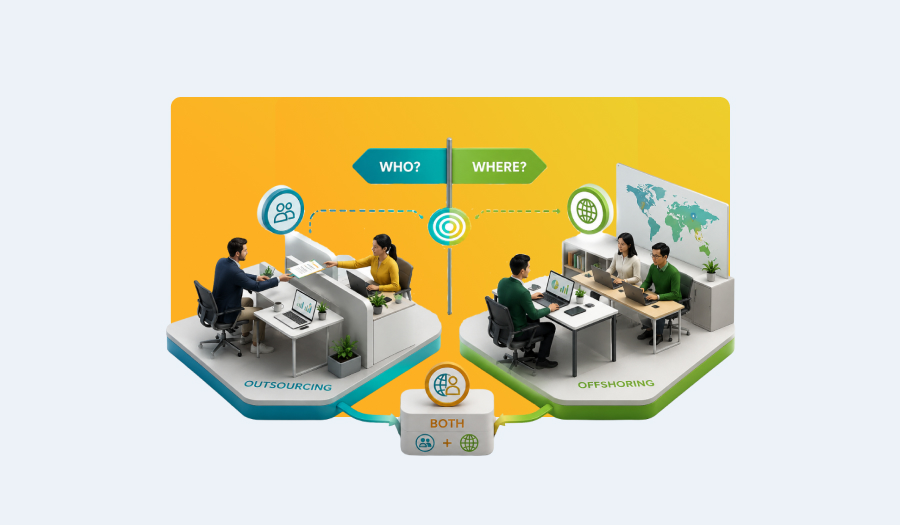
- Outsourcing is about who does the work; offshoring is about where it happens.
- You can outsource locally, offshore with your own team, or do both at once.
- Outsourcing offers flexibility and faster implementation with less management responsibility.
- Offshoring can deliver greater long-term savings and access to global talent.
- Nearshoring is a form of offshoring that prioritizes geographic and time-zone proximity.
- The right model depends on your budget, timeline, control needs, and long-term goals.
You've probably heard these two words used like they mean the same thing, but they don't. Mixing them up can lead you to the wrong staffing decision, and that mistake gets expensive fast.
Outsourcing means you pay another company to handle a task for you. Offshoring means you move a business function to another country, whether you hire a vendor there or build your own team there. One is about who does the work, while the other is about where the work happens.
You can outsource without offshoring, you can offshore without outsourcing, and plenty of companies do both at once.
This guide breaks down what each term actually means, how they differ across cost, control, and risk, and how to figure out which one fits your business.
What Is Outsourcing?
Outsourcing is when you hire a third-party company or an independent contractor to handle a task instead of doing it in-house. You see this constantly with payroll, IT support, customer service, and software development. The provider could sit down the street from your office or on another continent. Location isn't the point; it’s that you're handing off responsibility for a function to someone outside your company.
Businesses outsource for a few clear reasons.
- They want to cut labor costs without hiring full-time staff
- They need specialized skills they don't have internally
- They want to free up their team to focus on core work
- They have a short-term or seasonal project that doesn't justify a permanent hire
In return, you give up some day-to-day control. Your vendor manages their own staff, their own training, and quality standards. You set expectations in a contract, but you're not in the room when the work gets done.
What Is Offshoring?
Offshoring means relocating part of your operations to another country. This could mean opening your own office overseas and hiring local employees directly, or it could mean using a vendor based there. Either way, the defining feature is geography.
Common examples include a US software company opening its own development center in Poland, a retailer running its call center from the Philippines, or a manufacturer shifting production to a country with lower labor and material costs.
Companies choose offshoring mainly to cut costs over the long run and to reach talent pools that are harder to tap domestically. Setting up shop abroad takes real investment up front. You need to handle local labor laws, tax rules, and often a language or cultural gap.
But once that groundwork is done, many businesses see substantial savings and gain access to skilled workers who might be scarce or pricier at home.
How Outsourcing and Offshoring Actually Differ
The two terms overlap, which is exactly why people confuse them. A company can outsource a task locally, offshore a task while still owning it directly, or combine both by hiring an offshore vendor. Here's where they split apart in practice.
Who Controls the Work
With outsourcing, your vendor runs the show. They hire, train, and manage their own staff, and you typically interact with them through a manager or account rep rather than the people doing the work.
With offshoring, if you build your own team abroad, you keep that same level of control you'd have with any domestic employee. You set the processes, you manage performance, and your offshore staff report to you the same way your local staff does.
Cost Structure
Outsourcing turns a fixed cost into a variable one. You pay for what you use, and you can scale up or down without hiring or laying off anyone.
Offshoring usually asks for a bigger upfront commitment, whether that's setting up an office, registering a legal entity, or building a hiring pipeline in a new country. The payoff shows up later, through lower ongoing labor costs and reduced overhead.
Talent Access
Outsourcing gives you fast access to specialized skills without the hassle of recruiting for them yourself.
Offshoring opens up an entire international labor pool, which matters if the skills you need are scarce or expensive where you're based. The catch is that certain roles benefit from local market knowledge, so an offshore hire isn't always the right substitute for a domestic specialist.
Risk
Outsourcing carries risks around quality consistency and vendor reliability, since you're trusting someone else's processes.
Offshoring adds a different set of risks on top of that, including time zone gaps, cultural differences, currency shifts, and exposure to political or regulatory change in the country you've moved into. Neither option is risk-free, but the risks aren't identical.
When Outsourcing Makes Sense
Outsourcing tends to fit best when you need to move fast, keep costs flexible, or hand off a function that isn't core to what makes your business competitive. A startup outsourcing its bookkeeping, a retailer outsourcing customer support during the holiday rush, or a company outsourcing a one-off marketing campaign are all classic cases. You get expertise on demand without adding headcount.
When Offshoring Makes Sense
Offshoring fits companies looking for sustained savings and willing to invest in building a real presence abroad. It suits businesses that want round-the-clock coverage across time zones, or that need a workforce large enough that domestic hiring alone can't fill the gap. Software companies building offshore engineering teams and manufacturers moving production overseas both fall into this category. The commitment is bigger, but so is the long-term payoff for the right business.
Where Nearshoring Fits In
You'll also run into the term nearshoring, and it's worth a quick mention since it sits between the other two. Nearshoring means moving work to a nearby country, usually one that shares a similar time zone or a short flight distance. A US company nearshoring to Mexico or Canada gets some of the cost benefits of offshoring without the scheduling headaches that come from a twelve-hour time difference. Think of it as a specific flavor of offshoring, one you choose when proximity matters more than finding the absolute lowest labor cost.
Can You Combine Both?
Yes, and many companies do exactly that. A US business might outsource its customer support to a call center in another country, which is both outsourcing and offshoring at once. That same business might also build its own offshore engineering team in India while outsourcing its domestic marketing to a local agency. No rule says you have to pick one model and stick with it across your whole company. Most growing businesses end up with a mix, choosing whichever approach fits each specific function.
How to Decide Which One Your Business Needs
Ask yourself these questions before you commit to either path.
- How much control do you actually need? If you want direct oversight of the people doing the work, offshoring with your own team gives you that. If you're fine trusting a vendor's process, outsourcing is simpler.
- Is this a short-term need or a long-term investment? Outsourcing suits projects with a defined end date. Offshoring pays off when you're planning years, not months.
- Do you have the bandwidth to manage foreign regulations? Offshoring means dealing with another country's employment law, tax code, and compliance requirements. If that sounds overwhelming, a vendor who already operates there, whether local or offshore, removes that burden from your plate.
- What's your budget shape? If you need to keep costs variable and avoid big upfront spending, outsourcing wins. If you can absorb setup costs now in exchange for savings later, offshoring becomes attractive.
- How fast do you need this running? Vendors, whether local or offshore, can often start work within weeks. Building your own offshore team takes months, since you're recruiting, training, and setting up local infrastructure from scratch.
The choice depends on your goals, your risk tolerance, and how much control you want to keep.
Frequently Asked Questions
- What is the main difference between offshore and outsourcing? Outsourcing is about who does the work, meaning a third party instead of your own staff. Offshoring is about where the work happens, meaning another country instead of your home base. The two often overlap but aren't the same thing.
- Can a company offshore without outsourcing? Yes. A company can open its own office in another country and hire employees directly, without using a third-party vendor at all.
- Is offshoring cheaper than outsourcing? It depends on the timeline. Outsourcing usually saves money faster since there's no big upfront investment. Offshoring often costs more to set up but can deliver larger savings over several years once the operation is running.
- Which is riskier, offshoring or outsourcing? Both carry risk, just different kinds. Outsourcing risks center on vendor quality and reliability. Offshoring adds risks tied to time zones, legal compliance, and political or economic shifts in the country you've moved into.
- Do most companies use one model or both? Many use both, applying outsourcing to some functions and offshoring to others based on what each task actually needs. A hybrid approach is common among growing and enterprise businesses alike.