1099 vs W-2: A Decision Guide for Small Business Owners in 2026
Key Takeaways
- 1099 is a legal status, not just a tax form.
- Three legal tests determine worker classification: IRS Common Law, DOL Economic Reality, and state ABC tests.
- A signed contractor agreement does not guarantee 1099 status. Actual day-to-day operations matter more than the contract.
- Core business work, fixed schedules, company-provided tools, and long-term engagements can create misclassification risk.
- Misclassification can lead to back taxes, penalties, benefits liability, and costly settlements.
- When a legitimate 1099 structure doesn't fit, businesses can consider alternative staffing models such as offshore + EOR.
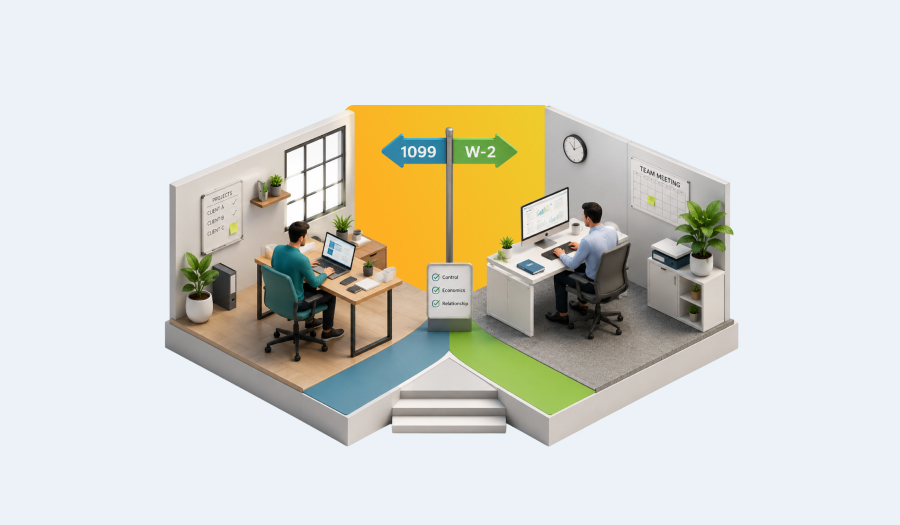
For the small business owner who signed a 1099 contract in the last couple of years, the math looked clean. The 1099 contract saved roughly 30% on payroll costs; the agreement was signed, the work got done, and the invoice went into the books as a contractor expense. As it stands, the contractor uses the company email, attends the Monday team meeting, and has a desk in the back office.
To cover all bases, the 1099 form has been carefully filed every January to avoid any auditing issues. The setup feels like a smart trade, because the contractor is good at the work and their rate came in well below the equivalent W-2 cost. However, the reality is that 1099 is a legal status. Not a tax form, not an accounting trick, and that legal status carries a different cost than the tax form suggests.
Several high-profile businesses with very clever lawyers, whether deliberately or unknowingly, have misclassified their employees to significant consequences. Countless more small businesses often get into a financial quagmire over the same issues, but these cases do not make the news. They are often quietly settled with a financial penalty that could prove ruinous to a business in a highly competitive market. Any business owner must be wary of the various qualifiers that turn a 1099 classification into a W-2.
The Difference Between 1099 and W-2 (and Why It Costs More Than You Think)
The first half of the 1099 vs W-2 framework operates on three concurrent tests that the IRS, the DOL, and state labor agencies apply in parallel in every 1099 misclassification case. A worker who passes one test can still fail the other two, and the SMB owner is responsible for satisfying all of them at once.
The Three Legal Tests
The IRS Common Law test evaluates worker status for federal employment tax purposes (FICA, FUTA, federal income tax withholding) by examining the degree of control the hiring entity retains across three categories:
- Behavioral control (who directs when, where, and how the work is performed),
- Financial control (who controls the economic aspects of the work, including unreimbursed capital investment, opportunity for profit or loss, and market availability), and
- The relationship of the parties (written contracts, benefits, permanency, and whether the services are a core aspect of regular business operations).
The IRS publishes the full 20-factor analysis for small businesses in the common law framework, and the three control factors the test reads (behavioral, financial, relational) are the same three dimensions the state and federal courts use when the IRS audit escalates to litigation. The three concurrent tests are not redundant; each one reads a different dimension of the same working relationship, and a worker who passes one test can still fail the other two.
The DOL Economic Reality test, applied under the FLSA, asks a different question: is the worker economically dependent on the employer (employee) or genuinely in business for themselves (independent contractor), and the test evaluates the totality of the circumstances across control, profit and loss opportunity, capital investment, relationship permanence, skill level, and integration into the production process.
Finally, the State ABC test, adopted by California, Massachusetts, New Jersey, and Vermont, establishes a strict statutory presumption of employment that the hiring entity must overcome on all three prongs:
- The worker is free from control and direction in connection with the work (Prong A),
- The work performed is outside the usual course of the hiring entity's business (Prong B), and
- The worker is customarily engaged in an independently established trade (Prong C).
Prong B is the barrier that closes most SMB contractor relationships, because a software agency hiring freelance developers or a janitorial firm hiring freelance cleaners fails the "outside the usual course" test the moment the contractor performs core business work.
A worker who passes the IRS Common Law test and the DOL Economic Reality test can still fail the ABC test and trigger mandatory W-2 reclassification under state law, and the four states that apply the full ABC test (California, Massachusetts, New Jersey, Vermont) represent the geographic concentration where misclassification enforcement has produced the largest 2024-2026 settlements.
The state test is the strictest of the three because the statutory presumption of employment flips the burden of proof onto the hiring entity, and the SMB owner who tries to satisfy the federal tests first is reading the wrong statute.
The Substance Over Form Doctrine
A universal legal principle governing worker classification across federal and state jurisdictions is the substance-over-form doctrine, which holds that written agreements explicitly labeling a worker as an "independent contractor," a "freelancer," or a "1099 consultant" carry minimal evidentiary weight in administrative audits or judicial proceedings.
Regulatory enforcement agencies and courts look past contractual boilerplate to examine the actual, day-to-day operational realities of the working relationship, and if the day-to-day practices demonstrate employer-style behavioral control or economic dependence, the contract is legally disregarded and the worker is reclassified as an employee regardless of what the agreement said. The doctrine is the bridge between the three legal tests and the operational reality of the SMB's day-to-day operations, and the operational reality is what the audits and courts read, not the document the SMB signed with the worker at hire.
The doctrine has been applied with particular force in the small business context, where the same enforcement bodies (the IRS, the DOL Wage and Hour Division, state labor agencies, and state attorneys general) treat the substance-over-form inquiry as the first step in every audit. The 2024 DOL Final Rule, the 2026 DOL Notice of Proposed Rulemaking (RIN 1235-AA46), and the California Labor Commissioner's Office all operationalize the doctrine by listing behavioral indicators, including mandatory training, set working hours, required attendance at staff meetings, and detailed reporting requirements, that establish employee status even when the contract says otherwise.
The legal test is not what the contract calls the worker; the legal test is what the day-to-day work looks like. The DOL's misclassification rulemaking page carries the full text of both the 2024 rule and the 2026 proposed rule, and the indicator list is the operational diagnostic the agency uses to read the substance.
Four Myths That Lead SMB Owners Into Misclassification
Most SBC misclassification exposure comes from a smaller set of beliefs than the legal framework suggests, and each belief survives because the business decision makers are reading the form (the title, the agreement, the label) while the doctrine reads the substance (the day-to-day work, the operational control, the economic dependence). These beliefs are not subtle, and the cost of each one are significant and include back-tax liability, statutory penalties, worker compensation, and the case-study fines.
Myth 1: “1099 workers are not entitled to benefits”
The 1099 is treated as a benefit-free arrangement, where the SMB saves on health insurance, 401(k) match, and paid time off by signing the worker as a contractor instead of an employee, but the legal reality is that the obligation is deferred rather than eliminated. On reclassification the SMB pays the unpaid health insurance premiums, the 401(k) match they would have contributed, and the accrued paid time off.
items in the math table the next section walks through — plus the statutory penalties the enforcement record documents. The myth is the most expensive of
the four because the benefits savings are the largest single line item in the 25% to 33% non-wage markup the SMB believes they are capturing on the 1099.
Myth 2: The "Signed Agreement"
A signed contractor agreement is treated as the legal determination of status, but courts apply the substance-over-form doctrine, and a signed agreement does not determine worker status if the working relationship meets the W-2 criteria across behavioral, financial, and relational indicators. The same gap appears when the agreement fails the State ABC test on any of the three prongs. Founders who want to understand how aggressive non-compete enforcement can flip into misclassification evidence should review the independent contractor non-compete breakdown for how a clause meant to protect the business can itself be the exhibit the IRS reads. The signed agreement is a document, not a determination, and the doctrine reads the work, not the signature.
Myth 3: The "Freelancer for Special Projects"
Project-based or remote engagement is treated as the contractor signal, but project-based work and remote work do not automatically qualify a worker as a contractor. The IRS Common Law test, the DOL Economic Reality test, and the State ABC test all still apply, with Prong B of the ABC test failing for any freelancer whose work is part of the hiring entity's usual course of business. The myth survives because the SMB owner reads the project scope and the remote work as the contractor signal, when the tests read the substance of the working relationship.
Myth 4: The "Reclassification Is Just Paperwork"
Reclassification is treated as a paperwork exercise (convert W-2 to 1099 and save 25% in non-wage markups), but converting existing W-2 employees to 1099 status without changing the work is the same misclassification pattern as the original problem. The conversion forfeits Section 3509 safe-harbor relief because the IRS treats structural non-change as intentional misclassification, triggering full back-tax liability plus the statutory penalties documented in the next section. The myth is the most expensive of the four because the SMB owner believes the conversion is a structural improvement, when the IRS reads it as a structural regression.
The four myths are myths because the doctrine reads the work, not the form, and the SMB owners who believe them are the ones whose day-to-day operations fail the three legal tests, fall under the substance-over-form doctrine, and end up paying the statutory penalties the enforcement record documents. The second half of the framework is the record: the four patterns that get SMBs sued, the case-study dollar amounts, the math proof, and the red flags that the next section names. Each myth in turn produced one of the four patterns the next section documents, and the SMB owners who believed the myths are the SMB owners the cases cite.
“Worker classification is legally determined by the "substance-over-form" doctrine, which prioritizes the actual day-to-day operational reality of a working relationship over labels used in written contracts. Because businesses must simultaneously satisfy multiple federal and state legal tests, relying on common misconceptions about independent contractor status frequently results in severe financial penalties and back-tax liabilities.”
The Four Worker Misclassification Patterns That Get SMBs Sued (With Case Studies)
The second half of the 1099 vs W-2 framework is the enforcement record, and it is built from four operational patterns that the IRS, the DOL, the state labor agencies, and the state attorneys general have used to cite SMB owners in 2024-2026, with settlements ranging from $865,000 for a Massachusetts grocery delivery platform to $4.4 million for a California home care agency. The four patterns are not subtle, the case studies are not anomalies, and the red flags are undisputable.
The Ongoing "Freelancer" for Core Operations
The first enforcement pattern is the SMB owner hiring an individual as a 1099 contractor to perform essential, daily business operations (a digital marketing agency hiring a full-time content writer, a plumbing firm hiring a routine plumber), and the pattern fails Prong B of the State ABC test because the work performed is inside the usual course of the hiring entity's business.
Under federal law the same pattern is classified as an integrated production unit under the 2024 DOL Final Rule's six-factor totality-of-the-circumstances test, and the structural reality is that the contractor is performing the same work the SMB's W-2 employees perform, on a 1099 form, without the W-2 protections or the W-2 tax obligations. The pattern is the most common of the four because the SMB owner reads the daily delivery of work as a project, when the tests read it as a continuous role inside the business.
California Attorney General Rob Bonta finalized a $2,000,000 settlement with commercial janitorial franchisor CleanNet USA, Inc. in July 2025 because CleanNet sold commercial cleaning unit franchises to individual workers who personally performed the cleaning labor but were treated as 1099 contractors. The AG established that cleaning services constituted CleanNet's core business and therefore failed Prong B of the ABC test, with $1,700,000 paid to the cleaners, $150,000 in civil penalties, three years of state compliance monitoring, and the removal of non-compete clauses restricting cleaner mobility.
In a parallel enforcement, the California Labor Commissioner cited Ritz-Carlton Half Moon Bay and three janitorial subcontractors over $2,000,000 in July 2025 for misclassifying 155 hotel janitors, with Ritz-Carlton held jointly liable for $746,001 under California Labor Code § 2810.3 because primary contracting entities cannot shield themselves from misclassification liability by outsourcing labor to third-party staffing vendors. The CleanNet franchisor model, the AG noted, was structured to manufacture the appearance of independent business ownership while the workers remained functionally employees of the cleaning operation; the non-compete removal in the settlement is the structural tell that the state read the relationship as employment.
Founders weighing offshore options as an alternative to local freelancer engagement can compare the structural differences in this outsource sales rep framing, and the joint-liability principle that hit Ritz-Carlton is the same principle the offshore + EOR architecture removes.
Converting W-2 to 1099 Without Changing the Work
The second enforcement pattern is the SMB owner attempting to reduce operational overhead by transitioning existing W-2 employees to 1099 status while retaining identical duties, hours, and management structures. The legal reality is that reclassifying existing staff without structural changes in operational control constitutes intentional misclassification under IRS guidelines, forfeits Section 3509 safe-harbor relief, and triggers the full back-tax liability plus statutory penalties.
The 25% to 33% non-wage markup savings that motivated the conversion are exactly the unpaid employer obligations the IRS bills on reclassification, and the conversion pattern is detectable because the work, the hours, and the management structure have not changed. The pattern is the most expensive of the four because the conversion forfeits the only safe harbor the IRS offers, and the audit can reach back through the entire employment history of every reclassified worker.
On April 23, 2026, the California Labor Commissioner's Office cited Canoga Park-based Hart Placement Agency Inc. and its owners $4,423,450 for misclassifying 144 in-home caregivers as independent contractors in Los Angeles County. This was after the agency required caregivers to obtain municipal business licenses, register fictitious business names, and open business bank accounts to manufacture a false appearance of independent business status under Prong C of the ABC test.
The investigation revealed that Hart Placement maintained control over working schedules, duties, and pay while instructing workers to falsify timesheets to mask shifts exceeding 12 to 24 hours. The citation ordered $4,266,450 paid directly to affected workers, plus statutory interest, wage statement violations, and denied paid sick leave. That dollar amount represents the financial penalty of attempting to convert W-2 staff to 1099 without changing the work.
The fictitious business license pattern, the Labor Commissioner noted, was specifically engineered to manufacture a Prong C defense, and the timesheet-falsification instruction was the operational evidence that the workers were not running an independent enterprise.
Mandating Fixed Schedules and Locations for Contractors
The third enforcement pattern is the SMB owner engaging a 1099 contractor but requiring fixed working hours (9 AM to 5 PM), a designated office desk, mandatory attendance protocols, and corporate schedules. All of these constitute behavioral control under IRS Common Law principles and serve as strong evidence of employee status under the 2026 DOL compliance guidance. The DOL explicitly noted that requiring contractors to follow corporate schedules, wear branded uniforms, or submit to internal performance reviews serves as strong evidence of employee status under federal law, and the pattern is the most common enforcement trigger in state wage and hour claims because the schedule and location are objectively verifiable. The pattern is loud because the schedule is on the calendar, the location is on the lease, and the attendance log is on the timeclock, and the audit can read all three.
On August 5, 2025, Massachusetts Attorney General Andrea Joy Campbell announced an $865,000 enforcement settlement with online grocery delivery platform Weee! Logistics LLC and Weee! OD Foods LLC, with state investigators determining that Weee! misclassified over 160 delivery drivers as independent contractors under Massachusetts' strict ABC statute (M.G.L. c. 149 § 148B) by denying drivers mandatory wage stubs and earned sick leave entitlements.
The agreement required full conversion of delivery personnel to W-2 employee status. The structural reality of the pattern is that schedule control, location control, and time tracking are the operational evidence the doctrine reads, and the dollar amount scales with the workforce size. Founders who have built their contractor pipeline through standard recruiter channels should review the diagnostic criteria in good recruiter qualities for how recruiter-driven hiring can also mask the structural control signals the IRS reads, and the Weee! citation is the structural proof of why the schedule-and-location pattern is the most common enforcement trigger.
Equal Pay Rates for Equivalent W-2 and 1099 Roles
The fourth enforcement pattern is the SMB owner hiring a 1099 contractor alongside W-2 employees performing identical functions and paying the contractor the exact same hourly base rate, which creates an unsustainable financial arrangement for the worker and invites internal employee complaints that trigger IRS Form 8919 filings and state labor agency audits. The cost burden comparison is the proof:
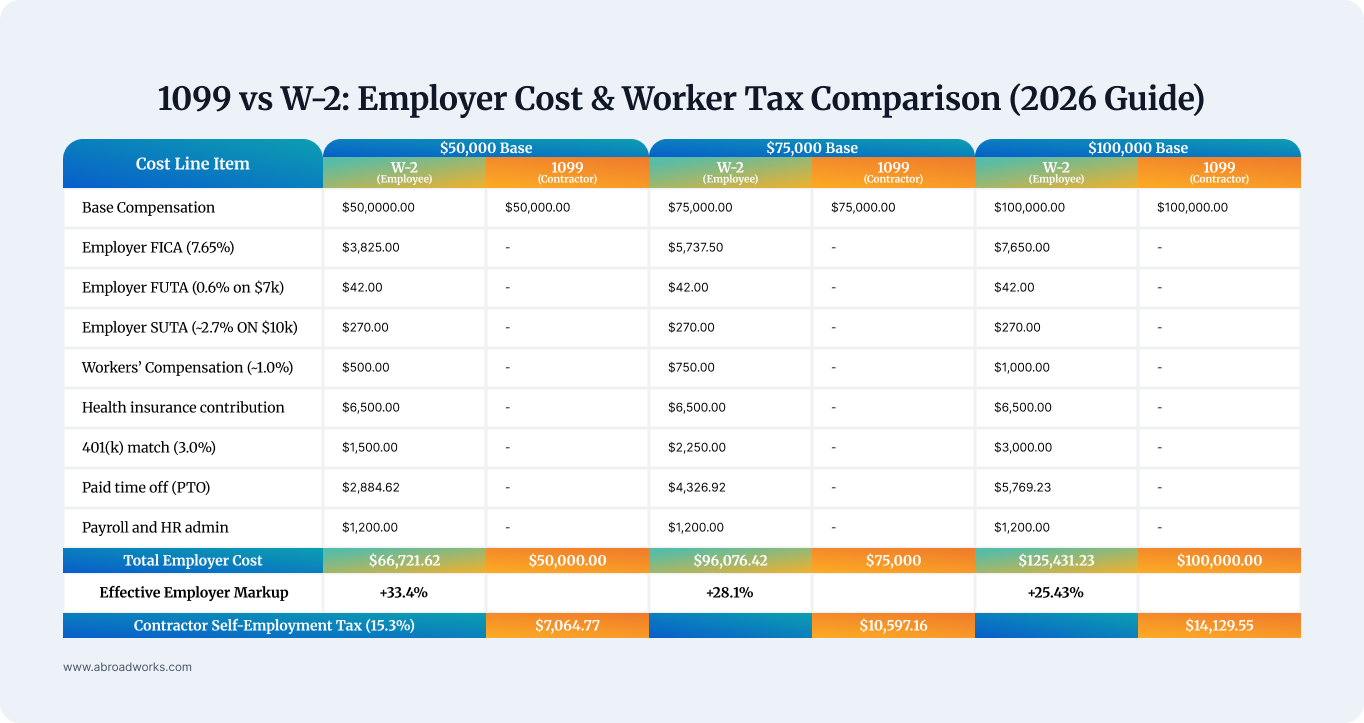
The apparent 25% to 33% savings the SMB captures on a 1099 at the same hourly rate are the unpaid employer obligations (taxes, workers' comp, health insurance, 401(k) match, paid time off, payroll admin) that the IRS, the state labor agency, and the workers' compensation carrier all expect to be paid. On reclassification the SMB pays both the unpaid employer obligations and the statutory penalties on top, with California Labor Code § 226.8 willful-misclassification penalties ranging from $5,000 to $25,000 per violation depending on whether the pattern is treated as a first offense or a pattern of willful violations. The same-hourly-rate pattern is the structural giveaway the audit reads, and the differential at each tier is the dollar amount the SMB ends up paying twice when the audit catches the pattern.
The Five Red Flags That Trigger Reclassification
The enforcement record and the math proof together name a diagnostic: the five operational red flags below are the day-to-day signals that law enforcement and regulators use to identify a misclassification pattern. These red flags are objectively verifiable and, together, describe the operational surface the audit uncovers. Each red flag the audit finds is a separate trigger for reclassification.
- Integration: The contractor uses company email, attends staff meetings, has a desk, or follows the daily schedule, and the integration is structural evidence that the work is part of the hiring entity's usual course of business, which is the precise pattern that fails Prong B of the State ABC test.
- Duration: The engagement has run more than 12 months without a clear project end or scope change, and the duration pattern signals permanency of the working relationship, which is the IRS Common Law indicator that treats the worker as an employee rather than a contractor.
- Exclusivity: The contractor works only for the SMB, or refuses other clients per the SMB's request, and the exclusivity pattern is the operational evidence that the worker is economically dependent on the hiring entity, which is the precise dependency the DOL Economic Reality test reads to find employee status.
- Tools and Equipment: The SMB provides the laptop, software, and workspace, not the contractor, and the tools-and-equipment pattern is the IRS Common Law financial-control indicator that signals employee status, with the absence of unreimbursed capital investment by the worker being the precise test of contractor independence.
- Control over Hours: The SMB sets the work hours, requires a specific schedule, or tracks time the way it tracks W-2 employees, and the hours-control pattern is the behavioral-control indicator that the IRS, the 2024 DOL Final Rule, and the 2026 DOL NPRM all use to find employee status, with corporate schedule mandates carrying the strongest evidentiary weight in state wage and hour claims.
District of Columbia Attorney General Brian Schwalb settled a major misclassification lawsuit against virtual customer service provider Arise Virtual Solutions Inc. for $3,000,000, with Arise having classified over 250 remote customer service representatives as 1099 independent contractors and having required agents to complete unpaid client training programs and pay monthly software access fees.
The D.C. Attorney General established that Arise exercised pervasive operational control over agent calls, metrics, and schedules (the fifth red flag, control over hours, and the third red flag, exclusivity, both present in the same enforcement action). The settlement required $2,060,000 in worker restitution, $940,000 in civil penalties, and forced Arise to completely exit the D.C. market.
The enforcement record, the math, and the red flags together describe a system meant to protect employees from unfair practices, and treating regular employees as independent contractors is unfair. However, there are instances when SMB genuinely require the services of independent contractors. In such cases, the SMB should run tests to ensure they do not misclassify their workers.
“Enforcement agencies catch small businesses by exposing four distinct misclassification patterns: hiring contractors for core operations, forced status conversion, rigid control, and pay parity. These trigger audits through five objectively verifiable red flags like schedule mandates and tool provision.”
When Contractors Make Sense (And When They Don't)
The 2026 framework is not a prohibition on contractor relationships; it is a framework that separates the legitimate 1099 from the independent contractor vs employee misclassification, and there are three conditions that any SMB owner can verify against the day-to-day work.
The Three Conditions for Legitimate 1099 Classification
The first condition for a legitimate 1099 is that the work performed must be outside the usual course of the hiring entity's business, which is the precise Prong B of the State ABC test, the precise integrated-production-unit test under the 2024 DOL Final Rule, and the precise operational test the IRS applies under the relationship-of-the-parties factor. A software agency hiring a freelance developer fails Prong B because development is the agency's core service, and a janitorial firm hiring a freelance cleaner fails for the same structural reason. The condition is dispositive in ABC states and load-bearing in the federal tests. Any SMB owner who cannot satisfy the condition is not running a contractor relationship under any of the three concurrent tests.
The second condition is operational and financial autonomy: the contractor determines their own working hours, uses their own tools and equipment, sets their project fees, and maintains full discretion over how deliverables are completed. There must be no mandatory company training, no required attendance at staff meetings, and no corporate schedule mandates. The contractor also bears unreimbursed capital investment in their own tools and accepts the profit-and-loss risk.
The third and final condition is the independent market business entity. Does the worker operate a distinct commercial enterprise (LLC or Corporation), maintains separate commercial insurance, advertises services publicly, actively serves multiple unaffiliated commercial clients, and provides a Form W-9 with a valid Employer Identification Number (EIN)? The multi-client test is the diagnostic that separates a genuine independent contractor from a captive 1099. The captive 1099 fails the test because the worker is economically dependent on the single hiring entity.
Where all three conditions are present, the 1099 vs W-2 classification holds under all regulatory and legal scrutiny. To verify your 1099 setup is legitimate, SMBs should examine how they would terminate the relationship with the worker. For example, contractor exit guides demonstrate how to spot true independence markers during the wind-down phase. If that exit looks like a clean break between two separate businesses, your setup likely holds up under the legal tests. .
The Offshore Pattern: Geographic Separation as Structural Protection
Where the three legitimate conditions cannot be satisfied because the work is core to the US business, the structural alternative is the offshore pattern: workers in a different country who support a US business but without performing the core operation and with the geographic separation creating a legal barrier the three concurrent tests cannot reach.
Founders weighing whether to engage a local freelancer or route the work through offshore staff can compare how each option interacts with the three concurrent tests. A worker in a different country cannot perform the core US business in the United States, and the operational reality is that the framework's three tests (Common Law control, Economic Reality dependence, ABC Prong B business course) all read the substance of the work performed on US soil. The effective alternative is not a workaround for a failing 1099; it is a different category of arrangement that the framework does not reach, a category offshore + EOR architecture is built to hold.
The offshore pattern is structured through an Employer of Record, which creates multiple layers of legal protection:
- the offshore provider holds the employer-of-record relationship in the worker's country,
- the IP assignment is governed by the offshore jurisdiction's contractor agreement structure,
- and the IRS, DOL, and State ABC tests do not reach the offshore operation because the legal relationship is between the offshore provider and the offshore worker, not between the US SMB and the offshore worker.
The Decision Framework: Practical Rules
Apply these diagnostic rules before signing any 1099 agreement to stress-test your setup against the legal tests and red flags detailed above:
- The Core Function Rule: If the role performs work that constitutes the primary service or product sold by the business, the worker should be classified as a W-2 employee.
- The Control Rule: If the manager needs to direct working hours, mandate office presence, specify step-by-step methods, or conduct regular operational performance reviews, classify the position as W-2.
- The Duration Rule: If the engagement is expected to run more than 12 months without a clear project end or scope change, treat the relationship as ongoing employment for classification purposes.
- The Multi-Client Test: Never engage a worker as a 1099 contractor unless they possess an established business entity, provide a Form W-9 with a valid Employer Identification Number (EIN), and actively offer their services to other commercial clients in the open market.
- The Equal Pay Rule: If the SMB would pay the 1099 the same hourly rate as a W-2 employee doing the same work, the differential between the rate and the W-2 cost is the SMB's unpaid employer obligations.
- The Offshore Test: If the work is core to the US business and the three conditions above cannot be satisfied, route the work through the offshore + EOR architecture.
Frequently Asked Questions
- Can I reclassify my existing W-2 employees as 1099 contractors to save on payroll taxes? No. Converting existing W-2 employees to 1099 status without changing the day-to-day work, hours, or management structure forfeits Section 3509 safe-harbor relief because the IRS treats structural non-change as intentional misclassification. The conversion triggers the full back-tax liability plus statutory penalties — exactly the same exposure as the original misclassification — and the audit can reach back through the entire employment history of every reclassified worker.
- What if my contractor signs a strong independent contractor agreement? The signed agreement carries minimal evidentiary weight under the substance-over-form doctrine. Courts and enforcement agencies (IRS, DOL Wage and Hour Division, state labor agencies, state attorneys general) look past contractual boilerplate to examine the actual day-to-day operational realities of the working relationship. If the day-to-day practices demonstrate employer-style behavioral control or economic dependence, the contract is legally disregarded and the worker is reclassified as an employee regardless of what the agreement said.
- Which state's ABC test applies — the contractor's state or mine? The state ABC test applies based on where the work is performed, not where the contractor or the hiring entity is located. California, Massachusetts, New Jersey, and Vermont apply the full ABC test; many other states apply the IRS Common Law test or variations of the ABC test. If the work is performed in California — even remotely — California Labor Code § 226.8 willful-misclassification penalties ($5,000 to $25,000 per violation) can apply. The geographic concentration where misclassification enforcement has produced the largest 2024-2026 settlements maps to the four ABC-test states.
- How much does misclassification actually cost? The cost has three layers. (1) Back-tax liability: the unpaid employer FICA, FUTA, SUTA, workers' compensation, health insurance contributions, 401(k) match, paid time off, and payroll administration that should have been paid during the misclassification period. (2) Statutory penalties: California Labor Code § 226.8 willful-misclassification penalties range from $5,000 to $25,000 per violation depending on whether the pattern is treated as a first offense or a pattern of willful violations. (3) Settlement exposure: state attorneys general settlements in 2024-2026 ranged from $865,000 (Weee! Logistics, Massachusetts) to $4.4 million (Hart Placement Agency, California).
- Can offshore contractors fix the misclassification exposure? Yes, for work that is core to the US business and cannot satisfy the three legitimate-1099 conditions onshore. The offshore + EOR architecture creates a structural barrier the three concurrent tests cannot reach because the legal relationship is between the offshore provider and the offshore worker, not between the US SMB and the offshore worker. The architecture requires a properly structured agreement (IP assignment non-negotiable, trade secret provisions standard, contractor structure aligned to the offshore jurisdiction) — it is not a workaround for a failing 1099 but a different category of arrangement that the framework does not reach.
- What if I've already misclassified workers for years? The IRS Voluntary Classification Settlement Program (VCSP) offers reduced penalties for employers who voluntarily reclassify workers as W-2 employees, but eligibility is limited and the program requires the employer to have filed Forms 1099 for the workers for the previous three years. For multi-year misclassification exposure outside the VCSP parameters, the IRS Form SS-8 formal worker-status determination process can take 6 to 12 months and may itself trigger an audit. A tax attorney with multi-state employment law experience is the right next step, and the faster the SMB owner acts, the lower the compounding penalties on the back-tax liability.