Offshoring vs Outsourcing: Which Is Better for Your Business?


Key Takeaways
Outsourcing focuses on external expertise, while offshoring taps into global talent. One gives you speed, the other gives you control. In many cases, the smartest approach combines both to balance flexibility with consistency. Treat them as interchangeable and you’ll miss valuable opportunities. Understand the nuance, though, and you’ll build far more effective systems.
If you’ve ever tried to cut costs, scale faster, or simply get more done in less time, you’ve probably come across two buzzwords: offshoring and outsourcing. People often use them interchangeably, and that’s where confusion starts.
They’re related and they overlap, but they’re not the same thing.
Understanding the difference is extremely important as it directly affects how you hire, how you grow, and how much control you keep over your operations. Choose wrong and you’ll feel it in your margins, your team dynamics, and your customer experience.
Let’s break it down with real-world context.
What Is Outsourcing?
Outsourcing is when you hand off a task, process, or function to an external company or individual. That partner could be down the street or across the world, location doesn’t matter here.
You’re essentially saying, “This isn’t our core focus. Let someone else handle it.”
Common examples of outsourcing:
- Hiring an agency to run your paid ads
- Using a freelance writer for blog content
- Contracting a call center to handle support
- Working with an accounting firm for bookkeeping
In each case, the work moves outside your business. You don’t manage the people directly, you simply manage the outcome.
What Is Offshoring?
Offshoring, on the other hand, is about location.
It means moving business operations to another country, usually to reduce costs or access a broader talent pool. You can still own and manage the team - that’s the key difference between the two.
You’re not handing off responsibility, you’re just relocating it.
Common examples of offshoring:
- Hiring a virtual assistant in the Philippines
- Building a development team in India
- Setting up a finance team in South Africa
- Opening a back-office operation in Eastern Europe
Here, the work stays within your control, the team just happens to be somewhere else.
The Core Difference Between Offshoring & Outsourcing
Outsourcing is about who does the work, offshoring is about where the work gets done.
That’s basically it, but the implications run deep.
Offshoring vs Outsourcing: Side-by-Side Comparison
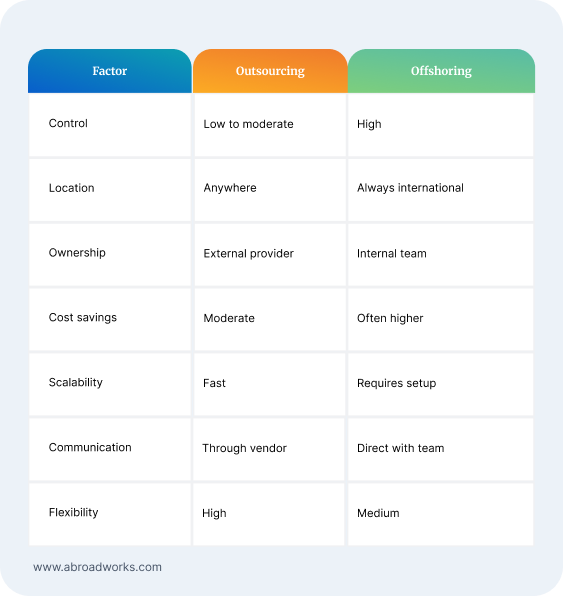
Simply, outsourcing gives you speed, and offshoring gives you control.
When Outsourcing Makes More Sense
Sometimes, you don’t need another team, you just need a problem solved.
Outsourcing shines in situations where:
- The task is specialized and not core to your business
- You need results quickly
- You don’t want to manage additional staff
- The workload is inconsistent
Example:
Imagine you run a small eCommerce store, and you need a new website design. Hiring a full-time designer doesn’t make sense, so you outsource the project to an agency.
The job is done and delivered swiftly, with no long-term commitment.
Outsourcing allows you to get from A to B without the time consuming process of making a new hire.
When Offshoring Is the Better Play
Offshoring becomes powerful when you’re thinking long-term.
It works best when:
- You have a continuous stream of work
- You want to build expertise internally
- You value consistency and brand voice
- You need to have tighter control over processes
Example:
Let’s say you publish content on a weekly basis, and instead of constantly hiring freelancers, you build an offshore content team. After a while, they learn your brand, your tone, and your audience.
The result feels effortless, and not just pieced together. Of course, you have more responsibility, but you also have more control.
Cost Differences: What You Actually Save
Both models can reduce costs, but they do it differently.
Outsourcing costs:
- You pay for expertise
- Rates are often higher per hour
- No overhead or benefits
- No long-term commitment
Offshoring costs:
- Lower salaries in global markets
- Some setup and management overhead
- Long-term savings compound over time
For example, hiring a US-based marketing manager might cost $80,000 per year. Hiring offshore talent could reduce that by 40-70%, depending on the region.
That said, cheaper doesn’t always mean better. Poor management can wipe out savings quickly.
Control and Quality: The Trade-Off
Control is where you really see the difference between the two.
With outsourcing, you define the outcome, but the provider decides how to get there. That can be efficient if you don’t have a lot of time to guide someone, and prefer proactiveness, but it can also be frustrating if expectations don’t align.
With offshoring, you manage the team directly, you train them and you guide the process. It takes effort upfront, but the payoff is consistency.
A quick analogy:
Outsourcing is like ordering food, and offshoring is like hiring a chef.
Both of these methods feed you, but only one lets you control the recipe.
Communication and Time Zones
This is often overlooked, until it becomes a problem.
Outsourcing:
- Communication flows through account managers
- Updates may be scheduled or delayed
- Less day-to-day interaction
Offshoring:
- Direct communication with team members
- Requires clear processes
- Time zones can be an advantage or a hurdle
For example, a team in a different time zone can work while you sleep. That creates a 24-hour workflow. But if meetings overlap poorly, things slow down.
The trick lies in setting expectations early.
Risk Factors You Shouldn’t Ignore
Every strategy comes with risks, but choosing to ignore them is where things start to fall apart.
Outsourcing risks:
- Lack of transparency
- Inconsistent work quality
- Dependency on external vendors
Offshoring risks:
- Cultural differences
- Management complexity (especially with time zone differences)
- Initial setup time and effort
One overlooked issue is knowledge retention. With outsourcing, knowledge often stays with the vendor, and if you switch providers, you have to start from scratch.
With offshoring, that knowledge stays in your business.
Hybrid Models: The Smart Middle Ground
Here’s the good news, you don’t have to choose one or the other.
Many businesses blend both models:
- Offshore your core team
- Outsource specialized tasks
Example:
You might have an offshore marketing team handling daily content, and at the same time, you outsource advanced SEO audits to experts.
This hybrid approach gives you the flexibility you’re looking for without having to sacrifice control.
How to Decide: A Simple Framework
If you’re stuck, ask yourself these questions:
- Is this task ongoing or a once-off?
- Do I need full control over the task/process?
- How important is consistency during this task?
- What’s my budget over the next 12 months?
- Do I have the time to manage a team?
Quick rule of thumb:
- Short-term, specialized work = outsource
- Long-term, repeatable work = offshore
Real-World Scenario: Scaling a Startup
Let’s look at this scenario. A startup begins with outsourcing, it hires freelancers for design, content, and development. Everything moves quite quickly, and costs stay flexible. They then experience a rapid increase in growth.
Suddenly, inconsistency creeps in, messaging feels scattered, deadlines aren’t being met, and costs become unpredictable.
So the company adjusts, it builds an offshore team of writers, designers, and developers who now work together full-time. Processes become more strict and output improves.
Outsourcing helped them start, but offshoring helped them scale.
Common Mistakes Businesses Make (And How to Avoid Them)
Even with a clear understanding of offshoring and outsourcing, many businesses still struggle because of poor execution.
One common mistake is choosing outsourcing purely based on price. It’s very tempting to go with the cheapest provider, especially when you have a small budget. However, lower costs often come with sacrifices in quality, communication, and/or reliability. Over time, fixing mistakes can cost more than doing it right the first time.
Another issue is treating offshore teams like external vendors. This creates distance, and when people feel disconnected, accountability drops. Instead, integrate offshore employees into your workflows. Include them in meetings, share goals, treat them like part of the team, this way you’ll see a noticeable difference in performance.
There’s also the problem of unclear expectations. Whether you outsource or offshore, vague instructions lead to poor results. Define deliverables, timelines, and success metrics from the beginning.
Lastly, businesses often underestimate onboarding, they assume experienced professionals will “just get it,” but that rarely happens. Even the best talent needs context, and investing time upfront saves frustration later.
Avoid all of these pitfalls and both models become far more effective.
FAQs
- Is offshoring the same as outsourcing? No, offshoring is about location while outsourcing is about who performs the work.
- Which is cheaper: offshoring or outsourcing? Offshoring usually costs less long-term, but outsourcing has lower upfront commitment.
- Can a business use both at the same time? Yes, many companies combine both for flexibility and control.
The Future of Work: Why This Matters More Than Ever
Remote work truly changed the game, and businesses no longer think locally by default. Talent is global, competition is global, and expectations are higher than ever.
Offshoring isn’t just about saving money anymore, it’s about accessing skills you can’t find locally.
Outsourcing isn’t just about convenience, it’s about speed and specialization.