How to Scale Real Estate Wholesaling with a Dedicated Virtual Assistant

Key takeaways
- Hire for your current workload. Start with part-time support and expand as your deal pipeline grows.
- Choose dedicated support. A dedicated VA learns your scripts, CRM, and processes for more consistent seller follow-ups.
- Calculate your break-even point. Compare hiring costs with the additional assignments needed to cover the investment.
- Keep critical decisions in-house. Retain control over pricing, negotiations, contracts, and financial access.
- Build compliance into every process. Establish calling hours, opt-out procedures, and state-specific disclosure requirements.
- Measure performance weekly. Track contact rates, qualified leads, appointments, response times, and compliance flags.
Wholesaling income depends on two things, one being how many motivated sellers you contact each week, and the other is how fast you respond when one is interested. Most solo wholesalers hit a ceiling on both, because the person negotiating offers is also required to pull lists, dial numbers, update the CRM, and email buyers.
Wholesaling means getting an unlisted home under contract at a discount and assigning that contract to another buyer before closing. A dedicated virtual assistant takes over the repeatable work behind that process so your hours go to offers and negotiation.
This guide helps you to delegate at each growth stage, it discusses what the hire costs against what one extra deal pays, which rules belong in every script, and how to onboard someone who stays.
Choose a Dedicated VA Over Shared Help
A shared or rotating VA works a queue, a dedicated VA learns your scripts, your CRM tags, and the way you prefer interactions with seller’s to go, and that knowledge compounds every month.
Wholesaling rewards continuity because seller conversations stretch across weeks, and each handoff to a new person resets the context.
Speed is just as important. A Harvard Business Review study of online sales leads found that leads contacted within an hour were about seven times more likely to turn into customers, while firms that waited a day or longer were roughly 60 times less likely to convert.
The research covered web leads, so it maps most directly to seller inquiries from your website, ads, and mailer callbacks. A VA who owns the inbound line, with working hours that overlap your sellers' day, closes the gap a solo operator leaves open while negotiating or driving to a property.
Hand Off Work by Growth Stage
Hire against workload and not ambition. The table shows how the VA seat changes as deal flow grows.
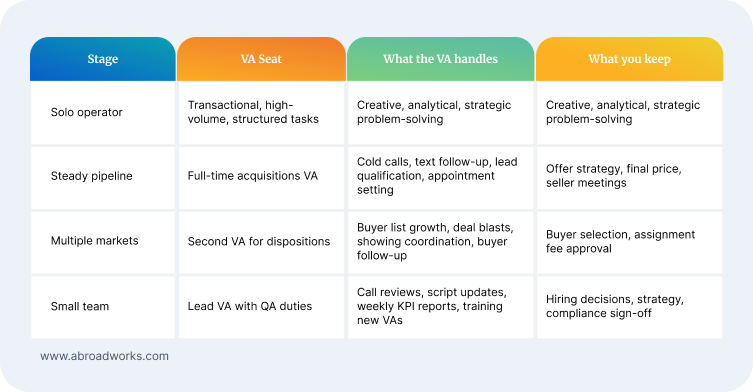
Add the disposition seat when signed contracts sit unassigned because nobody has time to market them. The acquisitions seat feeds that pipeline, so adding it first keeps both sides of the business balanced.
Keep Final Decisions on Your Desk
A VA prepares the work, and you still make all the important decisionsl. These five items stay with the owner.
- Set the final price, offer terms, and counteroffers.
- Select, edit, and sign every contract.
- Approve the after-repair value and repair estimates that set your maximum offer.
- Control earnest money, escrow instructions, and all bank access.
- Answer legal questions and describe your role to sellers.
Run the Math Before You Hire
Cost depends on where the VA lives. Rate guides published by VA agencies put a dedicated Philippines-based real estate VA at roughly $7 to $12 an hour and a US-based assistant at $22 to $40.
The table below converts example rates into annual cost and shows how many extra assignments at a $10,000 fee cover the seat.
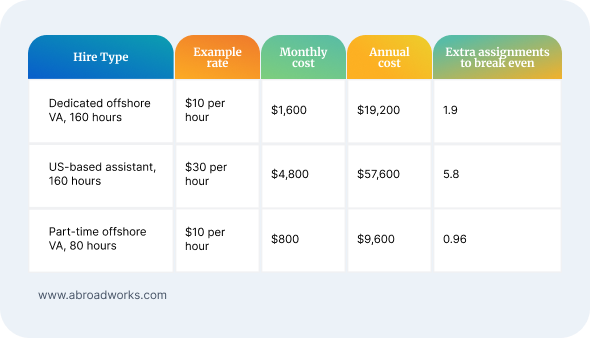
These figures assume the VA's added outreach turns into signed contracts, which depends on list quality, your close rate, and how quickly you work the offers the VA surfaces. Treat the breakeven number as a floor to test against your own results during the first 60 days and not as a promise.
Protect Every Call With Compliance Rules
Scaling outreach increases legal exposure and deal flow, so write the rules into the VA's SOP before they get started.
With regards to calls, the FTC bars telemarketing calls before 8 a.m. or after 9 p.m. in the recipient's local time and expects sellers to scrub the National Do Not Call Registry, with fines that can reach $50,120 per illegal call.
Whether a particular wholesaling call counts as telemarketing depends on multiple factors. Many investors apply the same window and registry scrub to every list and then ask an attorney about unique cases.
According to state law, at least 15 states have recently approved new wholesaler regulations, with seller disclosure rules in Maryland, Ohio, Oklahoma, and Texas and licensing requirements in Illinois, South Carolina, and Rhode Island. Missouri requires a written disclosure at least 14 days before closing.
We suggest putting the following steps in the SOP:
- Store each lead's time zone and block calls outside 8 a.m. to 9 p.m. local time.
- Scrub every list against the registry and your internal opt-out list before upload.
- Log each opt-out the same day and suppress that number everywhere.
- Add your state's required seller disclosure language to scripts and written offers.
- Prohibit the VA from posing as a licensed agent, advising sellers, or promising a price.
Track a Weekly Scorecard
Numbers will tell you whether the seat earns its cost. Set your baseline from the first 30 days of recorded calls, then raise targets on a monthly basis.
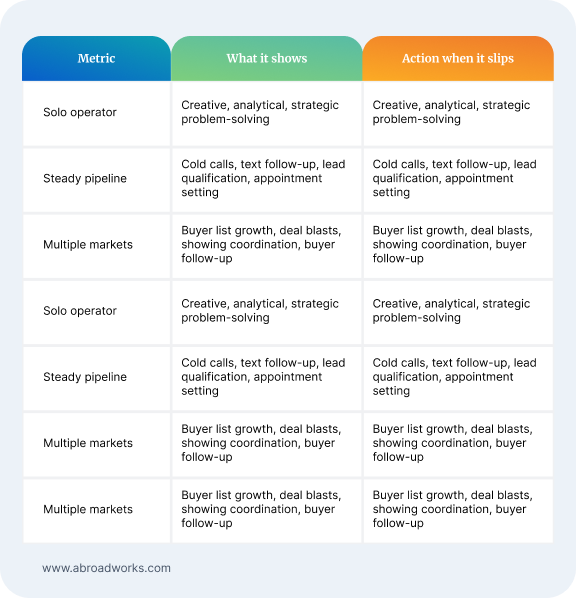
Listen to five recorded calls each week with the VA, then update the script with whatever the strongest calls do differently.
Hire and Onboard in Four Steps
- Write the buy box and SOPs, covering things like property types, price ranges, motivation signals, and CRM stages, before you post about the role.
- Assess finalists with paid work by asking each to clean a sample list and run a recorded role play of a seller call.
- Start a two-week trial with set hours, a daily report, three numbers the VA owns, and working hours that overlap your sellers' day.
- Hold a weekly review to hear calls, adjust scripts, and add duties only after the scorecard holds steady.
Keep the first month simple and organized, week one covers CRM access, scripts, and listening to recorded calls. Week two covers supervised outreach on a small list. By weeks three and four, the VA should work a full list on their own while you review the scorecard. Expanding duties earlier reduces the efficieny of training and makes it harder to see which tasks the VA handles well.
FAQs
- What does a virtual assistant for real estate wholesaling do? A wholesaling VA builds and cleans seller and buyer lists, skip traces owners, makes outbound calls, sends texts, qualifies leads, sets appointments, updates the CRM, and sends deal blasts to buyers. The owner handles pricing, negotiation, and contracts.
- How much does a wholesaling virtual assistant cost? Agency-published guides list about $7 to $12 an hour for a Philippines-based real estate VA and $22 to $40 for a US-based one. A full-time offshore seat at 160 hours a month works out to roughly $1,120 to $1,920 before any agency fee.
- Can a VA make cold calls for wholesaling legally? Yes, when the process follows calling rules. The FTC sets an 8 a.m. to 9 p.m. window in the recipient's local time and expects sellers to scrub the Do Not Call Registry. Rules vary by state and call type, so have a real estate attorney review your scripts and lists.
- When should I hire my first VA? Hire when leads or follow-ups wait on your calendar, and you can describe the work in written steps. If a task needs your judgment each time, document your process first. A VA multiplies a working process and cannot repair an undefined one.
- Do I need a license to wholesale or to hire a VA? Hiring a VA generally requires no license, but wholesaling can. No state has banned wholesaling, yet Illinois, South Carolina, and Rhode Island have required many wholesalers to hold real estate licenses, and several states mandate seller disclosures. Check your state rules before you scale outreach.
The Bottom Line
It’s important to remember that the VA does not replace your judgment on price and contracts, you’re still very much in control. The new hire only pays off when it lets you contact more sellers, answer each inquiry faster, and keep every call inside the rules. Start with one dedicated seat, measure it against the scorecard for a duration of 60 days, and add roles only when it’s appropriate to do so, i.e. the work backs up.