HIPAA-Compliant Virtual Assistants: Security Protocols and Hiring Guide
Key Takeaways
- Understanding HIPAA Compliance in Global Offshoring: How cross-border data privacy actually works under federal regulations.
- Core Administrative Roles and Operational Benefits: Identifying key non-clinical workflows to offload immediately.
- Addressing Cross-Border Data Guardrails & IT Security: The technical safeguards, cloud VDIs, and hardware lockdowns that keep PHI safe.
- The DIY Hiring Trap vs. The Offshore Agency Model: Why working with an offshore staffing partner is the smartest way to scale safely.
- A Step-by-Step Guide to Hiring & Onboarding: Practical steps to source, integrate, and manage your new remote team members smoothly.
Running a modern U.S. healthcare practice can feel like an impossible balancing act. Between rising overhead, endless insurance paperwork, and packed waiting rooms, administrative burnout happens fast.
Managing patient inquiries, verifying insurance coverage, pre-filling charts, and chasing billing claims consume precious hours every day. That constant friction pulls your focus away from what matters most: delivering high-quality patient care.
To eliminate these back-office bottlenecks without inflating your payroll, forward-thinking practices are expanding their teams through strategic labor offshoring. This proven approach lets you bring dedicated, highly skilled global talent directly into your daily operations.
By utilizing a skilled offshore virtual assistant, you can protect your clinical team from burnout, provide responsive support for your patients, and maintain a seamless workflow without overstretching your budget.
When you partner with a specialized offshore staffing agency, integrating a remote virtual assistant into your administrative ecosystem becomes effortless and completely secure.
An experienced partner ensures you connect with pre-vetted, highly fluent professionals who understand healthcare workflows and operate within strict data privacy standards.
In this guide, we will explore how HIPAA compliant virtual assistant services safeguard your sensitive data and help you build a resilient, scalable practice:
- Understanding HIPAA Compliance in Global Offshoring: How cross-border data privacy actually works under federal regulations.
- Core Administrative Roles and Operational Benefits: Identifying key non-clinical workflows to offload immediately.
- Addressing Cross-Border Data Guardrails & IT Security: The technical safeguards, cloud VDIs, and hardware lockdowns that keep PHI safe.
- The DIY Hiring Trap vs. The Offshore Agency Model: Why working with an offshore staffing partner is the smartest way to scale safely.
- A Step-by-Step Guide to Hiring & Onboarding: Practical steps to source, integrate, and manage your new remote team members smoothly.
Why the Expansion of Offshore Labor Is Reshaping Healthcare Administration
The Rise of Global Healthcare Support
In recent years, healthcare organizations across the country have rapidly embraced labor offshoring to offload non-clinical administrative tasks. Trying to manage every back-office operation with local staff has become increasingly complex, expensive, and unsustainable for growing clinics.
By shifting routine clerical work to dedicated global professionals, your medical practice can rapidly streamline its daily workflows by shifting repetitive tasks from in-house to specialized offshore workers, allowing your in-house staff to stay focused on what matters most: patient care and clinical operations.
Market Growth Data
The shift toward global support in healthcare is not a temporary trend; it is backed by massive industry growth and wide-scale adoption.
The global healthcare business process outsourcing market is expanding at an unprecedented rate, projected to surge from over $350 billion toward $1 trillion in the coming years. Recent industry data shows that approximately 68% of healthcare providers now outsource at least one non-clinical administrative function to keep their practices running efficiently.
Economic & Operational Realities
Adopting offshore labor directly addresses the pressing financial and staffing challenges faced by healthcare practice managers today.
First, it helps your practice overcome severe domestic talent bottlenecks. Local administrative recruitment frequently stalls due to persistent labor shortages, high turnover, and rising wage inflation that strains your operational budget.
Second, partnering with a skilled offshore virtual assistant delivers significant overhead savings, drastically cutting non-clinical workload costs without sacrificing quality or accuracy.
Finally, these substantial payroll savings create room for strategic reinvestment. Capital saved on routine administrative tasks can be funneled directly back into practice growth, patient care initiatives, facility upgrades, and advanced medical technology.
Essential Medical Support Roles for Offshore Virtual Assistants
A specialized offshore virtual assistant can manage a wide variety of non-clinical administrative tasks to keep your clinic running smoothly:
- EHR Maintenance & Chart Prep: Pre-filling patient charts, updating medical histories, tracking incoming lab results, and routing portal messages.
- Insurance Verification & Prior Authorization: Conducting proactive coverage checks, securing pre-certifications, and following up with payers prior to patient appointments.
- Revenue Cycle & Billing Support: Pre-auditing insurance claims, managing basic coding compliance (ICD-10/CPT), posting payments, and tracking claim denials.
- Patient Intake & Appointment Scheduling: Managing appointment calendars, running automated reminder workflows, and guiding patients through pre-registration.
Security Protocols & Guardrails: How Medical Data Is Safeguarded Overseas
When you evaluate international administrative support, keeping your patient data safe is non-negotiable. Sending sensitive medical information across borders requires robust, multi-layered security protocols that meet stringent federal standards.
To protect Protected Health Information (PHI), reputable staffing partners implement dedicated technical, physical, and administrative guardrails. Here is how your data remains completely secure while working with remote teams.
Cloud Infrastructure & Zero-Local Data Storage
The foundational rule of secure remote medical support is simple: patient data must never be saved to an offshore worker's local hard drive.
Instead, your offshore virtual assistant connects directly through encrypted Virtual Desktop Infrastructures (VDI) or secure Business VPNs.
This setup keeps all PHI strictly inside your U.S.-hosted cloud environment or EHR system. Your remote team views and processes information in real time, but no actual files or data ever touch or reside on their physical computers.
Workstation & Hardware Lockdowns
To prevent data exfiltration, the physical workstations used by remote staff undergo strict hardware and software lockdowns.
USB ports are disabled to prevent file transfers to external storage drives. Administrative whitelisting blocks screen recording, unauthorized web browsing, and local printing capabilities entirely.
Furthermore, Multi-Factor Authentication (MFA) and granular Role-Based Access Control (RBAC) ensure your virtual assistant accesses only the specific records and tools necessary for their assigned daily duties.
Administrative Safeguards & Audit Logging
Advanced technical safeguards must always be backed by continuous administrative vigilance and clear operational oversight.
Automated system logging tracks every login, record modification, and system action. This gives your practice total visibility and an immutable audit trail to satisfy internal compliance reviews.
Additionally, remote staff complete mandatory, recurring HIPAA privacy training. This ongoing education keeps your global team vigilant against cybersecurity threats, phishing attempts, and privacy risks.
DIY Hiring vs. Partnering with a Reputable Offshore Staffing Agency
The Temptation of the "DIY" Route
When you decide to add remote administrative support to your practice, it can be tempting to recruit independent freelancers directly on global gig platforms.
Sifting through profiles to find a low-cost offshore virtual assistant might seem like a quick way to save money. However, in the healthcare industry, taking the DIY route is a dangerous operational and legal minefield.
The Hidden Risks of DIY
Handling global recruitment without dedicated legal and IT infrastructure introduces major vulnerabilities to your practice.
Independent freelancers operating from overseas cannot legally execute an enforceable U.S. Business Associate Agreement (BAA). Without a valid BAA, your practice bears full legal liability for any compliance violations or privacy breaches that occur.
Additionally, individual freelancers work from unmonitored home network environments that lack physical security controls, hardware lockdowns, or enterprise firewalls.
Unvetted hires also bring high turnover risks. If a freelancer suddenly drops off, your administrative workflows stall immediately, leaving you with no backup coverage.
Why Smart Businesses Partner with an Offshore Staffing Agency
To eliminate compliance and operational risks, smart practice leaders partner with specialized agencies that specialize in labor offshoring.
A reputable staffing agency provides the structural framework, legal shielding, and security infrastructure required to scale your back office safely.
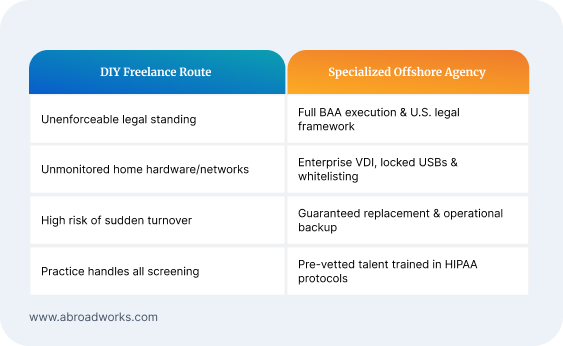
Working with a specialized partner ensures that your HIPAA compliant virtual assistant services are backed by formal legal agreements, including executed BAAs.
Agencies run multi-stage candidate screening to evaluate medical terminology fluency, software proficiency, and privacy awareness before a candidate ever interviews with you.
They also provide managed IT infrastructure, equipping staff with monitored, locked-down workstations built for healthcare compliance.
Finally, your practice gains operational continuity. If your primary assistant takes sick leave or transitions off your account, the agency provides cross-trained backup talent so your clinic's workflows never miss a beat.
Step-by-Step Guide: How to Hire and Onboard a HIPAA-Compliant Virtual Assistant
Bringing dedicated remote support into your clinic shouldn't feel overwhelming. When you follow a structured hiring and onboarding roadmap, expanding your team through labor offshoring is smooth, secure, and predictable.
Here is how you can move from identifying administrative bottlenecks to integrating a pre-vetted, offshore virtual assistant into your daily operations.
Step 1: Identify Non-Clinical Bottlenecks
Start by auditing your daily practice operations to pinpoint where your in-house staff spends the most time on repetitive, non-clinical tasks.
Look for back-office workflows that do not require physical patient contact. Tasks like prior authorization follow-ups, insurance eligibility checks, patient intake, and scheduling backlogs are ideal functions to delegate first.
Step 2: Select a Specialized Offshore Staffing Partner
Evaluate potential staffing agencies carefully to ensure they specialize in healthcare operations rather than generic remote support.
Ask direct questions about their organizational HIPAA alignment, hardware security configurations, VDI deployment, and BAA execution. Partnering with a dedicated agency guarantees that your HIPAA compliant virtual assistant services meet rigorous federal privacy standards from day one.
Step 3: Define Clear Standard Operating Procedures (SOPs)
Before your remote team member logs in, document clear, step-by-step guidelines for every task they will handle.
Outline specific software login procedures, data entry formats, patient communication rules, and escalation pathways for complex billing or clinical questions. Clear SOPs remove guesswork and set your new team member up for immediate success.
Step 4: Execute a Phased Deployment
Start small to build confidence within your team and test your operational workflows.
Deploy one or two virtual assistants into a single focus area—such as pre-visit insurance verification—before expanding global support into other departments like revenue cycle management or chart preparation.
Step 5: Maintain Continuous Compliance & Performance Audits
Establish a consistent feedback loop between your onshore practice manager and your staffing agency lead.
Periodically review system access logs, check EHR audit trails, and maintain open communication. Regular check-ins ensure high productivity while keeping your data protection protocols sharp and compliant over the long term.
Frequently Asked Questions
- Can an offshore virtual assistant legally sign a Business Associate Agreement (BAA)? An individual offshore freelancer cannot directly sign a legally binding U.S. BAA. However, when you work with a specialized offshore staffing agency operating under a U.S. legal entity, the agency signs the BAA directly with your practice, ensuring full legal protection and regulatory compliance.
- How do we prevent remote assistants from downloading sensitive patient data locally? Data security is enforced through technical guardrails rather than trust alone. Your virtual assistant works within a secure Virtual Desktop Infrastructure (VDI) or cloud environment with local drive saving, USB transfer, screen capture, and printing capabilities completely disabled.
- Will an offshore assistant require extensive training on our specific EHR system? Reputable staffing partners recruit administrative professionals who already possess background experience in major healthcare platforms like Epic, Cerner, Athenahealth, and eClinicalWorks. They quickly adapt to your practice’s specific SOPs and workflows.
- H-3: How much can my medical practice save by using offshore virtual assistant services? Practices routinely save between 30% and 50% compared to equivalent domestic administrative hires. These savings stem from reduced wage overhead, no local office equipment costs, and zero domestic payroll tax liabilities.
Conclusion: Build a Secure, Scalable Healthcare Practice with Offshore Talent
Running a thriving medical practice shouldn't require your clinical team to drown in administrative paperwork or sacrifice their work-life balance.
As healthcare administrative demands continue to grow, maintaining a smooth, cost-effective back office requires a modern operational approach.
By pairing secure technology with the strategic advantage of labor offshoring, you can transform your practice into a highly efficient, patient-focused operation.
A dedicated offshore virtual assistant brings the professional focus and administrative skill needed to streamline your daily workflows—from complex insurance verifications and EHR chart prep to billing follow-ups and patient scheduling.
When implemented through a specialized offshore staffing partner, adding global talent to your team is effortless, fully compliant, and budget-friendly.
Instead of constantly battling staff burnout and back-office backlogs, you gain a reliable, secure extension of your workforce that helps your practice grow safely and sustainably.