How to Calculate 13th Month Pay in the Philippines: A US Employer's Guide


Key takeaways
- 13th month pay is mandatory for covered employees in the Philippines under Presidential Decree No. 851.
- Independent contractors are generally excluded, but misclassified employees may still qualify for the benefit.
- Eligible employees include rank-and-file, probationary, contractual, and project-based workers, even if they leave before December.
- Only basic salary is included in the calculation, excluding overtime, holiday premiums, night differentials, and most allowances.
- The calculation is simple: Divide the employee's total basic salary earned during the calendar year by 12.
- Employers must pay by December 24 and submit their DOLE compliance report by January 15.
If you employ anyone in the Philippines, one payroll line item will surprise you the first December it comes around. Filipino labor law requires a mandatory extra payment called 13th month pay, and it has no direct equivalent in the United States. Many US companies discover this only after a Filipino hire asks about it, or worse, after an audit or a labor complaint.
This guide walks through what 13th month pay actually is, who qualifies for it, how to calculate it correctly, and what changes if you hired your Filipino team member as a contractor rather than an employee.
What 13th Month Pay Actually Is
13th month pay comes from Presidential Decree No. 851, signed in 1975. It requires covered employers to pay an extra amount equal to one twelfth of the basic salary an employee earned during the calendar year. For a full year on a steady salary, that works out to roughly one additional month of pay.
It is not a Christmas bonus, and it is not discretionary. It sits on top of any holiday bonus or performance bonus you already give, and Philippine authorities treat it as a legal entitlement rather than a perk.
Does This Apply If You Hired a Contractor
This is the single biggest source of confusion for US companies, because most Filipino remote workers hired by US businesses are engaged as independent contractors rather than formal employees.
13th month pay under Philippine law attaches to an employer-employee relationship. An independent contractor, who sets their own hours, uses their own equipment, and can take on other clients, is not legally owed the benefit.
Philippine labor authorities look at how the working relationship actually functions. If you manage the person's schedule, require exclusivity, supply their tools, and treat them like staff in every practical sense, that arrangement can be reclassified as employment regardless of what you labeled it as in the contract.
When that happens, back pay for 13th month pay, along with social contributions, becomes owed retroactively, often with penalties attached.
Many US companies choose to pay a voluntary 13th month or year-end bonus even when there is no legal requirement to do so, since the benefit is deeply embedded in Filipino work culture and plays into retention. That is a business decision, not a compliance one, and the two should not be confused when you are budgeting.
Who Qualifies for 13th Month Pay
Coverage under Philippine law is broad. The table below breaks down who is included and who is not.
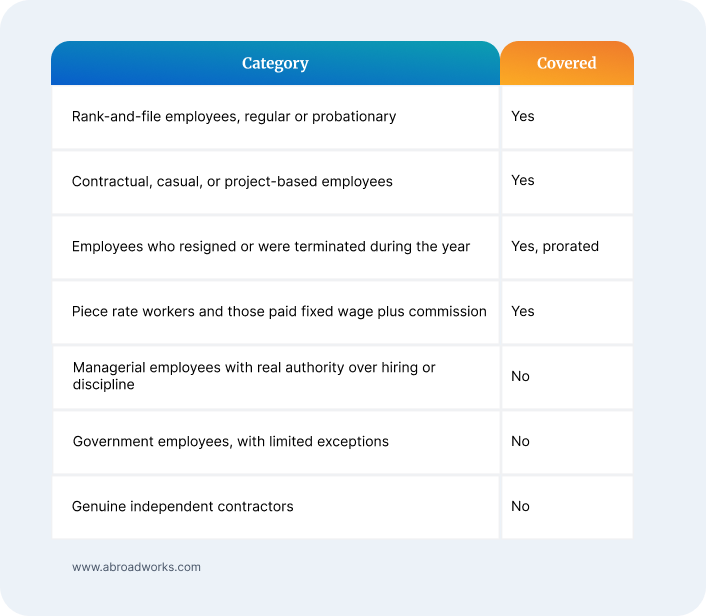
A job title alone does not decide the outcome. Someone called a manager who has no actual authority to hire, discipline, or set policy is still rank and file for this purpose.
What Counts as Basic Salary
Calculation errors almost always trace back to this step. 13th month pay is based on basic salary earned, not gross pay.
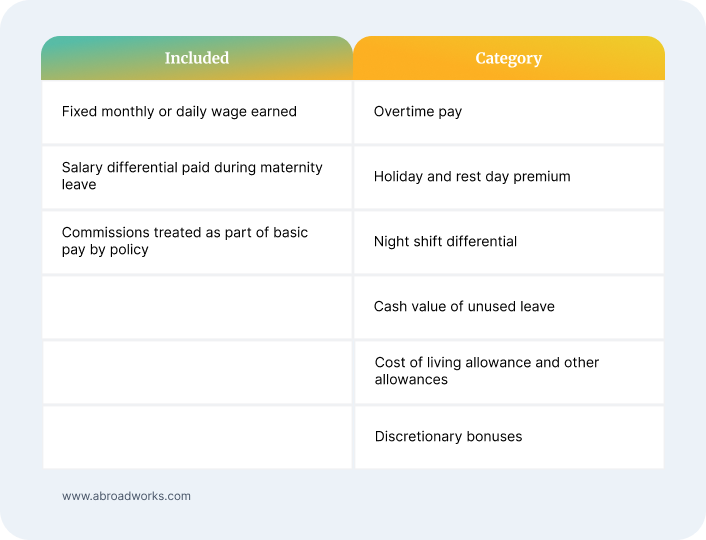
If a payment compensates ordinary work, it counts. If it compensates something extra, working a holiday, a night shift, or converting unused leave, it stays out of the base.
How to Calculate 13th Month Pay
The formula stays constant. Total basic salary earned during the calendar year divided by 12 equals the 13th month pay owed.
Three worked examples make this concrete.
A full year with a steady salary. An employee earns 40,000 pesos a month for all 12 months. Total basic salary earned is 480,000 pesos. Divided by 12, the 13th month pay is 40,000 pesos, exactly one month's pay.
A mid year hire. An employee starts on May 1 earning 35,000 pesos a month and works through December, eight months total. Total basic salary earned is 280,000 pesos. Divided by 12, the 13th month pay is 23,333 pesos.
An employee who resigns partway through the year. An employee earning 38,000 pesos a month resigns after seven completed months. Total basic salary earned is 266,000 pesos. Divided by 12, the 13th month pay is 22,167 pesos, and this amount should be settled as part of their final pay rather than held until December.
Unpaid leave reduces the numerator for whichever month it occurs in, since the person earned less basic salary that month. There is no shortcut version that skips summing actual earnings across the year.
Tax Treatment Under the TRAIN Law
13th month pay is not automatically tax free, but a wide exemption usually keeps it that way. Under the TRAIN law, the first 90,000 pesos of combined 13th month pay and similar benefits received in a calendar year is excluded from income tax.
This ceiling is cumulative, it covers 13th month pay together with Christmas bonuses, productivity incentives, and similar payments added up across the year, not the December payout alone. Only the amount above 90,000 pesos becomes taxable, and it gets added to the employee's regular taxable income for the year.
Most rank and file employees in typical roles never come close to this threshold, so in practice the majority of 13th month payments end up fully tax exempt.
Payment and Reporting Deadlines
Two dates matter for staying compliant.
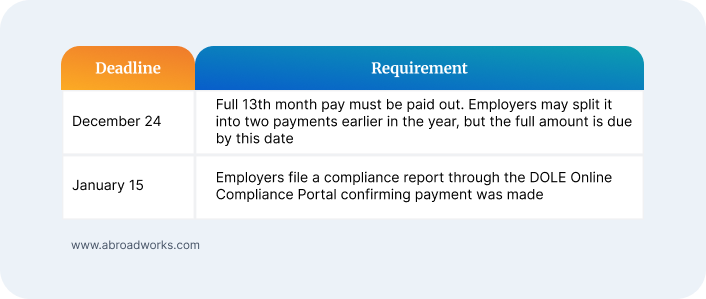
Employers file a compliance report through the DOLE Online Compliance Portal confirming payment was made
No extensions or exemptions are granted for financial hardship without prior authorization from labor authorities, and missing the December deadline turns the unpaid amount into a claim an employee can pursue directly.
Three Ways US Employers Stay Compliant
Once you know a genuine employment relationship exists, or you have chosen to pay the benefit voluntarily, you have a few practical routes.
Setting up a local entity lets you run payroll directly, but it means registering with Philippine tax and social agencies and managing the calculation and filing yourself.
Using an employer of record puts a local company between you and the worker as the legal employer, and they handle the calculation, payment, and DOLE report on your behalf while you keep managing the day to day work.
Working with a staffing partner that already employs the person locally shifts the entire compliance burden to that partner, which is usually the simplest option for a US company that only needs one or two roles filled rather than a full local operation.
Whichever route you go, treat the cost as a real line item from the start, since it adds roughly one twelfth to the annual cost of every covered role.
FAQs
- Does 13th month pay apply to a Filipino virtual assistant I hired as a contractor? Generally no, as long as the relationship is genuinely a contractor arrangement. If you control their schedule, provide tools, and treat them like a staff member, Philippine authorities can treat the relationship as employment regardless of the contract.
- How is 13th month pay calculated for someone who joined partway through the year? Add up the actual basic salary they earned from their start date through December, then divide that total by 12. There is no need for the person to be employed for a full 12 months to qualify, and even one month of work creates a prorated entitlement.
- Is 13th month pay taxable in the Philippines? The first 90,000 pesos of combined 13th month pay and similar benefits received in a calendar year is exempt from income tax under the TRAIN law. Only the amount above that combined threshold becomes taxable income.
- What happens if a US employer misses the December 24 deadline? The unpaid amount becomes due and demandable immediately, and the employee can file a money claim with DOLE. No deferment or exemption is available without prior authorization, so late payment is treated as noncompliance.
- Do allowances and overtime count toward 13th month pay? No, not unless your company policy explicitly treats them as part of basic salary. Overtime, night shift differential, holiday premiums, and cost of living allowances are excluded from the calculation by default under Philippine labor guidelines.
The Bottom Line
13th month pay is straightforward once you know which formula to run and which category your Filipino worker actually falls into. The calculation itself is simple math, the part that catches US employers off guard is the classification question, since most Filipino remote hires are contractors with no legal entitlement to the benefit, right up until the working relationship starts looking like employment in practice. Get the classification right first, then the calculation takes care of itself.