The 14 Day Remote Onboarding Checklist for Offshore Team Members

Key takeaways
- Prepare before day one. Set up tool access, payment systems, agreements, and onboarding materials in advance.
- Structure onboarding into three phases. Start with orientation, move to core workflows, and finish with greater ownership and performance reviews.
- Establish overlapping work hours. Schedule daily communication windows that work across time zones.
- Document your processes. Use SOPs and short screen recordings to clarify expectations and reduce repetitive questions.
- Measure results, not just activity. Evaluate work quality and completed tasks instead of focusing solely on hours logged.
- Reuse your onboarding checklist. Turn your 14-day plan into a repeatable process for every new offshore team member.
Congrats! You hired a great virtual assistant. Now you have two weeks to turn that hire into a working team member instead of just another name on your payroll list.
Most US businesses stretch VA onboarding across 30 days. That works fine when your new hire is in the office, but not as well when your VA is twelve time zones away, learning your tools, your accent, and your business all at once. A 14-day plan forces you to make decisions faster, and it gets your offshore assistant contributing real work while the excitement of a new job is still fresh.
This guide gives you a full virtual assistant 14-day onboarding checklist for US teams, built specifically around the extra friction that comes with hiring offshore. You will find a day-by-day plan, tool recommendations, and answers to the questions US founders and managers ask most often.
Why 14 Days Beats 30 for Offshore Hires
A long onboarding process sounds efficient, but in reality it’s just a drag. Every extra week without clear ownership is a week your VA fills with guesswork.
Offshore onboarding carries three extra layers that a local hire does not:
- You need to agree on overlap hours before any work starts, since a VA in Manila or Lagos is not awake at the same time you are.
- You need a payment and contractor setup that works across borders, not just a direct deposit form.
- You need official documentation that survives a language or cultural gap, since tone and context do not always translate through a chat message.
A brief 14-day window forces you to solve these three things early on instead of letting them surface as problems in week five. Set the structure now, and your VA spends day 15 doing real work instead of still learning where things live.
What to Prepare Before Day One
Before your VA logs on for the first time, do the following; it’ll only take around two hours and will save you far more than that in back-and-forth once they start:
- Set your overlap hours in writing. Pick two to four hours where your schedules meet, even if that means your VA works an evening shift on their end.
- Choose a payment platform built for cross-border work, such as Deel, Wise, or Papaya Global, etc.
- Draft a short contractor agreement detailing scope, pay schedule, confidentiality, and notice period.
- Create logins for every tool your VA needs on day one. Do not make them wait a week for access.
- Write a welcome one-pager detailing what your company does, who is on the team, and what success looks like in the first two weeks.
- Record two or three short screen recordings of your core workflows. A five-minute video saves hours of typed explanation later and can be reused as needed.
-
Your Day-by-Day Onboarding Checklist
Break the 14 days into three phases. Each phase has a different goal, so resist the urge to pile on tasks too early.
Days 1 to 3: Orientation and Access
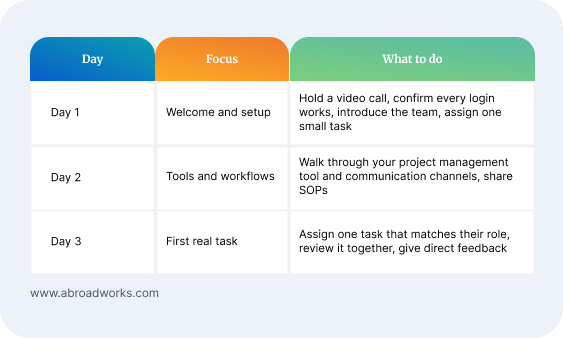
Days 4 to 7: Core Workflows
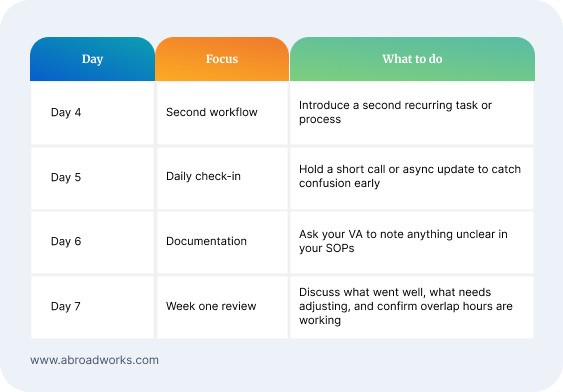
Days 8 to 14: Ownership and Review
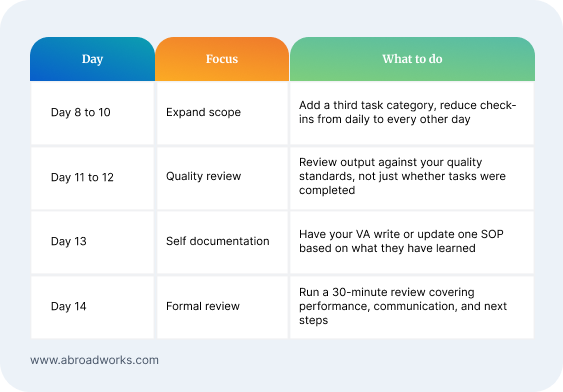
Run a 30-minute review covering performance, communication, and next steps
By day 14, your VA should own two or three recurring workflows without needing step-by-step guidance. If they are still asking basic questions at this point, the gap is usually missing documentation, not a bad hire.
Tools Every US Team Should Set Up for an Offshore VA
Offshore hiring adds a few tool categories that a local hire does not need. Here is the minimum stack.
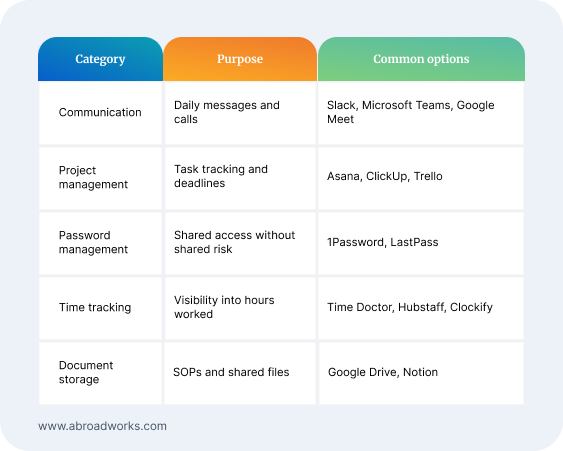
Set every one of these up before day one. A VA who spends their first three days waiting on tool access is not learning your business; they are watching your onboarding fall apart.
Handling Time Zones Without Losing Momentum
Time zone gaps are the biggest differentiator between onboarding an offshore VA and someone local, and you have to plan around it, not against it.
Set a standard overlapping time for communication and stick to it — even if it’s only 90 minutes per day — and use that for a live video call during the first two weeks of your VA’s work.
Schedule all regular communication outside of this time frame in another program and, instead of conducting weekly calls, send your VA a brief summary of what was discussed at the end of each day’s work.
Record your explanations instead of writing them out, and clarify public holidays and local schedules before week one begins because a surprised VA on their busiest day is not an efficient VA.
Common Mistakes That Stall Offshore Onboarding
- The first mistake is skipping the conversation about overlapping hours. You can’t troubleshoot a process together if there is no time when you are both free.
- Sending logins piecemeal over several days. You can batch up your logins, upload them to a password manager, and share them on day one.
- Assuming written English fluency means cultural fluency. Make sure to give them feedback about your process in writing instead of assuming that because they read English, they understand your tone of voice or humor.
- Don’t measure activity in hours spent; look at output instead.
- Delaying the payment setup. Don’t wait until day one to set up the payment system. Nothing will make your new offshore hire doubt your intentions more than a late or drawn-out first payment.
Frequently Asked Questions
- How is a 14-day onboarding checklist different from a 30-day plan? A 14-day plan allows us to achieve the same goal in a shorter timeframe. We prepare and introduce access and tools to assistants before day one, and the ownership of the identified tasks is handed over to them on day 14 instead of day 30. This plan is more suitable for an experienced Virtual Assistant who requires less training and supervision.
- What is the ideal overlap window for a US team hiring offshore? Aim for two to four hours of daily overlap. Executive assistants and client-facing roles require more, while research or content roles need less.
- How should US companies pay offshore virtual assistants? Most US teams use a contractor platform such as Deel, Wise, or Papaya Global rather than direct wire transfers. These platforms handle currency conversion, tax documentation, and payment timing automatically.
- What if my VA is still confused after day 14? Check your documentation before questioning the hire. Missing or unclear SOPs cause most onboarding delays, not a lack of skill. Add a short video walkthrough for any task that keeps generating questions, and review it together.
- Do I need a formal contract for an offshore virtual assistant? Yes. A short contractor agreement covering scope, pay schedule, confidentiality, and notice period protects both sides and sets clear expectations from day one. Most contractor payment platforms include a template you can adapt.
Build This Once, Reuse It Every Time
A 14-day onboarding checklist is not something you make once, use once, and throw away. By creating the document, you're already improving the processes because every new offshore hire will follow the onboarding checklist.
Before your VA comes, set up the tools, and make sure the first three days they spend with you are about orientation (and not work). Let them begin to ramp up during their second week, then do a real review of how the first month is going on the 14th day (not the first three months).
By implementing this process, you'll be able to improve every subsequent VA onboarding process since they will get to start faster (but not too fast).