The Unbiased Interview Myth: Can Rubrics and AI Actually Fix Global Hiring? (Why the Answer is "Not Quite—Yet")

Key Takeaways
- Human Bias Affects Hiring: Affinity bias, the halo effect, and cultural differences can influence how interviewers evaluate international candidates.
- Rubrics Improve Consistency: Structured hiring scorecards help measure curiosity, coachability, and job-related competencies using observable behaviors.
- Skills Tests Reveal Real Ability: Practical assessments give candidates a fairer opportunity to demonstrate their skills beyond interview performance and communication style.
- Standardized Interviews Reduce Bias: Consistent questions, scoring criteria, and blind evaluations make candidate comparisons more objective.
- AI Strengthens Hiring Evaluations: LLMs can assess interview transcripts against defined rubrics, measure relevant responses, and flag inconsistencies in human evaluations.
- Human Oversight Still Matters: Combining AI analysis with human judgment creates a more balanced and effective global recruitment process.
Every business owner scaling an offshore team eventually hits the exact same hiring paradox.
You are on a video call with a standout international candidate—a senior programmer in Colombia, a data scientist in Romania, or an accountant in the Philippines. On paper, their credentials are spotless. Yet twenty minutes in, hesitation creeps in. Their cadence feels unusually formal, or they skip the casual Western small talk you normally use to gauge "chemistry."
To guard against costly mis-hires and personal prejudices, smart companies rely on structured hiring rubrics—and increasingly, AI tools to score interviews automatically. Strip away emotion, grade everyone on the same scorecard, and let objectivity win.
So, can rubrics or AI make the interview process truly unbiased?
The short answer is not quite—and frankly, it never will be.
As long as a human sits anywhere in the hiring loop, complete objectivity is impossible. Not out of malice, but simply because human brains rely on subconscious shortcuts under pressure.
Still, "impossible to perfect" doesn't mean "impossible to improve." By pairing structured rubrics and practical tests with AI as an objective second set of eyes, companies can strip away gut-feeling bias and uncover elite global talent.
In this piece, we’ll explore:
- The Human Bottleneck: Why rubrics still bend to unconscious bias and cross-cultural friction.
- The HubSpot Blueprint: Where quantifiable soft-skill rubrics succeed—and where gut feel sneaks back in.
- The AI Advantage: How pairing LLMs with rubrics creates a smarter, human-in-the-loop hiring process.
The Illusion of Objectivity: Why Interviews Are Inherently Biased
Before fixing the interview process, leaders have to confront an uncomfortable reality: most traditional interviews are little more than "vibe checks" dressed up in corporate attire.
We like to believe we evaluate candidates purely on merit, logic, and technical qualifications. Yet the moment a human being enters the evaluation loop, pure objectivity disappears. That isn't because hiring managers are malicious or careless—it is simply because human brains are hardwired for cognitive shortcuts when making fast judgments about strangers.
Even the most experienced executives routinely fall into predictable psychological traps:
- Affinity Bias: We naturally gravitate toward people who mirror our own communication style, humor, pacing, or background. When a candidate talks and thinks like us, our brains mistake that familiarity for competence.
- The Halo and Horns Effect: A single standout credential—or one awkward moment—can hijack the entire evaluation. If a candidate nails the opening question, we forgive later red flags; if they stumble early, we view every subsequent answer through a lens of skepticism.
- Post-Hoc Rationalization: Behavioral research shows interviewers frequently decide whether they like a candidate within the first few minutes, then spend the rest of the call subconsciously hunting for evidence to justify that initial gut reaction.
Consider how the brain processes “favorites.” We don’t choose favorites based off a series of objective data points within our minds, we pick them because they fit preexisting information within our minds and they reduce the amount of energy required to make decisions. We don’t decide to eat a peanut butter and jelly sandwich based off all available information – we choose to eat it because it’s our favorite.
When you expand your hiring globally, these everyday blind spots go into overdrive.
In domestic recruiting, managers often disguise familiarity bias as "culture fit." Across borders, that instinct becomes an expensive liability. High-skilled professionals in Latin America, Southeast Asia, or Eastern Europe bring different cultural norms around directness, conversational pacing, and deference to authority.
A brilliant software architect might give concise, matter-of-fact answers instead of pitching themselves with Western bravado. An elite accountant might pause thoughtfully before responding rather than jumping in immediately. To an uncalibrated interviewer, that cultural friction registers as "low energy" or "poor communication"—causing companies to pass on top-tier talent for all the wrong reasons.
Recognizing that human intuition is inherently flawed isn't a defeat; it's the essential starting point for building a smarter hiring system.
Case Study: What HubSpot’s Famous Rubric Got Right—and Where Gut Feel Creeps Back In
To see both the power and the limits of structured hiring, look no further than Mark Roberge’s famous Sales Acceleration Formula at HubSpot.
When Roberge was tasked with scaling HubSpot’s revenue team, he realized that hiring based on manager intuition was a recipe for inconsistency. Instead of relying on gut feel, he analyzed historical performance data to isolate the exact traits that predicted success—landing on two standout characteristics: curiosity and coachability.
Rather than leaving those traits vague, Roberge built a practical, quantifiable rubric around a mock sales scenario ("How do you sell HubSpot?"):
- Measuring Curiosity: Instead of judging how persuasive a candidate sounded, interviewers literally counted how many thoughtful questions the applicant asked about the prospect’s business before launching into a pitch.
- Measuring Coachability: Midway through the roleplay, the interviewer offered direct, critical feedback on the candidate’s approach, then asked them to run the pitch again immediately to see how well they absorbed and applied the critique.
While Roberge designed this framework for sales reps, the underlying principle translates directly to high-skilled offshore roles.
For a computer programmer or IT specialist, "curiosity" means asking clarifying questions about edge cases and system constraints before writing a single line of code. For an accountant or data scientist, it means interrogating messy assumptions in a spreadsheet rather than blindly crunching numbers. Likewise, "coachability" shows up when a developer or virtual assistant receives critical feedback during a live workflow review and immediately adjusts their output without defensiveness.
On paper, HubSpot’s rubric looks remarkably objective. Yet even inside this gold-standard framework, a stubborn flaw remains: a human still has to grade the reaction.
Counting how many questions a candidate asks is objective math. Deciding how positively they responded to criticism is still a judgment call. Was their reaction genuinely receptive, or merely polite compliance? Does that earn a 4 out of 5, or a 2 out of 5?
In cross-border hiring, that gray area widens fast. One manager might interpret a candidate’s calm, understated acknowledgment of feedback as mature coachability, while another misreads that exact same composure as a lack of enthusiasm.
A great rubric narrows the playing field—but as long as human intuition holds the whistle, subjective "gut feel" always finds a way back into the score.
Narrowing the Gap: How to Build an "As Unbiased As Possible" Hiring Process
If a 100% unbiased interview is impossible, the executive goal shifts from perfection to bias containment. You cannot eliminate human intuition overnight, but you can design an evaluation system that forces decisions onto hard evidence rather than conversational charm.
To strip as much subjectivity out of global hiring as possible, smart companies anchor their process around three operational guardrails:
- Define Observable Behaviors Before the Call Begins Vague rubric categories like "Strong Communication (1–5)" invite personal bias. Before interviewing a single candidate, define in plain English what each score actually looks like in practice. For example, a "5" on technical problem-solving shouldn't mean "seemed confident"—it should mean "identified at least two edge cases, asked clarifying questions, and explained trade-offs clearly." When interviewers have to match answers against concrete behaviors, it becomes much harder to justify a gut feeling after the fact.
- Replace Hypothetical Questions with Practical Skills Tests Talk is cheap, and fluency in Western corporate buzzwords is not the same thing as job competence. When hiring for high-skilled offshore roles, real-world work samples are the ultimate equalizer. Give software engineers a live debugging exercise, have accountants reconcile a messy sample ledger, ask data scientists to clean and interpret a raw dataset, or put virtual assistants through a timed inbox-and-scheduling simulation. Practical exams strip away accent bias and conversational polish, letting actual work product speak for itself.
- Standardize Prompts and Blind Early Evaluations Comparing candidates fairly requires comparing apples to apples. Ask every applicant the exact same core questions in the exact same order, and score each answer immediately rather than waiting until the end of the interview when recency bias sets in. Whenever possible, review technical assessments and writing samples with names, locations, and backgrounds stripped out so early-stage evaluators judge pure output.
Together, these steps build a far cleaner baseline. Yet even with standardized questions, practical exams, and behavioral rubrics, human reviewers still bring blind spots to the table—which raises the next logical question: can artificial intelligence step in to finish the job?
Enter the LLM: Can AI Grade the Interview Better Than We Can?
This brings us to the ultimate question on every forward-thinking executive’s mind: What happens when you record a video interview, pair it with your company’s strict grading rubric, and feed both directly into a Large Language Model (LLM)?
On paper, it sounds like the missing link in objective hiring. Unlike a fatigued hiring manager at 4:00 PM on a Friday, an LLM doesn't get distracted by a heavy accent, regional phrasing, or whether a candidate smiled enough on camera.
When used properly, AI acts as a powerful equalizer in cross-border recruiting by focusing purely on substance over delivery:
- Evaluating Structured Reasoning: An LLM can analyze the interview transcript against your behavioral rubric to verify whether the candidate actually answered the prompt, hit the required technical benchmarks, and walked through their problem-solving steps logically.
- Quantifying Conversational Metrics: Borrowing directly from HubSpot’s playbook, AI can effortlessly track objective markers—such as how many clarifying questions an engineer asked before proposing a fix, or how specifically an accountant adjusted their approach after receiving mid-interview feedback.
- Auditing Human Bias: Perhaps most valuably, an LLM can check the interviewer’s blind spots. It can flag inconsistencies across candidates—pointing out, for instance, that you rated Candidate A lower on "analytical depth" than Candidate B, even though Candidate A provided three concrete examples of root-cause troubleshooting while Candidate B spoke in generalities.
Still, feeding an interview recording into an LLM is not a silver bullet—and leaning on AI without strict guardrails introduces new risks.
First, businesses must avoid using AI to judge body language, facial micro-expressions, or vocal tone. Early video-analysis tools drew widespread backlash because algorithms trained on narrow Western datasets frequently penalized neurodivergent applicants and international candidates with different cultural expressions. Modern LLMs shine when evaluating what a candidate said and how they reasoned—not playing digital mind-reader.
Second, AI is only as objective as the instructions you give it. If your rubric is vague, or if you prompt an LLM to look for "executive presence" without defining it, the model will simply mirror and scale existing human biases.
AI doesn't magically make the interview process 100% unbiased. What it does offer is a tireless, remarkably consistent second data point—one that strips away surface-level friction so global talent is judged on the strength of their thinking.
The Future of Global Recruiting: AI + Human, Not AI vs. Human
So, when the dust settles, should companies let AI run the interview process on its own, stick strictly to traditional human judgment, or combine both?
The winning formula is unambiguous: AI + human collaboration, not AI versus human.
Leaving hiring decisions entirely to human intuition exposes your business to affinity bias, interviewer fatigue, and cross-cultural blind spots. On the flip side, turning the keys completely over to an automated algorithm strips away human empathy, team chemistry, and contextual judgment—the exact qualities needed to build cohesive remote teams.
When you compare the three models side by side, it becomes clear why a "human-in-the-loop" approach outperforms either extreme:
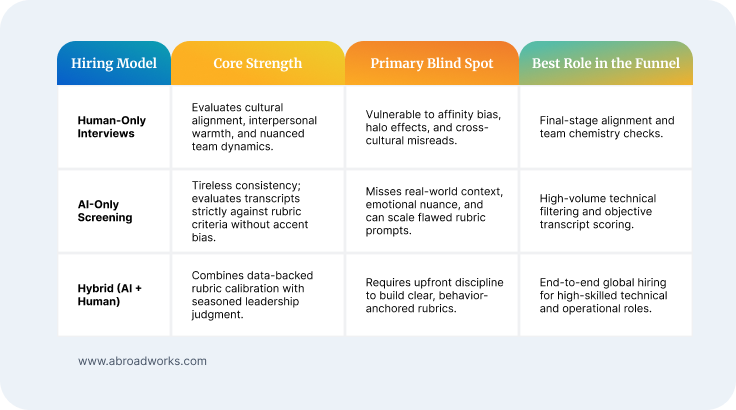
This hybrid model defines the future of global recruiting.
Over the next few years, interviewing won't look like a cold interrogation run by a robotic avatar. Instead, structured video interviews paired with AI transcript and rubric analysis will serve as an objective second data point alongside human interviewers. AI will handle the heavy lifting of pattern-matching, verifying technical depth, and flagging interviewer inconsistencies—freeing human leaders to focus on leadership potential, collaboration style, and final hiring decisions.
For companies hiring offshore talent across IT, engineering, data science, accounting, and operations, that shift levels the playing field. Brilliant global professionals will no longer lose out on opportunities simply because their conversational pacing or cultural background differs from a Western manager’s comfort zone.
Conclusion: Smarter Systems, Better Global Teams
The truly unbiased interview doesn't exist—and pretending our gut instincts are infallible is one of the most expensive mistakes a growing company can make.
Human beings naturally gravitate toward what feels familiar. Left unchecked, that instinct causes businesses to pass over elite international talent while overpaying for local candidates who simply "sound the part."
You cannot engineer human nature out of recruiting, nor should you hand your hiring decisions over to an unchecked algorithm. Instead, the smartest companies build systems that keep human bias in check.
By pairing battle-tested behavioral rubrics and practical skills tests with modern AI acting as an objective second set of eyes, you upgrade human judgment rather than replacing it. You strip away surface-level friction, compare global candidates on hard evidence, and build stronger, higher-performing offshore teams that give your business a lasting competitive edge.