Sourcing Developers Beyond LinkedIn: An AI Playbook for GitHub & Open-Source Repos


Key Takeaways
- Look Beyond Resumes: GitHub contributions offer real evidence of a developer's coding skills and experience.
- Evaluate Actual Work: Review commit history, pull requests, code reviews, and documentation to assess technical ability.
- Use AI for Faster Sourcing: Natural-language AI search makes finding qualified developers easier than traditional Boolean searches.
- Define Technical Requirements: Focus on specific programming languages, frameworks, and architectural skills instead of job titles alone.
- Expand Your Talent Pool: Global sourcing gives startups access to skilled remote developers beyond their local markets.
- Simplify Global Hiring: EOR solutions help businesses manage international contracts, payroll, and employment compliance.
Managing a growing tech team at a startup or small-to-midsize business can quickly turn into a full-time engineering headache. Independent founders and technical leads often find themselves trapped in a frustrating routine—digging through endless, unverified resumes at midnight, trying to decipher whether a candidate's impressive job title actually translates to clean code, and struggling to compete with enterprise salary bids.
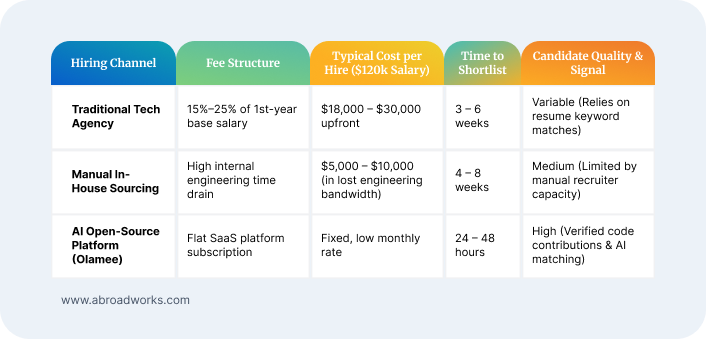
Hiring a traditional technical recruiting agency to take over the search comes at a heavy cost. Agencies often charge 15% to 25% of a developer's first-year base salary. On a software engineer earning $120,000, you could end up handing over $18,000 to $30,000 upfront for a single hire—money that early-stage startups desperately need for product development and runway.
Fortunately, there is a much smarter way to find elite engineering talent without burning your capital or wasting dozens of hours on manual screening. By utilizing a comprehensive github talent sourcing guide alongside modern AI-driven discovery platforms, growing businesses can tap directly into open-source ecosystems, bypass traditional filtering bottlenecks, and scale their engineering teams with absolute confidence.
What You’ll Learn in This Guide:
- The Real Cost Comparison: How agency placement fees stack up against modern AI-driven global sourcing platforms.
- The Developer Sourcing Bottleneck: Why traditional resume platforms fail to surface actual coding competence.
- Open-Source Discovery: How to evaluate GitHub repositories and public code contributions effectively.
- Technical Recruitment Automation: Transitioning from clunky Boolean search strings to natural-language AI prompts.
- The 4-Step Sourcing Playbook: A step-by-step framework to source, vet, and onboard developers efficiently.
- Global Tech Talent Acquisition: Expanding your search across international borders to find elite remote developers.
Why Is Traditional Developer Recruiting Failing Startups and SMBs?
What Are the Limitations of Rigid Keyword Strings and Basic Resumes?
For years, hiring managers relied on static job boards and professional networking sites to find developers. These platforms depend heavily on self-reported keywords, buzzwords, and optimized profile summaries rather than verifiable technical proof. A candidate can easily craft a polished resume filled with trending tech stacks like Rust, Go, or Kubernetes, yet struggle to architect a scalable backend or write clean, maintainable code.
For lean startup teams, filtering through dozens of inflated profiles just to find one qualified candidate wastes precious engineering hours and delays critical product milestones. When recruiters rely strictly on profile text, they often end up competing for the exact same high-profile engineers that enterprise tech giants are targeting with massive cash packages.
Why Do Growing Tech Teams Struggle to Find Pre-Vetted Talent?
Unlike large enterprises with dedicated talent acquisition departments, growing startups operate with lean teams where every hour counts. Engineering leads cannot afford to spend forty hours a week reviewing hundreds of generic applications or conducting initial technical phone screens on under-qualified candidates.
Furthermore, standard recruitment tools offer zero insight into how a candidate collaborates, handles code reviews, or contributes to complex software projects. They show where someone worked, but fail to demonstrate how they work. To break free from the administrative burden of traditional hiring, forward-thinking tech teams are shifting their focus toward code-first sourcing channels.
How Can Engineering Leaders Master GitHub Talent Sourcing?
What Makes Open-Source Repositories a Richer Signal Than LinkedIn?
When evaluating software engineers, actual code speaks louder than any resume summary. GitHub and open-source repositories provide an undeniable, transparent record of a developer's true capabilities, problem-solving style, and architectural patterns.
By examining public pull requests, repository contributions, and issue resolutions, technical leads can see exactly how a candidate writes code, manages version control, and interacts with other developers. This open-source transparency eliminates guesswork, allowing startups to discover high-caliber talent based on real merit rather than keyword optimization.
How Do You Filter Real Technical Competence From Inflated Profiles?
Effective GitHub talent sourcing relies on looking beyond follower counts and examining concrete behavioral signals. To get the highest return on your sourcing efforts, engineering leaders should evaluate three core indicators:
- Commit Cadence & Recency: Active contributors maintain a steady history of commits and code submissions, indicating hands-on development momentum rather than past static achievements.
- Code Review Etiquette: Reviewing how developers comment on pull requests and respond to feedback reveals their communication skills, empathy, and collaborative mindset.
- Documentation Standards: High-performing engineers write clear README files, clean inline documentation, and structured commit messages—proving they build for team maintainability.
Are candidates actively fixing bugs, reviewing code for other maintainers, or building original tools? Reviewing these repositories gives hiring managers an unvarnished look at an engineer's technical depth, consistency, and passion for software craftsmanship.
How Does Natural-Language AI Revolutionize Technical Recruitment Automation?
What Is the Difference Between Boolean Search Strings and AI Prompting?
Traditional technical sourcing required constructing clunky, complex Boolean search strings filled with quotation marks, AND/OR operators, and rigid category filters. If a recruiter missed a specific framework synonym or syntax variation, brilliant engineers remained invisible.
Modern technical recruitment automation replaces rigid syntax with natural-language processing. Instead of wrestling with filters, recruiters can type conversational queries into advanced platforms—such as "Senior Golang engineer with distributed systems experience in Latin America"—to immediately surface matching profiles based on deep semantic understanding.
How Do AI Recruiting Tools for Startups Speed Up Shortlisting?
By leveraging semantic intelligence, ai recruiting tools for startups can instantly parse massive global databases of developers, matching specific project requirements against actual portfolio activity and skills.
This dramatic shift from manual data-mining to AI-assisted curation cuts candidate sourcing time from weeks to minutes. It ensures that lean hiring teams never miss out on hidden-gem talent hiding outside traditional recruitment networks, allowing startups to move at startup speed.
What Are the Core Steps in Executing a GitHub Talent Sourcing Playbook?
Successfully integrating open-source discovery into your hiring workflow requires a structured, repeatable framework.
Step 1: How Do You Define Technical Criteria Beyond Standard Job Titles?
Standard job titles like "Senior Backend Developer" or "Full Stack Engineer" mean completely different things across different companies. Begin your sourcing process by mapping out the exact architectural challenges your team needs to solve.
Translate those engineering requirements into concrete repository tags, specific language frameworks (e.g., Python/FastAPI, Node.js/TypeScript), and infrastructure tools (e.g., Terraform, Docker). This ensures your search focuses on specific technical competencies rather than vague corporate hierarchies.
Step 2: How Do You Deploy AI Prompts to Surface Global Contributors?
Once your technical criteria are defined, leverage AI-powered talent acquisition platforms to search across global developer ecosystems. Instead of manually parsing GitHub user locations and repository stars, input conversational search prompts into your discovery tool.
For instance, prompting an AI engine with "Find active contributors to open-source microservices projects located in South America or Eastern Europe" instantly surfaces candidates with proven code contributions in your exact domain without requiring manual syntax configuration.
Step 3: How Do You Evaluate Code Quality and Repository Activity Efficiently?
When reviewing shortlisted profiles generated by your search engine, perform a targeted evaluation of their public repositories. Look for clean architectural separation, efficient error handling, and robust testing suites.
Pay close attention to how recent their activity is and whether they contribute to recognized open-source libraries or maintain well-structured personal projects. This step ensures that every candidate invited to an interview has already demonstrated production-ready coding standards.
Step 4: How Do You Streamline Outreach and Technical Assessment?
High-performing engineers rarely respond to generic, mass-templated recruiter emails. When reaching out to GitHub candidates, reference specific projects or pull requests they have contributed to, explaining why their specific technical work aligns with your product roadmap.
Once engagement is established, transition candidates into a streamlined assessment pipeline using automated coding evaluations or practical pair-programming sessions to validate their real-time problem-solving ability.
How Does Global Tech Talent Acquisition Tie Into Remote Engineering Scaling?
Where Do Companies Find Top-Tier Remote Software Engineers?
Building a world-class engineering team no longer requires restricting your search to a single local metro area. Emerging tech hubs across Eastern Europe, Latin America, Southeast Asia, and Africa produce thousands of exceptional, highly skilled software engineers every year.
Embracing hiring remote software engineers allows startups to access top-tier technical talent at sustainable compensation levels, giving smaller companies the firepower to compete with enterprise tech giants while dramatically extending their financial runway.
How Do You Handle Cross-Border Compliance and Payroll for Remote Tech Talent?
Once you source and vet an elite international developer, the next challenge is compliant onboarding. Setting up local legal entities in multiple countries is prohibitively expensive and legally complex for growing SMBs, requiring local legal representation, foreign tax registrations, and complex regulatory reporting.
This is where unified global platforms like Olamee bridge the gap. By combining advanced AI candidate discovery with built-in Employer of Record (EOR) infrastructure, platforms allow companies to source, hire, contract, and pay international software engineers seamlessly across 150+ countries without establishing local subsidiaries. The underlying EOR handles local employment contracts, statutory health benefits, regional holidays, and automated multi-currency payroll directly inside the software interface.
Frequently Asked Questions
- Can startups effectively source developers on GitHub without a dedicated recruiter? Yes. Modern AI-powered recruitment tools empower lean engineering leads and startup founders to run professional, targeted sourcing campaigns independently, eliminating the need for expensive external recruiting agencies.
- How does GitHub talent sourcing differ from searching professional networking sites? GitHub sourcing focuses on verifiable code contributions, pull requests, and real-world project history rather than self-reported resume claims and keyword-optimized job titles.
- What role does AI play in automating technical candidate screening? AI streamlines technical recruitment by using natural-language processing to match exact project requirements against global developer profiles, instantly surfacing pre-vetted shortlists and reducing manual filtering overhead.
- How do companies legally onboard international software engineers once they are sourced? By utilizing platforms with embedded Employer of Record (EOR) infrastructure, businesses can legally employ international developers, manage multi-currency payroll, and handle local tax compliance without setting up local legal entities.
Conclusion: Master GitHub Talent Sourcing Playbooks to Build World-Class Engineering Teams
Scaling an innovative tech company requires speed, precision, and smart resource allocation. Relying on static resumes and legacy keyword filters leaves startup engineering leads buried in administrative noise and vulnerable to costly mis-hires.By following a robust github talent sourcing guide framework, leveraging natural-language AI discovery, and utilizing unified global platforms for compliant international onboarding, you can uncover elite developers wherever they code. Stop wasting time on outdated recruitment channels and start building your global engineering powerhouse today.