HR Outsourcing and Staffing: How They Work Together
Key Takeaways
- HR outsourcing manages your existing employees, including payroll, benefits, compliance, and employee relations.
- Staffing outsourcing helps you find new talent, from temporary workers to permanent hires through RPO and staffing agencies.
- HR outsourcing and staffing overlap at recruiting, making integration valuable for growing businesses.
- ASO, PEO, RPO, staffing agencies, and EORs solve different workforce needs, so choosing the right model matters.
- Combining HR and staffing can improve workforce continuity, reduce coordination gaps, and create better visibility into costs.
- The right outsourcing strategy depends on your actual workforce gap, not simply whether a provider offers a bundled solution.
Every company faces two related but separate problems: managing the people already on the payroll, and finding the people it still needs to hire. Most articles on this topic only answer half the question. They explain HR outsourcing (payroll, benefits, compliance) or staffing (recruiting, temp workers), but rarely how the two actually connect.
That's a gap worth closing, because in practice these two functions overlap constantly. A growing company doesn't just need help managing its current team. It needs help finding the next ten people to add to it. Understanding where HR outsourcing ends, and staffing begins, and where the smartest companies deliberately blend the two, makes it much easier to build a workforce strategy that actually works.
What HR Outsourcing Actually Covers
HR outsourcing means handing off the administrative and compliance work involved in managing employees you already have. This typically includes payroll processing, benefits administration, tax filings, workplace safety compliance, and employee relations support.
The two most common models are an Administrative Services Organization (ASO), which lets you pick specific services à la carte, and a Professional Employer Organization (PEO), which takes on most HR responsibilities through a co-employment arrangement and shares some employer liability with you.
Either way, HR outsourcing is fundamentally about the people already inside your company. It answers questions like: How do we pay them accurately? How do we keep their benefits compliant? How do we handle a workplace dispute without exposing the company to legal risk?
What Staffing Outsourcing Actually Covers
Staffing outsourcing solves a different problem entirely: finding people you don't have yet. This includes traditional staffing agencies that supply temporary or contract workers, and Recruitment Process Outsourcing (RPO) providers that manage some or all of your permanent hiring process, sourcing, screening, interviewing, and extending offers.
Staffing answers a completely different set of questions: Where do we find qualified candidates fast? How do we fill a seasonal spike without permanent headcount? How do we hire 20 people this quarter without building an internal recruiting team from scratch?
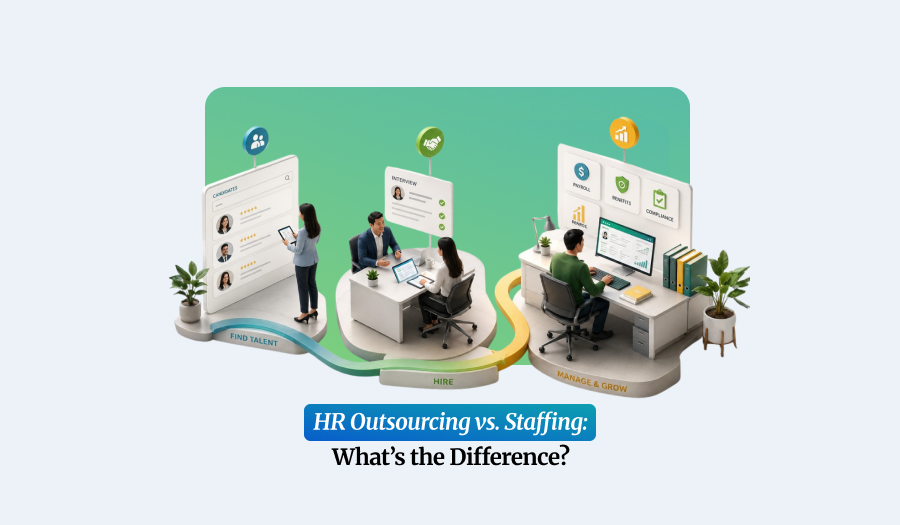
The distinction matters. HR outsourcing manages people already employed. Staffing outsourcing finds and delivers new people. Confusing the two leads companies to hire the wrong kind of partner for the problem they actually have.
Where the Two Overlap
Recruiting is technically the first stage of the employee lifecycle, which means it sits at the boundary between staffing and HR. Some PEOs include light recruiting support as part of a comprehensive package. Some staffing agencies have expanded into offering payroll and compliance services for the temp workers they place, which is a form of HR outsourcing for that specific population.
This overlap is exactly why companies searching for help often end up needing both services at once, even if they started out looking for just one. A company that outsources payroll and benefits to a PEO still needs a way to find new hires. A company that uses a staffing agency for contract workers still needs someone managing compliance for its permanent staff. The two functions are separate, but they rarely operate in isolation from each other.
The Core Models, Side by Side
- ASO (Administrative Services Organization): Handles specific HR administrative tasks like payroll and benefits. You choose the services, and you retain your own employer status and typically your own recruiting function.
- PEO (Professional Employer Organization): Takes on most HR responsibilities through co-employment, sharing liability with you. Often bundles access to better benefits rates than a small company could get alone. Some PEOs offer light recruiting support, but full-scale hiring usually still requires a separate staffing partner.
- RPO (Recruitment Process Outsourcing): Focused entirely on staffing. An RPO provider manages part or all of your hiring process for permanent roles. This does not typically include ongoing HR administration once someone is hired.
- Staffing or Temp Agency: Supplies temporary, contract, or contract-to-hire workers, often employing them directly and handling their payroll and compliance while they're on assignment with you. Best suited for variable or short-term staffing needs rather than permanent headcount planning.
- EOR (Employer of Record): Legally employs workers, often in another country, on your behalf. Useful when you need to hire someone in a location where you don't have a registered business entity. Functions as both a staffing and HR solution for that specific hire.
Why Companies Combine HR Outsourcing and Staffing
The strongest argument for combining these services is continuity. When HR administration and hiring live in separate systems with separate vendors, information gets lost in the handoff. A new hire brought on through a staffing agency has to be manually onboarded into a completely different HR system. Compliance data doesn't transfer automatically. Nobody has a single view of total workforce cost across both permanent staff and contract workers.
A combined approach, whether that's one provider offering both services or two providers who integrate closely, keeps the employee data, compliance records, and cost reporting in one place from the day someone is sourced through the day they leave the company. This matters more as companies scale, since the coordination cost of disconnected systems grows faster than the headcount does.
The financial case is real too. Businesses that outsource HR functions see an average ROI of 27.2%, largely because they spend less managing HR per employee than they would running everything internally. Add a staffing function that shortens time-to-fill and reduces the cost of a bad hire, and the combined savings compound.
When to Keep Them Separate
Combining HR outsourcing and staffing isn't right for every company. If you already have a strong internal recruiting function that knows your industry and culture well, adding an external staffing partner may create more friction than value. In that case, outsourcing just the HR administration, payroll, benefits, and compliance, while keeping recruiting in-house, often makes more sense.
The reverse is also true. A company with a lean but capable internal HR team that just needs help filling roles fast during a growth spurt may be better served by a standalone staffing agency or RPO provider rather than a full HR outsourcing package it doesn't need.
The right call depends on where your actual gap is. Outsource the function that's genuinely straining your team, not both functions by default just because a provider offers a bundle.
How to Evaluate a Provider That Offers Both
If you're leaning toward a combined solution, a few questions separate a genuinely integrated offering from two loosely connected services wearing the same logo.
- Does the same platform track both current employees and candidates in the pipeline? If HR data and recruiting data live in separate systems that don't talk to each other, you haven't actually solved the coordination problem.
- Who's accountable when something falls through the cracks? A new hire's first paycheck being late because staffing and payroll didn't communicate is exactly the failure mode a combined provider should prevent. Ask how they handle the handoff specifically.
- Can they flex between contract and permanent staffing as your needs change? Growth doesn't always look the same six months from now. A good combined provider can move a contract worker to permanent status without restarting the entire onboarding and compliance process.
- What's included versus what costs extra? Bundled offerings sometimes advertise "staffing support" that turns out to be minimal. Get specific about what recruiting activity is actually covered.
The Market Reflects the Shift Toward Integration
This isn't a niche trend. The recruitment process outsourcing market alone is projected to grow from $7.33 billion in 2022 to $24.32 billion by 2030, reflecting how many companies are formalizing staffing as an outsourced function rather than treating it as purely internal work. At the same time, HR outsourcing providers are increasingly building or acquiring recruiting capabilities to meet demand for a more connected service, rather than leaving clients to stitch together two unrelated vendors.
FAQs
- What's the actual difference between HR outsourcing and a staffing agency? HR outsourcing manages employees you already have: payroll, benefits, compliance, and employee relations. A staffing agency finds and supplies people you don't have yet, whether temporary, contract, or permanent.
- Can one provider realistically handle both HR outsourcing and staffing? Yes, and a growing number do, particularly larger PEOs and full-service HR firms that have added recruiting capabilities. The key is confirming the two functions are genuinely integrated on the same platform rather than run as separate services under one company name.
- Is a PEO the same thing as a staffing agency? No. A PEO manages HR administration for your existing employees through a co-employment arrangement. A staffing agency's core business is sourcing and placing workers, often as their direct employer during a temporary assignment. Some PEOs offer light recruiting support, but that's an add-on, not their core function.
- How much does combined HR outsourcing and staffing typically cost? HR outsourcing through a PEO is usually priced per employee per month, often in the range of $40 to $150 depending on services included. Staffing and RPO costs vary more widely, from a percentage of the placed employee's salary for permanent roles to an hourly markup for temporary workers. Combined packages should be priced transparently for each component, not bundled into one opaque number.
- Is combined HR outsourcing and staffing support worth it for a small business? Often yes, specifically because small businesses rarely have the internal capacity to run both a compliant HR function and an effective recruiting process at the same time. A combined provider lets a small team get support on both fronts without hiring dedicated staff for either one, which is usually the more expensive option at that scale.
The Bottom Line
HR outsourcing and staffing solve different problems: one manages the people you have, the other finds the people you need. They're not interchangeable, but they're also not meant to operate in total isolation. The companies that get the most value treat workforce management as one continuous process, from sourcing a candidate to managing their employment to eventually offboarding them, rather than two disconnected functions run by unrelated vendors.
Start by identifying which side of that process is actually causing pain right now. Then decide whether a combined provider, or two well-coordinated specialists, gets you there faster.