Labor Offshoring in the 2026 Discount Economy
Key Takeaways:
- 74% of consumers are switching brands to find better value, making discounts a business necessity.
- Rising domestic labor costs and increasing demand for promotions are creating a severe margin squeeze.
- Offshoring can reduce labor costs by up to 70%, helping businesses maintain profitability.
- Lower operational costs create "profit elasticity," allowing companies to offer aggressive discounts without sacrificing growth.
- Offshore professionals now support high-value functions including marketing, accounting, customer support, and project management.
- Businesses that strategically leverage global talent are better positioned to compete in the 2026 Discount Economy.
In 2026, the American consumer has undergone a fundamental psychological shift. Driven by persistent inflation and economic chaos, the “Discount Hunter” has replaced the “Brand Loyalist.”
Recent data from Capgemini has revealed a stark reality: 74% of customers are now “trading down” or switching brands specifically to find a better value. The voucher is no longer just a seasonal perk – it’s a prerequisite for the “Add to Cart” button.
Businesses are trapped between two stark truths. While shoppers demand 20% to 25% discounts to justify a purchase, domestic operational costs are rising by more than 5% annually.
The math of a purely domestic workforce no longer adds up: for many, it’s becoming a recipe for “discount death,” where every successful sale actually erodes the bottom line.
To thrive in the “Discount Economy,” businesses must do more than just cut prices – they must lower their operational floor.
By strategically integrating offshore professional labor – from marketing and accounting to product and customer support – companies can realize labor savings of up to 70%. This isn’t just about cost-cutting; it’s about creating profit elasticity.
This article explores how leveraging a global workforce provides the financial cushion necessary to offer the aggressive discounts your customers demand while maintaining the healthy margins required to scale.
The Psychology of the 2026 Discount Hunter
We are no longer in the era of “brand loyalty at any cost.” In 2026, the consumer is defined by Strategic Thriftiness. An overwhelming 74% of consumers are actively “trading down” – switching from their preferred premium brands to more affordable alternatives or store brands just to balance their budgets.
The Baseline Expectation: No Promo, No Purchase
The “discount” has evolved from a pleasant surprise into a mandatory prerequisite for the digital checkout. 62% of all U.S. shoppers now refuse to complete an online transaction without first hunting for a promo code or voucher.
The Death of Traditional Loyalty
The modern shopper views value as a form of respect. When a brand offers a voucher, it is perceived as an acknowledgment of the consumer’s economic reality. However, this creates a dangerous “loyalty vacuum.” Consumers are now more loyal to the deal than the logo.
- Over 60% of shoppers report that a 15% discount from a competitor is enough to make them abandon a brand they have used for years.
- This trend is even more pronounced among younger demographics, where nearly 80% of Gen Z shoppers use browser extensions and AI-driven deal hunters to automate discount searches before they hit the purchase button.
The “Affordable Aspiration” Trend
This isn’t just a trend for the budget-conscious either.
High-income earners – those making over $100,000 annually – are among the most aggressive users of digital vouchers. They are leveraging discounts to maintain an “aspirational” lifestyle despite rising service costs across the board. This segment isn’t looking for the cheapest product; they’re looking for the best deal on a quality product.
For a business to survive this brutal landscape, it must find a way to offer these 20% and 25% discounts without eroding its ability to pay its staff or invest in growth.
It’s in this new discount dynamic that the math of domestic labor begins to break down, and labor offshoring starts to shine. By lowering the internal cost of each product, businesses can feed the consumer’s hunger for discounts while keeping their profit margins healthy.
Consumers are increasingly loyal to value rather than brands. Businesses that can consistently offer attractive pricing while maintaining quality are best positioned to win market share in 2026.
The Business Crisis: Why Traditional Margins are Dying
While the consumer’s appetite for discounts has never been greater, the businesses trying to feed the hunger are facing a brutal new reality: the “Margin Squeeze.”
In the current economic climate of 2026, the traditional model of an entirely domestic workforce, while competing on price, has become impossible for many.
The Anatomy of the “Squeeze”
The crisis is driven by two opposing forces. On one side is consumer resistance. Customers are hypersensitive to price hikes; they effectively veto any attempt by a brand to pass on rising costs by simply moving their business elsewhere.
On the other side, businesses are battling rising operational costs. Domestic wages for specialized roles – accountants, virtual assistants, tech support, product support, and marketing managers- have continued to climb, driven by a shortage of local talent and the high cost of living in American urban centers.
2026 operational expenses for U.S. firms have risen by an average of 5.4% in the last year alone. When your costs go up, and your customers demand your prices go down, your profit margin is crushed in the middle.
The Risk of “Discount Death”
For many small- to mid-sized businesses, the knee-jerk reaction to a sales slump is to issue a voucher. However, without lower labor costs, a business could be forced into a phenomenon known as “discount death.”
Consider the math;
- A service-based business has a gross margin of 30%.
- They issue a 20% discount code to keep up with competitors.
- Their remaining margin is now only 10%.
- If their domestic labor costs (payroll, benefits, office space) account for 15% of their revenue, the business is now losing 5% on every single sale.
In this scenario, the more successful the marketing campaign, the faster the business goes bankrupt.
Businesses face growing pressure from both sides: customers want lower prices while operational costs continue rising. Without structural changes, maintaining profitability becomes increasingly difficult.
The Strategic Pivot: Lower the Operational Floor
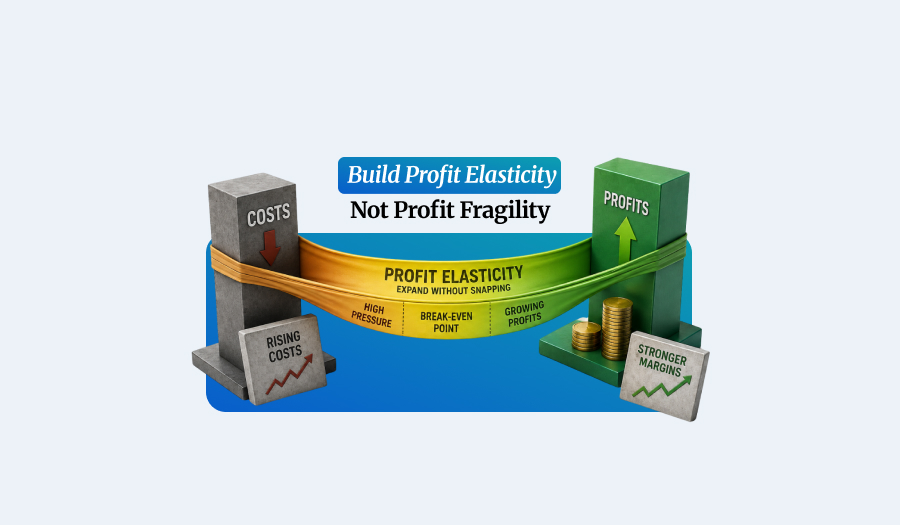
To survive the margin squeeze, businesses must move towards a strategy of “Profit Elasticity”. This involves lowering the “operational floor” – the fixed cost required to keep the lights on and the services running – so that the business remains profitable even when prices are slashed for a promotion.
Defining Profit Elasticity
Profit elasticity is the ability of a business to expand its marketing reach (via discounts) without snapping its financial backbone.
In a traditional high-cost model, your margins are rigid; in a 2026 global model, they are elastic. By integrating offshore labor, your business isn’t just saving, it’s building a buffer that allows you to out-maneuver competitors who are stuck managing higher overhead.
When offshore labor offers a business savings of upwards of 70% on even high-skilled work, the cost of production can be cut by half, turning a 20% discount to the customer from a sacrifice into an investment.
Beyond Production: The “Brain Center” Shift
For decades, offshoring was associated almost exclusively with blue-collar manufacturing or low-level work, but that changed in 2026. The pivot has moved into the company's “Brain Center.” Modern offshoring targets the professional services that drive businesses, including:
- Virtual Assistants – Taking over high-level administrative coordination.
- Accountants & Bookkeepers – Managing a business’s finances from top to bottom.
- Marketers – Executing data-driven campaigns and social media management.
Global education standards have never been higher, and the world has never been more interconnected, giving U.S. employers access to countless new destinations where they can find highly skilled and highly motivated employees who can fill even the most complex roles for less than their domestic competitors.
The Math of Reinvestment
The true power of lowering the operational floor isn’t just about hoarding the savings – it’s about reinvesting.
If a business saves $50,000 a year by hiring an offshore account manager rather than a local one, that $50,000 doesn’t just sit in the bank. It becomes:
- A deeper discount pool – The ability to offer “Free First Month” or “50% Off” vouchers that capture new market segments.
- Higher Ad Spend: The ability to outspend competitors on Google or Meta because the cost of fulfilling the resulting work is lower.
- R&D Capital: Funds to develop new products that keep the brand ahead of the discount-seeking curve.
By lowering the floor, you raise the ceiling. Offshoring provides the leverage necessary to play the “volume game” that 2026 consumers demand, ensuring that your business doesn’t just survive the era of the discount – but thrives because of it.
The most effective response to margin pressure is reducing fixed operating costs. Lowering the operational floor creates flexibility, resilience, and room for sustainable growth.
Role-Specific Impact: How Offshoring Enables Growth
In 2026, relying on global teams isn’t about replacing quality; it’s about optimizing where the heavy lifting happens. By moving specific high-value roles offshore, businesses can create the margin necessary to offer aggressive vouchers without compromising the quality of their output.
Product and Customer Support: Handling the “Promotion Surge”
A major promotion- such as a 30% off voucher – often leads to a massive spike in customer inquiries and technical issues. If a business relies solely on U.S.-based support, it faces a choice: pay for expensive overtime or let customer service quality slip.
By using offshore support teams, a business can have 24/7 coverage for a fraction of the cost.
By using a “follow-the-sun” model, when your U.S. office closes, your offshore team in a different time zone takes over, ensuring that the customers you attracted with your discount are greeted with immediate, high-quality support, protecting your brand reputation during high-traffic periods.
Offshore Marketers: More “At-Bats” for Less Capital
Marketing is the engine that delivers your discounts to the public. However, when a local marketing manager spends 60% of their time on execution tasks like scheduling posts, tweaking ad copies, and analyzing data, the real purpose of marketing, attracting customers, can get lost in the shuffle.
By hiring offshore marketing teams to handle execution, the business can run three times as many campaigns for the same budget. Instead of one local hire, you can afford a three-person offshore growth pod, including a:
- Content Creator to design the voucher graphics.
- An Ad Specialist to manage the PPC spend.
- A Data Analyst to track the ROI of the discounts.
This allows for scaling through volume – you reach more people, offer more deals, and ultimately drive more total revenue into the business.
Offshore Accountants: Protecting the Bottom Line
Accounting is often a business’s highest “hidden” cost. A mid-level domestic accountant can command a salary of $75,000- $95,000, excluding benefits.
By moving bookkeeping, accounts payable/receivable, and tax preparation to offshore hubs like India or the Philippines, a business can reduce its accounting labor costs by upwards of 60%.
These savings directly lower the break-even point of every product sold. When your fixed accounting overhead is cut by half, you can afford to offer a 20% discount on your services and still maintain the same net profit margin as you would with a domestic team.
Management and Project Coordination
A common myth is that management must be local.
In 2026, offshore project managers are becoming the backbone of mid-sized firms. These professionals coordinate between local leadership and offshore teams.
By offshoring the management of various departments, a CEO can reclaim up to 20 hours a week of their own time, allowing them to focus where it matters – on growing the business.
Strategic offshoring allows businesses to scale critical functions, improve efficiency, and support growth while maintaining the financial flexibility needed to compete on price.
Frequently Asked Questions
- Is labor offshoring only about reducing costs? No. While cost savings are a major benefit, offshoring also provides access to specialized talent, increased scalability, extended operational coverage, and greater flexibility for business growth.
- Which business functions are most commonly offshored? Commonly offshored roles include customer support, virtual assistants, bookkeeping, accounting, marketing, graphic design, software development, project management, and administrative support.
- Can offshore employees maintain the same quality standards as domestic hires? Yes. Many offshore professionals possess strong educational backgrounds, extensive experience, and specialized expertise. Success depends on effective hiring, onboarding, management, and communication practices.
- How much can businesses typically save through offshoring? Savings vary by role and location, but many businesses report labor cost reductions ranging from 40% to 70% compared to equivalent domestic positions.
- Is offshoring suitable for small businesses? Absolutely. Small and medium-sized businesses often benefit the most because labor savings can significantly improve cash flow, profitability, and growth potential while reducing hiring constraints.
Conclusion: From Survival to Competitive Advantage
The economic landscape of 2026 has made one thing clear: price is the new loyalty.
As consumers become more adept at hunting for the lowest price point, the businesses that survive will be those that have rebuilt their cost structures from the ground up.
The margin squeeze doesn’t have to be a death sentence. By pivoting to a global labor model, you effectively decouple your ability to compete from the high overhead of domestic-only operations.
Offshoring the “Brain Center” of your business – your accountants, marketers, and support teams – does more than just save money; it buys you the strategic freedom to:
- Absorb the cost of aggressive promotions without dipping into your personal capital.
- Reinvest in growth by scaling your output while competitors are forced to downsize.
- Protect your time so leadership can focus on high-level strategy rather than administrative execution.
In the 2026 Discount Economy, you can’t control the inflation rate or the consumer’s demand for vouchers, but you can control your operational floor.
By embracing a global workforce, you aren’t just lowering costs – you’re building a more resilient, elastic, and profitable future.
The math of business has changed; it’s time to change your equation.
Make the switch to offshore labor today.