AI for Small Business: Is It Worth It?

Key Takeaways
- Most small business AI failures happen because companies adopt tools before fixing their data and workflows.
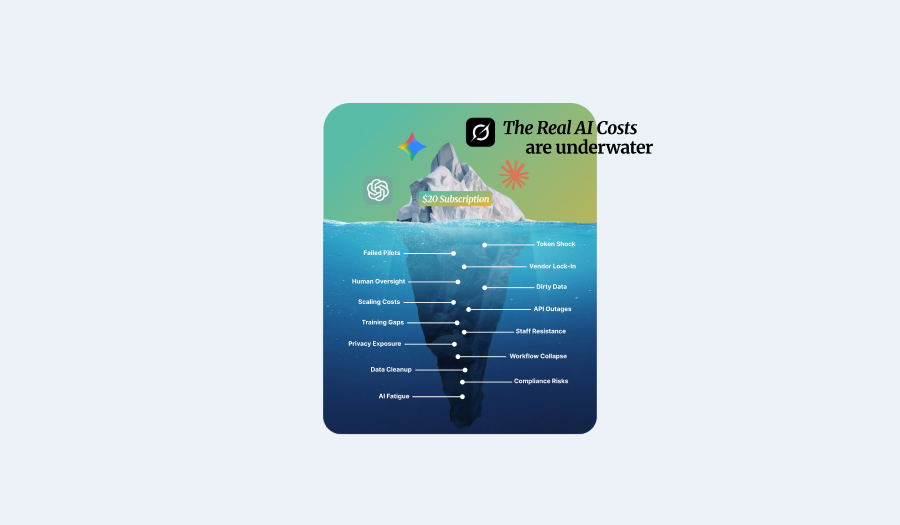
- AI implementation costs often grow far beyond the original subscription price due to training, integration, and oversight.
- The best AI use cases are usually boring back-office workflows, not fully automated sales or customer service.
- A successful AI strategy depends more on human oversight and process design than on the software itself.
- Ignoring AI completely can slowly erode competitiveness, but reckless adoption can damage profitability just as fast.
- The most resilient businesses use hybrid workflows where AI handles speed and humans handle judgment.
Every AI article tells small business owners to adopt. Yet, your survival might actually depend on knowing when to say no.
AI is pitched everywhere: vendor emails, competitor demos, and that teenager next door who believes they’re smarter than all parents combined. The AI market is targeting small businesses specifically—and that targeting isn't a compliment; it’s a business model. The $20 subscription looks small on paper, and the vendor demo makes implementation look effortless.
But behind the slick marketing lies a documented pattern of failure. Most small businesses buy AI for the wrong reasons, before their data is ready, or under the assumption that "Greg from accounting" can handle the integration because he’s "good with computers."
The gap between a working AI system and an expensive subscription that produces nothing isn't a matter of luck—it's a matter of understanding the trap.
Why do 42% of small business AI projects fail?
The marketing brochures describe AI as a plug-and-play productivity engine, yet the data tells a story of systemic failure. Most small business owners treat AI like a consumer app, ignoring the structural requirements that turn a simple subscription into a functional asset. It is not shocking, then, that the 2025 S&P Global Market Intelligence survey of over 1,000 enterprises across North America and Europe found that 42% of companies abandoned most of their AI initiatives in 2025, a staggering jump from just 17% in 2024.
Primary Reasons for Initial Failure
Unsurprisingly, getting the software integrated and running on systems is not the biggest hurdle for businesses. They are built to be intuitive; rather, it's the disorganised data graveyard that decision-makers try to build on. Most small business owners view AI as a magic filter that clarifies chaos. Yet, the reality, Gartner research confirms, is that 60% of these projects collapse due to data management failures. You cannot feed a Large Language Model a decade of siloed, unstructured PDF invoices and expect a coherent financial strategy. When the "brain" is fed garbage, it doesn't just fail; it hallucinates with confidence, burning through your capital in the process. Signing an AI contract before auditing your data hygiene is like buying a Ferrari to drive through a swamp.
Additionally, early onset failure is often baked into the project long before the first line of code is written. 3 other failures stand out beyond data preparedness:
- The Technology-First trap: Founders buy a shiny new tool and then wander around the office looking for a problem to aim at. Something about hammers and everything looking like a nail.
- Wrong Use Case Selection: If your customers are complaining about poor customer service, you don’t throw an AI at the problem. Specifically, the attempt to automate high-nuance tasks that still require human judgment is an example of a poor use case.
- Change Management Failure: Even if the tech works, your staff, if ill-prepared, will treat it like an invasive species. Without a culture that embraces the transition, your expensive new subscription will simply sit dormant, mocked by the very employees it was meant to empower.
Clearing these basic pitfalls ensures that your implementation gets off the ground but does not guarantee that it will stay afloat.
Continuity Failures: Why Successful Pilots Still Collapse
A Ferrari on a racetrack in the hands of a school bus driver is probably not breaking any lap records. Similarly, cutting-edge AI will not achieve much in the hands of people who use it for memes. Data from the T3 Adoption Rubric reveals that successful firms spend $2 to $3 on human talent for every $1 spent on software. Meaning, the biggest expense in integrating AI is not the subscription, but the skilled labour required to get the best out of the latest tools. Businesses discover this well after they have signed a long-term subscription agreement, but if you do not fund the driver, your high-performance racecar will never leave the garage. Ultimately, abandoning the human element is not a cost-saving measure but a common pathway to failure.
Another pitfall that results in unexpected failure is the reality of a single proprietary API without a redundancy plan. For a small enterprise, it is operational suicide. When you outsource your core logic to a single vendor, you are essentially handing them the keys to your profit margins. A sudden pricing spike or a service outage from a dominant provider can trigger an immediate collapse of your automated workflows. Small businesses often lack the technical depth to pivot overnight, making "single-threaded" operations a terminal vulnerability. True resilience requires a model-agnostic approach that prioritizes data portability over vendor convenience.
The Failure Timeline: Financial Landmines and the 90-Day Wall
Finally, the most seductive lie in the AI market is the low-cost barrier to entry. Most founders sign up for a $20 monthly subscription, thinking they’ve solved their productivity bottleneck for the price of a lunch. However, mid-implementation reality hits like a sledgehammer when you realize that the software is useless without a custom-built data pipeline. By the time you’ve accounted for data cleaning, employee training, and technical oversight, that $20 line item has mutated into a five-thousand-dollar pilot reality. If you haven't budgeted for this sudden shift from "consumer app" to "enterprise project," your implementation will die on the vine before it generates a single dollar in savings.
Even if you survive the initial setup costs, the 90-day wall presents a lethal hurdle known as "Token Shock." As your staff begins to rely on the automated workflow, usage-based billing can spike your expenses by 200% to 500% almost overnight. This AI cost crisis usually surfaces just as your initial pilot funding runs dry. Without specialized small models or strict usage caps, the very efficiency you bought starts to cannibalize your remaining profit margins. Most small businesses don't fail because the AI doesn't work; they fail because they simply cannot afford the price of its success.
Given such a treacherous map and fine margins between failure and success, is it critical to understand the cost of standing still in a fast-moving environment.
Is Ignoring AI a Risk to My Business Survival?
The debate over AI adoption is often framed as a simple choice between innovation and stagnation, but the reality is a calculated trade-off between two distinct possible types of failure. Choosing to stand still offers a reprieve from implementation chaos but invites a silent, compounding erosion of market share that is eventually impossible to reverse. Understanding the strategic landscape requires balancing the harsh laws of economic displacement against the very real danger of chasing technological mirages. It is critical to determine if AI hesitation/rejection is strategic caution and a valid defensive maneuver or a slow-motion surrender to more agile competitors.
Early Adoption of AI: Moving Fast v Moving Right
Business competition is rarely a sprint; companies that die out often experience a gradual erosion of operational margins amidst resistance to change. “This is the way we built the business, this is how we will survive” - not with fax machines and ballpoint pens, you won’t. The Hicks-Marshall law suggests that when a competitor achieves a structural efficiency gain, the market does not shift overnight, but the outcome becomes mathematically inevitable. As rivals use AI to slash lead response times or personalize client outreach, traditional, manual processes become increasingly decoupled from the industry standard. By the time the "wait and see" crowd recognizes the threat, the early adopters have already captured the high-intent traffic and optimized their unit economics. Ignoring these early signals isn't prudent caution; it is a terminal competitive delay that makes your business a historical footnote.
Conversely, speed without a stable technical foundation is just a faster way to hit a financial wall. The history of technology is littered with the corpses of "first movers" who rushed into half-baked ecosystems. To this day, there are investors, brands, and consumers who invested in real estate within the early Metaverse only to lose billions in unrecoverable capital. In the small business sector, the goal is not to be the first to adopt a tool, but to be the first to make it profitable within a functional workflow. Meticulous leaders are currently watching the reckless pioneers burn through their budgets while they wait for the technology to reach a survivable equilibrium. Strategic superiority belongs to those who prioritize operational maturity over the ephemeral hype cycles currently dominating the headlines. In light of this, it’s unclear what the right pathway for any individual business is, as there is contradicting evidence.
Competitive Erosion vs. Human-Certified Service
Take customer service as an example. Speed is no longer a luxury; it is a baseline expectation that dictates client loyalty in the modern economy. When your competitors utilize AI to resolve complex inquiries in seconds while your team takes hours to respond, you are not merely "traditional"; you are becoming a dinosaur. According to documented risks of ignoring AI, 30% of firms that delayed adoption report losing clients to faster, more personalized competitors. This erosion is not a singular event but a compounding loss of high-value accounts who prioritize immediate responsiveness over your legacy processes. Choosing to ignore the speed advantage of automation is a strategic decision to hand your most impatient, high-value clients directly to your rivals.
Conversely, as the market becomes saturated with robotic and generic interactions, a distinct counter-movement is gaining traction among premium consumer segments. There is a measurable "AI fatigue" occurring, where customers are actively seeking out businesses that guarantee an authentic human connection. Positioning your business with a "Human-Certified" brand identity allows you to transform your lack of automation into a high-value differentiator. This strategy works best in high-trust industries where nuanced judgment and empathy are more valuable than pure processing velocity. The strategic challenge is identifying whether your specific client base values the frictionless speed of a machine or the expensive, nuanced care of a human professional.
Two Types of Failure: Pick Your Poison
Choosing to ignore AI is not a neutral act; choosing to wait for the right moment to get on the bandwagon is not riskless either. It could be a wise decision that spares your business from flushing capital down a dead end. In an increasingly competitive global market, that could be the difference between survival and bankruptcy. Alternatively, it could be a commitment to a gradual liquidation of your market share. While you avoid the headaches of a messy implementation, you may be simultaneously ceding a 2.2 percent revenue lift that automated competitors are already harvesting every six months.
The job of a business owner is to determine which path is survivable. An annual erosion is a silent killer because it does not show up as a catastrophic event on your balance sheet until the gap becomes unbridgeable. Just ask BlackBerry in the wake of touchscreen technology. By the time you feel the effects of being out-scaled and out-priced, your business has already become a hollow shell of its former self. In the same vein, ignoring an emergent technology to focus on a comparative advantage may be considered a stroke of genius in hindsight, as demonstrated by Anthropic, which comfortably ignored video generation tech, while apps like Sora bloomed in 2025. We recently buried Sora, it will not be missed.
Similar to the terminal threat of market share erosion, a failed AI implementation could be equally terminal, particularly if locked into long-term AI service agreements or if the business has thin operating capital or margins. Conversely, a failed AI project could be a tactical wound, entirely survivable because your losses are limited to the money you poured in plus any contract release clauses. Spending $5,000 on a pilot that goes nowhere is a contained, one-time expense that provides you with valuable data on your operational weaknesses. You might lose a small amount of capital, but you retain your client base and your brand's integrity.
In other words, the risk of a sunk cost in an AI pilot program, when compared to the risk of a lost market due to stagnation, is not clear-cut. Savvy founders may have to accept that high-reward experimentation requires a willingness to absorb minor, localized failures to avoid a systemic collapse. There are a lot of "depends" when it comes to ignoring AI; as such, it is critical to understand the capabilities and limitations of AI.
What can AI actually do for my business? (Beyond the Sales Pitch)
Moving past the vendor hyperbole requires a pivot from viewing AI as a "visionary" replacement of personnel or established systems. While the market obsesses over AI sales agents that cannot calibrate trust, the actual profit is hidden in the mundane compression of eighteen-hour workflows into minutes. AI is no digital messiah and, like yet another anti-hero, it has a dark side.
Adverse AI Impact: Client-facing Communication and Business Continuity
We’ll start with the bad news, and nowhere is it more obvious than in high-stakes sales environments that demand a physiological and psychological synchronization that silicon cannot replicate. While a Large Language Model can generate a persuasive script, it is fundamentally blind to the micro-hesitations and non-verbal cues that signal a prospect's true objection. This "trust calibration" remains the final barrier to full automation, as closing a deal or addressing an irate customer often requires an intuitive pivot that relies on emotional intelligence rather than data processing. Outsourcing your client-facing integrity to a bot is a high-risk gamble that ignores the biological reality of trust. If your business model depends on nuanced relationships, removing the human element doesn't just lower costs; it destroys your conversion rate.
The less obvious is the AI threat to business continuity. The rush to automate entry-level tasks is creating a structural "youth squeeze" that threatens the long-term viability of small businesses. By delegating the "boring" foundational work to AI, companies are inadvertently dismantling the very training grounds required to develop future senior leaders. Skill acquisition in B2B environments typically happens through the high-volume repetition of basic tasks, where junior staff learn the industry's social nuances. When these roles are deleted, the pipeline for experienced management vanishes, leaving the firm with a massive internal talent deficit in five to ten years. You are essentially trading your future leadership capacity for a marginal increase in today's quarterly efficiency. But that’s fine, because, for a higher tier of subscription, you can hire an AI CEO to oversee your AI management team that runs the agent swarms at the bottom of the totem pole.
Operational Excellence: The Back-Office ROI
Regardless, there is undeniable progress, particularly with agentic AI. Most small business owners chase the "visionary" use cases like AI sales agents, yet the real profit is hidden in the mundane, back-office sludge. Marketing operations and automated data entry represent the most efficient path to solvency, yielding a three hundred percent ROI for those who prioritize infrastructure over optics. While your competitors are still debating prompt engineering for LinkedIn posts, successful firms are using these tools to compress eighteen-hour workflows into minutes. Data from the T3 Adoption Rubric confirms that these "boring" deployments achieve a full payback in approximately 2.5 months. By the time the hype-chasers realize their sales bots can't close, the back-office optimizers have already cleared their implementation costs and are harvesting pure margin.
Achieving operational excellence requires recognizing exactly where the machine’s "intelligence" ends and your professional liability begins. Total automation is a fantasy that often results in "High-Anxiety" failure points, particularly within legal compliance and high-value invoicing workflows. A single automated hallucination on a seven-figure invoice can trigger a liquidity crisis that no subscription tier can resolve. This is why a permanent "Human in the Loop" is not a bottleneck but a mandatory insurance policy against catastrophic system output. Smart integration involves utilizing AI for the heavy lifting of data throughput while reserving human judgment for final verification. Failing to maintain this guardrail turns your efficiency gains into a ticking time bomb of unvetted errors.
The Hybrid Workflow: Scaling Without Losing the Soul
The most resilient business models in the AI era don't aim for total replacement; they aim for a lopsided, 80% efficiency gain where the machine performs the manual labor. This hybrid approach allows the AI to handle the massive volume of data processing and drafting while human staff focus exclusively on high-value refinement. By separating throughput from judgment, you effectively turn your team into a series of "editors-in-chief" rather than entry-level researchers. This is the difference between a pilot program that survives and one that collapses under the weight of unvetted errors. Successful founders realize that the machine's speed is only an asset if it is governed by an expert's final signature.
Furthermore, in a marketplace increasingly flooded with generic, synthetic content, there is a mounting economic premium on a "Human-Certified" seal of approval. Positioning your firm as AI-powered but human-led allows you to harvest the speed of automation without sacrificing the client's hard-won trust. This strategy requires a transparent commitment to using AI for throughput while publicly maintaining human accountability for every strategic output. Clients are willing to tolerate the efficiency of a machine if they know a sentient professional is ultimately responsible for the results. Failure to maintain this distinction turns your brand into just another faceless commodity in a race to the bottom.
Is Your Business Actually Ready: A SMME AI Adoption Rubric
Do not mistake a decision to adopt AI for a commitment to progress; it's a high-stakes bet on your business's structural integrity. Before you sign a vendor agreement, you must audit your operational reality against this SMME Adoption Rubric to ensure you aren't just buying a faster way to fail. The industry is littered with founders who mistook a slick demo for a functional system, only to be crushed by the "Token Shock" of uncurated scaling. This rubric is your final filter, designed to separate genuine readiness from technological impulse. If you cannot answer "yes" to every point below, your pilot is a financial time bomb waiting for a reason to detonate.
- Do you have a named bottleneck? You can identify a specific task consuming 10+ hours/week.
- Is your data "Human-Clean"? A human can find any client record in 30 seconds. If they can't, the AI will just hallucinate through the mess.
- Have you budgeted for the $3 Multiplier? You have $3 ready for human implementation for every $1 of software.
- Is there a "Human-in-the-Loop" fallback? You have a plan for when the API goes down or the pricing spikes.
- Do you have a named Deployment Specialist? One person is accountable for the success of this integration.
- Is your data portable? You have a verified method to extract your source data in twenty-four hours if your vendor spikes their pricing.
- Do you have a "Privacy-Lock"? Your subscription level explicitly prohibits the provider from using your sensitive client data to train their public models.
- Is there a technical "Kill Switch"? You have a documented manual workflow that allows operations to continue the moment the external API fails.
Frequently Asked Questions (FAQs)
- Is my data safe with these AI companies? Most enterprise-tier subscriptions ($20+) have "Opt-out" clauses for data training, but for sensitive industries (HIPAA/GDPR), you may require a private instance or specific compliance wrappers.
- Which AI model is the "best" one to use? There is no single winner. The "best" model is the one that has the most reliable API for your specific use case. Most successful firms use a "Model-Agnostic" approach to avoid vendor lock-in.
- How long does it actually take to see a return on investment (ROI)? For successful Marketing Ops deployments, the average payback period is approximately 2.5 months. If you haven't seen an efficiency gain by Day 90, your implementation has likely hit the "Failure Wall."
- Can I just let my current IT guy handle the AI integration? Only if they understand your business workflows. AI integration is 20% technical and 80% process design. If they can't map your sales funnel, they shouldn't be building your AI.
- What happens if the AI vendor goes out of business? This is why "Single-Threaded Vulnerability" is a risk. Always maintain a "Human-in-the-Loop" fallback and keep your source data in a neutral repository (like a standard SQL database or CRM) rather than inside the AI tool itself.
- Who is legally liable if my AI provides incorrect advice or data to a client? Legally, the accountability resides entirely with your business, not the software provider or the model itself. Most AI vendors include ironclad indemnification clauses that protect them from your operational failures. If your bot hallucinates a legal requirement or a financial projection, you are the one facing the malpractice suit or the regulatory fine. You must treat AI output as raw, unverified data until a sentient professional signs off on its accuracy.
- Where do I actually find the specialized global talent mentioned in the roadmap? Finding an AI-literate integrator at an SMME price point requires bypassing domestic high-cost markets in favor of technical hubs in the Philippines or South Africa. You aren't looking for a "prompt engineer"; you are looking for a business process specialist who understands how to map logic to APIs. These specialists are best sourced through niche global hiring platforms or specialized BPO firms that focus on technical augmentation. Paying a domestic premium for a role that can be handled globally is a strategic error that breaks your implementation budget.
- Do I need to worry about upcoming government AI regulations as a small business? While most headlines focus on enterprise giants, small businesses are increasingly being caught in the crosshairs of data privacy and AI transparency laws. Compliance requirements like the EU AI Act or California’s privacy mandates often apply to any firm processing consumer data, regardless of employee count. Ignoring these regulatory shifts creates a "compliance debt" that can lead to massive fines or forced system shutdowns during an audit. Proactive leaders integrate "Privacy-by-Design" principles today to avoid the expensive, reactive re-architecting of their systems tomorrow.
The Bottom Line: Your Roadmap to Readiness
Mapping the High-ROI Bottlenecks
Don't fall for the trap of searching for a "game-changer" that promises to revolutionize your entire industry. Instead, conduct a ruthless audit of your back-office and identify the specific tasks draining ten or more hours per week. These high-friction bottlenecks are where your AI implementation will actually survive the 90-day wall. Starting with marketing operations and automated data entry ensures a rapid return on investment that offsets the initial technical debt. By focusing on these mundane drains, you secure a two-month payback period rather than a multi-year speculative loss.
Navigating the Global Talent Market
The domestic math for AI implementation is fundamentally broken for the average small business. Paying a six-figure salary for a local integrator to oversee a twenty-dollar subscription is a fast track to project abandonment. To satisfy the mandatory "$3 human multiplier," you must look toward the global labor market for specialized technical oversight. Technical specialists in markets like the Philippines or South Africa allow you to fund the necessary human element for ten dollars per hour without cannibalizing your operational margins. This global pivot is the only way to scale your throughput while maintaining the human-in-the-loop accountability required for high-stakes workflows.
Data Hygiene Before Subscriptions
Your first step toward AI readiness is not a vendor demo; it is a thirty-day commitment to aggressive data hygiene. Before committing to a long-term subscription, you must ensure that your internal records are "Human-Clean" and accessible in under thirty seconds. Attempting to automate a chaotic data graveyard will only result in confident, high-speed hallucinations that degrade your brand integrity. Run a manual trial of the target workflow to identify the logic gaps that the machine will inevitably encounter. Only once the manual process is bulletproof should you introduce the usage-based billing risks of a formal AI pilot.