Admin Assistant vs Executive Assistant: What's the Real Difference?

Key Takeaways
- Admin assistants support an entire team, while executive assistants support one senior leader.
- Executive assistants work more strategically, while admin assistants focus on operational tasks.
- EAs often make independent decisions, while admin assistants typically follow set instructions.
- Executive assistants handle higher-stakes work like board prep, travel, and stakeholder communication.
- Admin assistant roles are usually entry-level, while EA roles require more experience and responsibility.
- Choosing the right role depends on whether you need general office support or executive-level leverage.
These two job titles get mixed up all the time as both involve scheduling, communication, and keeping things organized. But the difference matters a lot whether you are trying to hire the right person or figure out which career path fits you best.
Here is a clear breakdown of what each role actually does, where they differ, and how to decide which one you need.
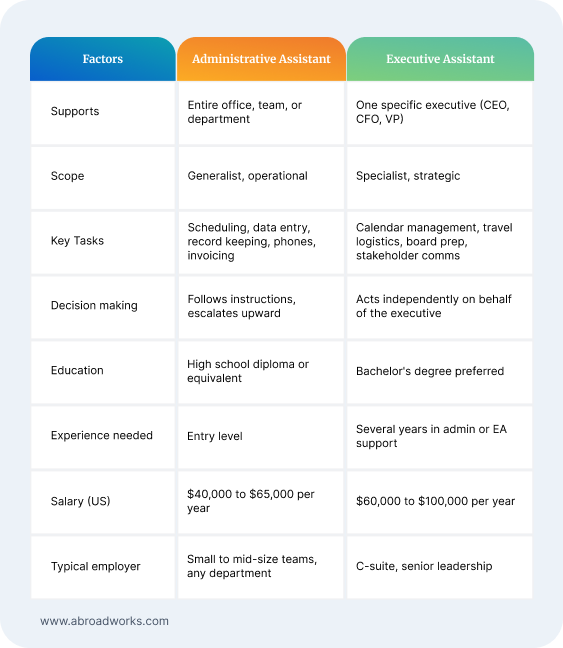
Quick Comparison Table
What Does an Administrative Assistant Do?
An administrative assistant’s job is broad; they keep the office running and support an entire team, department, or office rather than a single person.
Day to day, you can expect an admin assistant to handle:
- Answering phones and managing inboxes
- Scheduling meetings and booking conference rooms
- Data entry and maintaining records
- Processing invoices and basic bookkeeping
- Ordering office supplies and managing vendors
- Drafting correspondence and preparing reports
- Onboarding support for new staff
Admin assistants handle what needs to get done across the board. When someone in the office needs help with a task, the admin assistant is usually the first call.
Most admin assistant roles require a high school diploma or equivalent; some employers prefer an associate degree or administrative certification, but entry into the role is generally accessible. In the US, admin assistants earn between $40,000 and $65,000 per year, depending on industry and experience.
What Does an Executive Assistant Do?
An executive assistant’s role is more strategic, and they work directly with one person, usually a C-suite leader like a CEO, CFO, or VP.
Where an admin assistant keeps things running for a group, an executive assistant acts as an extension of the executive they support. They think ahead, anticipate problems, and often make decisions on behalf of the person they work with.
An executive assistant typically handles complex calendar management and prioritization, as well as:
- Travel planning and logistics, including international trips
- Preparing board materials, presentations, meeting notes, and briefings
- Managing relationships with stakeholders, investors, and partners
- Screening and drafting high-level correspondence
- Tracking projects and following up on behalf of the executive
Executive assistants need strong judgment and discretion as they work closely with senior leadership, often have access to sensitive information, and represent the executive in communications.
Most executive assistant roles prefer a bachelor's degree, and the salary range reflects the higher level of responsibility. In the US, executive assistants typically earn between $60,000 and $100,000 per year. In major cities or large corporations, total compensation can be higher.
Key Differences Between Admin and Executive Assistants
Here is where the two roles differ the most:
Who they support
Admin assistants serve a whole team or department, whereas executive assistants serve one person. That single difference shapes almost everything else about the role.
Scope of responsibility
Admin assistants handle operational tasks that keep the office functional, while executive assistants take on more important work that directly affects how a senior leader performs. They manage priorities, filter information, and protect the executive's time.
Decision-making authority
An admin assistant follows clear instructions and escalates decisions upward. An executive assistant often makes calls on their own as they know the executive's preferences and priorities well enough to act without checking in every time.
Relationship to the business
Admin assistants are internal-facing. Executive assistants are often the face of the executive to the outside world. They communicate directly with board members, clients, and external partners.
Required experience and education
Admin assistant roles are often entry-level, whereas executive assistant positions require years of experience. Many EAs started as admin assistants and moved up after proving they could handle more complex work.
Stress level and pace
Both roles can be demanding, but in different ways. Admin assistants manage volume, executive assistants manage complexity and urgency. When an executive is traveling, in back-to-back meetings, or handling a crisis, their EA is managing everything that would otherwise fall through the cracks.
Skills That Overlap
Both roles share a core set of skills:
- Organization: Both admin and executive assistants require strong systems as they manage multiple priorities at once.
- Communication: Written and verbal communication matters in both roles. You will draft emails, take messages, and coordinate with people across the organization.
- Technology: Proficiency with tools like Microsoft Office, Google Workspace, and scheduling software is expected in both positions.
- Discretion: Both roles involve access to internal information; knowing what to keep confidential is part of the job.
- Problem-solving: Both roles require calm, quick thinking when the unexpected happens.
Which Role Is Right for Your Business?
If you run a small team and need general support, an admin assistant covers most of your needs. If you are a founder, CEO, or senior executive spending too much time on emails, scheduling, travel, and follow-ups, you need an executive assistant. The right EA can free up several hours every week and help you operate at a higher level.
Some businesses start with an admin assistant and later add an executive assistant as the leadership team grows, while others bring in an EA from the start because the executive's time is the primary bottleneck.
Think about where your current support gaps are. If the problem is that general office tasks are falling through the cracks, that is an admin assistant problem. If the problem is that your CEO is buried in logistics and cannot focus on strategy, that is an executive assistant problem. The two issues are different and require different solutions.
One thing to avoid: hiring an admin assistant and then expecting executive assistant-level work. If you need someone to act as a strategic partner to senior leadership, budget for that role properly.
FAQs
- Is an executive assistant higher than an administrative assistant? Yes, executive assistants take on more responsibility, support more senior staff, and typically earn more. That said, the title alone does not tell the full story since experience and company size both affect where roles actually sit.
- Can one person do both jobs? In small businesses, one person often handles both, but as the company grows, these functions usually split. Keeping them combined for too long typically means one area suffers.
- What qualifications does an executive assistant need? Most roles require a few years of relevant experience, and a bachelor's degree is common, though not universal. Strong candidates bring excellent judgment, clear communication, and comfort working with ambiguity.
- What is the difference in salary between an admin and an executive assistant? Admin assistants in the US earn between $40,000 and $65,000 per year, while executive assistants earn between $60,000 and $100,000. The gap reflects the higher responsibility, access, and trust the EA role requires.
- Which role is harder to hire for? Executive assistants, by a wide margin. Finding someone with the right mix of technical skills, emotional intelligence, and discretion is genuinely difficult, which is part of why virtual EA services have grown so quickly.
Career Path: Moving from Admin to Executive Assistant
Many executive assistants started out as admin assistants. The move requires judgment, reliability, and the ability to handle high-stakes situations without someone looking over your shoulder.
If you are an admin assistant looking to move into an EA role, focus on building relationships with senior staff, volunteering for complex projects, and learning the business well enough that you can anticipate what leadership needs before they ask. When executive support needs come up, you want to be the obvious internal candidate.
Pay attention to how senior leaders communicate, notice what they prioritize, and what drains their energy. The best executive assistants understand the person they support well enough to protect their time, filter distractions, and flag what actually matters.
Professional certifications can also help. Organizations like the International Association of Administrative Professionals (IAAP) offer credentials that signal your commitment to the field. Some executive assistants also pursue project management training, since a significant part of an EA role involves tracking deliverables and keeping initiatives moving without formal authority over the people involved.
The jump from admin to executive assistant does not always happen at the same company. Sometimes the fastest path is to build your skills in a junior admin role, then apply for an EA position elsewhere where your experience is valued at the right level.
Both roles are valuable and require real skill. Treat these roles as interchangeable, and you will either overpay for work that does not need it or underpay for support that deserves more, so know what you need before you hire and where you want to go before you decide where to start.