Y2K 26 Years Later and the Rise of Indian Offshore Labor in the US

Key Takeaways:
- The Y2K bug created an urgent global labor crisis with a fixed deadline
- Offshore hiring, especially in India, became the fastest and most viable solution
- India’s talent pool, English proficiency, and legacy programming skills made it uniquely positioned
- Y2K accelerated infrastructure, telecom, and offshore delivery models years ahead of schedule
- Modern offshore workflows, documentation standards, and 24/7 teams trace back to Y2K
- Offshore labor shifted from a temporary fix to a long-term growth strategy
26 years ago, the world faced a problem it had never seen before. Software had already been integrated into almost every aspect of our world, but brewing within it all was a bug that threatened to crash the economy, a bug still remembered simply as “the Y2K bug.”
In the late 90s, businesses found a novel solution to a unique and unexpected problem: offshore labor over local labor.
To address the Y2K bug, businesses turned to the then-lesser-known Indian tech industry for the help they needed. Y2K, though, was just the beginning. Following offshore labor trends, the tech industry realized it could outsource to India - and India began its rise from a lesser-known region to an absolute behemoth.
As the new year begins, businesses are bound to face new challenges. Just as offshore labor was the solution to the Y2K bug, businesses can and should continue to look to offshore labor to solve their own bugs today. Just as Y2K reshaped labor offshoring, the challenges we face today will continue to reshape it.
Y2K – The Bug that Started the Offshore Boom
A Simple Problem with Big Consequences
So, what exactly was the Y2K bug?
For many of us who aren’t entirely familiar with the nuances of computer programming, the Y2K bug was a byproduct of a mathematical error caused by computers being “short-sighted” about the calendar.
In the 1960s, 70s, and 80s, computer memory was incredibly expensive. Any and every byte of data that could be spared was. When it came to dates, software designers took an obvious shortcut. Instead of writing the whole year, they’d simply use the last two digits. Instead of 1975, programmers would write 75, and rather than 1999, they would write 99.
This memory-saving method worked to a T – until the year 2000 approached. Computers weren’t programmed to understand the “20” at the beginning of the year, so when the clock struck midnight on January 1, 2000, computers would see the year as 00.
For computers that rely on dates and times for calculations, this simple bug could spell disaster. A safety system could automatically shut off as a precaution if it assumed that the last safety check was in 1900, rather than 1999. Interest rates could be miscalculated. Even GPS and navigation systems could produce errors.
A simple little bug that couldn’t see the 19 or the 20 in a year could have spelled disaster for billions of people.
A Not So Simple Fix
The problem sounded simple enough, and the solution seemed obvious – just add the first two digits to every year. But as is often the case, such a solution is far easier said than done.
The dates that needed to be updated were often buried in millions of miles of code across millions of systems spread across the entire planet. Every elevator, traffic light, hospital record, and bank vault would have to be checked manually for the error – an immense undertaking.
But the obstacles didn’t just end with a giant game of finding needles in haystacks. Much of the code being sifted through was extremely dated, even by the standards of the late 90s. Many global banking and aviation systems were written in COBOL, a language that had been largely abandoned.
The one looming reality of the Y2K bug was that solving it came with a hard deadline – January 1, 2000. Businesses needed to move, and they needed to move fast.
Most businesses realized that their in-house teams were too small, no one was particularly familiar with COBOL anymore, and the original developers had retired or moved on.
Y2K quickly turned from a technical issue into a labor crisis.
The Offshore Labor Solution
Desperate for solutions, businesses found an answer – offshore labor. Specifically, offshore labor in India.
Tech businesses have been working with Indian talent since the 60s, so there had been some presence in the nation for a long time, but even by the mid to late 90s the country wasn’t much of a destination for labor offshoring. Businesses at the time didn’t necessarily trust offshore destinations with their products, and India’s infrastructure lagged behind.
The de facto way of thinking by the late 90s was that software was developed and managed in the United States and other Western Nations, and that other countries, such as India, might lend support or expertise in specific regions.
While not yet popular, India had a lot going for it. To this day, India maintains a massive English-speaking population. Even in the 90s, they had one of the best higher education systems in the world, and today India’s universities are highly regarded internationally. Above all else, India offered a large and educated labor force that, owing to a lower cost of living and favorable exchange rates, enabled wages to be significantly lower.
When Y2K started knocking at the world’s door, India offered even more unexpected advantages. Top-tier Indian engineering colleges and private institutions continued to teach older programming languages such as COBOL well into the late 90s.
Tech Takes the Offshore Leap
The Offshore Hiring Problem
Western companies were quick to see the advantages of India as an offshore labor destination. The variables lined up just as needed, but finding the destination was the easy part.
The large-scale hiring required to address the Y2K bug was neither elegant nor sophisticated. Many firms simply turned up the dial on their preexisting vendor relationships or issued massive contracts to whatever Indian service firms they could find.
“We need 500 programmers by next quarter” became a common refrain among tech companies and Indian service providers.
Large offshore labor firms became Y2K factories, recruiting aggressively from local universities or retraining engineers from other disciplines. For many workers, Y2K was their first exposure to multinational corporate work and their first time touching vital Western systems.
The Infrastructure Revolution
Hiring the workers was part one, but actually getting them the data proved to be just as big a challenge.
In the late 90s, internet bandwidth was limited, secure data transfer was expensive, and the cloud didn’t even exist. So, companies began relying on dedicated lines, private satellite links, and even the literal shipping of tapes and disks.
The new load forced India to upgrade its infrastructure well ahead of schedule.
Telecoms were expanded, power infrastructure was expanded and made more reliable, and customs and port inspections were streamlined to speed up hardware imports. None of these were abstract policy ideas, but were very practical responses to the need to move data reliably into and out of the country at speed.
India even went so far as to create dedicated software technology parks to concentrate its resources, ensuring the fastest internet speeds, the most reliable telecom lines, and the most reliable power where they were needed most.
The financing and implementation of this endeavor fell heavily on multination companies, but the Indian government paved the way. They reduced red tape and created tax incentives, all to encourage a large-scale infrastructure buildup.
Offshore Innovations
While the dynamics of hiring took some major steps forward, and infrastructure expanded rapidly to keep pace, the real innovation happened with the actual working models used.
Most of the innovation seen during the chaos was not a byproduct of strategy, but rather necessity, and the results have since become the standard in tech offshoring.
Businesses knew that they couldn’t just “hand off” entire systems to offshore teams. All software needed to be split apart so that it could be picked apart by offshore workers. Responsibilities needed to be extremely narrow in scope, and any engineering nuances needed to be turned into purely checklist-driven tasks.
Software was often shipped overseas in batches. Workers would then go over it line by line for errors before fixing, testing, and documenting it. This simple task-based model became the foundation of offshore delivery frameworks.
Throughout the entire process, documentation was extremely strict, turning from a convenience into a survival mechanism. Offshore teams couldn’t always be easily reached, and the knowledge of the original software developers had long since faded. What resulted was an extremely rigorous system of standardization, including logs and naming conventions.
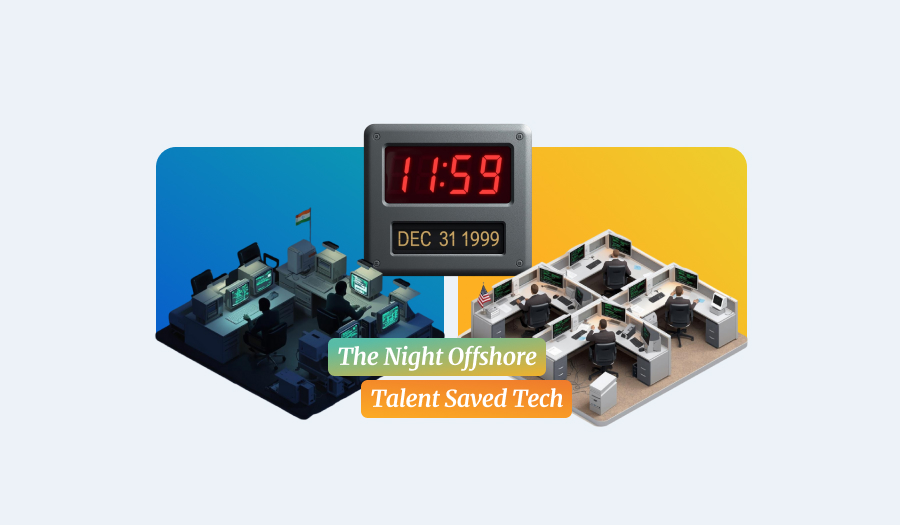
Businesses also found that thanks to the offshore model, they could keep the workflow around the clock. American workers would sleep while Indian workers worked, and the cycle would repeat. The 24/7 workforce is now a standard feature of labor offshoring.
Y2K and the Offshore Revolution
Disaster Averted
When the clock struck midnight on January 1, 2000, the change went off with little fanfare. There were a few glitches in some systems, but the biggest issues had been resolved. Disaster had been averted, thanks to offshore labor.
The Post-Y2K World of Offshoring
The core dynamics of labor offshoring shifted entirely as a result of the Y2K bug, and the world is still affected by them today.
Offshore labor in the tech industry wasn’t seen as viable or even desirable. The prevailing view was that if you paid your workers less, as was the case with offshore labor, the product would be inferior. Trust was also low, and the infrastructure and business models didn’t yet exist, but Y2K changed all of that.
Businesses realized they could send large software projects overseas to dedicated offshore teams that could handle delicate tasks just as effectively as their domestic counterparts.
Entire industry-wide systems were developed to streamline the process of sending and working on software offshore. Infrastructure was developed in India, the United States, and around the world. Entire employment networks were built up to hire tech workers worldwide.
Businesses quickly realized they could rely on offshore labor for far more than just bug fixes, and took the new systems and infrastructure in place and applied them to everything from research and development to product testing and support.
India once started as a lesser-known tech destination, but in a matter of years, it turned into a tech leviathan, a trend that has only continued to this day. Nations around the world took notice and quickly began building up their infrastructure and transforming their workforces in response to the new offshoring tech revolution.
Conclusions
With the start of the millennium, the world had a problem on its hands – a seemingly simple little software quirk that could turn into an absolute catastrophe.
Solving the issue wasn’t going to be easy, but businesses found the solution, and they found it in Indian offshore labor.
Offshore labor proved to be the solution to the Y2K bug, reshaping the entire concept of labor offshoring and changing the tech industry worldwide.
As the new year begins, businesses are bound to face new problems. Just as offshore labor was the solution some 26 years ago, it can be the solution today. Businesses can and should look overseas to find the best workers, to innovate in ways they never could have before, and to succeed in the new year.