Free-Tier CRM Mastery: The HubSpot Virtual Assistant
Key Takeaways:
- Most free CRM accounts fail within 90 days due to manual workload overload
- Founders lose an average of 4.5 hours daily to unstructured admin work
- Poor CRM hygiene causes up to 12 percent annual revenue leakage
- Software is not the problem. Execution ownership is
- A HubSpot virtual assistant acts as a Human API between strategy and systems
- Data hygiene matters more than advanced CRM features
Your subscription-free CRM is an untapped goldmine. We uncovered the hidden financial potential of the free-tier CRM, a tool often dismissed as "shelfware" but capable of delivering a staggering $8.71 return for every dollar spent on implementation. We quantified the "manual tax" paid by un-systemized founders, who lose an average of 4.5 hours of daily bandwidth to clerical tasks and suffer a 12% leak in annual revenue due to data decay and response lags. And we concluded that by activating neglected features like real-time behavioral tracking and automated scheduling, a microbusiness can effectively "cheat" its way to enterprise-level conversion rates. However, identifying this goldmine is only the first step; the true challenge lies in building the operational infrastructure required to extract that value consistently.
The transition from a manual hustle to a systemized enterprise is precarious — the lack of an operational owner is why most CRM for small businesses implementations never take hold. This failure is not due to a lack of intent, but rather a predictable psychological wall known as "SaaS Fatigue". In the context of CRMs, SaaS fatigue is where the manual friction of data entry eventually overrides the founder's willpower to implement the new system. If your free CRM subscription is now gathering cobwebs, you are not alone. To bridge this gap, you don't need a more complex platform or a paid subscription as a ransom to ensure you stick to the plan. Once you understand the barriers and how to overcome them, your small business can achieve enterprise-level CRM performance without a costly capital commitment.
The 90-Day Wall: Why Most CRM Projects Become "Shelfware"
Small business owners typically enter the CRM ecosystem with a burst of high-energy enthusiasm that rarely survives the transition from novelty to utility. The statistics are unforgiving: the majority of free-tier accounts are abandoned within three months as the administrative burden becomes an unacknowledged tax on the founder's primary revenue-generating activities. This "shelfware" phenomenon occurs when a tool intended to provide freedom becomes a source of daily resentment and digital clutter. To build a sustainable "digital brain," you must first diagnose the specific failure points in the implementation timeline and the specific skill gaps that prevent strategic intent from becoming permanent infrastructure.
The 70% Casualty Rate: Navigating the Implementation Timeline
If you have ever started a free CRM account only to watch it sit dormant after a few weeks of frantic setup, you are part of a documented 70% failure rate that plagues the industry. This implementation collapse is rarely a reflection of the software's quality, but rather an indictment of a process that treats a dynamic system as a static purchase. Most microbusinesses are not alone in this struggle; they are simply the most vulnerable to the lack of executive oversight required to keep the system alive. Without a dedicated operator to manage the transition, even the most intuitive platform will eventually be discarded in favor of old, manual habits.
The timeline of failure is highly predictable, beginning with an initial 30-day honeymoon phase driven by the excitement of new features and potential growth. By day 60, this novelty wears off and is replaced by the administrative grind, where the sheer volume of data entry begins to outpace the founder's available bandwidth. This leads inevitably to the day 90 SaaS fatigue wall, where the browser tab is closed for good, and the system is abandoned entirely. For a microbusiness, this abandonment may feel lossless, since it was a free account; yet it is a collapse of a revenue engine capable of taking the business to the next level.
"SaaS Fatigue is the moment the manual friction of data entry overrides a founder’s willpower—it is the silent killer of every great strategic intention."
The Friction Point: Why Intent Fails to Become Infrastructure
The primary reason these projects fail is the administrative drag that converts a founder’s strategic time into low-yield, repetitive clerical work. When a founder is forced to spend 4.5 hours daily on manual tasks, the requirement of CRM data entry feels like a productivity killer rather than a growth facilitator. This friction creates a psychological barrier that makes implementation feel like a chore rather than a strategic mandate. Without a mechanism to offload this friction, the founder inevitably becomes the bottleneck of their own revenue engine.
This systemic bottleneck triggers a silent retreat to the manual hustle, where the founder abandons the CRM system in favor of the fragmented spreadsheets and mental notes that initially built the business but is now stunting their growth. When the founder or a partner is the only one managing the CRM, the integrity of the data fluctuates based on personal energy levels, inevitably leading back to the relational blindness and response lags of the old ways. A CRM is only as valuable as the accuracy and recency of the information inside it. The system only works when it is fed consistently, a task that few founders can maintain alongside the demands of high-level sales.
The Structural Void: Identifying the Missing Operational Skill Set
Success in digital systemization requires the synthesis of three distinct skills: Strategic Vision, Technical Architecture, and Operational Hygiene. Most microbusiness owners possess the vision—they know who to target and what to sell—but they often lack the technical patience for complex platform mapping. That lack of structural skills ensures that even the most powerful CRM remains a "flat" digital rolodex rather than a relational intelligence engine. Attempting to be both the "Architect" and the "Manual Operator" of your software is a strategic miscalculation that traps visionaries in the clerical weeds.
While founders are excellent at identifying growth opportunities, they also often lack the consistent discipline and technical expertise required for rigorous data hygiene. Data hygiene is the relentless, manual process of ensuring that every record is accurate, deduplicated, and enriched with the latest context—a task that requires a level of clerical precision most visionaries find exhausting. Recognizing that you lack the specialized discipline for daily data management is not a weakness; it is the prerequisite for scaling your business. It is the first major move toward delegating the execution to a professional who can maintain your company's "Source of Truth" while you focus on building wealth.
"Attempting to be both the 'Architect' and the 'Manual Operator' of your software is a strategic miscalculation that traps visionaries in the clerical weeds."
Overcoming these barriers is one side of the equation, whether done alone or with help. Regardless, that effort to integrate a CRM could be wasted if the system being implemented is incompatible with the business.
The Landscape: Identifying the Five Primary Flavors of CRM Architecture
The market is fragmented into several distinct flavors, each designed for specific organizational sizes and departmental needs that rarely align with a lean micro-firm. Selecting the right CRM is not a search for "features," but a strategic assessment of which architecture will support your growth without imposing a growth tax on your success. For the Operational Architect, the goal is to identify the lowest-friction foundation that allows for rapid lead execution without unnecessary complexity. Understanding these categories is essential for avoiding a platform that creates more work than it solves, allowing you to focus on the specific engine that powers a high-velocity firm.
Operational CRMs: Automating the Customer Lifecycle (HubSpot, Salesforce, Pipedrive)
Operational CRMs are the standard "engines" of the industry, designed specifically to automate the sales, marketing, and service lifecycle. Platforms like HubSpot, Salesforce, and Pipedrive excel at moving a prospect through a visual pipeline, ensuring that every touchpoint is tracked and every follow-up is executed with surgical precision. This category is built for the "hustler" who needs to see their money moving in real-time, providing the visual clarity required to identify bottlenecks. By prioritizing an operational foundation, you ensure that your technology stack is actively driving revenue rather than just storing contact information.
This flavor is the most appropriate engine for microbusinesses because it focuses on the immediate need for lead management and revenue conversion rather than high-level data mining. Because these tools prioritize the daily grind of sales, they offer the highest adoption rates for small teams focused on execution. While they offer advanced features, their core strength lies in their ability to enforce a process that doesn't rely on human memory. Selecting an operational engine ensures that your business stays focused on the tactical work of closing deals while your data remains organized and actionable.
Collaborative CRMs: Unifying Cross-Departmental Communication (Monday.com, Copper)
Collaborative CRMs are designed to solve the "silo problem" by syncing data across multiple departments like sales, customer success, and finance. While tools like Monday.com or Copper are powerful for team visibility, they are frequently overkill for a micro-firm where the "departments" are often just one or two people. The overhead of managing complex internal handoffs and cross-team permissions creates a layer of friction that distracts from the core mission of customer acquisition. In a small environment, the priority should be moving a lead from cold to closed, not managing the bureaucracy of a large organization.
Choosing a collaborative flavor too early can result in a platform that feels more like a project management tool than a revenue-generating weapon. Without multiple teams to "collaborate" with, the advanced sync features become an unnecessary distraction that complicates the user experience. For a team of five, the need for aggressive sales automation is far more critical than the need for departmental data sharing.
Analytical CRMs: Extracting Patterns from Customer Behavior (Zoho, Insightly)
Analytical CRMs focus on big-data mining, trend analysis, and business intelligence to predict long-term customer behavior patterns. While platforms like Zoho and Insightly offer incredible depth, they require a massive volume of data to generate meaningful insights—data that most microbusinesses simply haven't accumulated yet. The "technical debt" required to configure these analytical engines often results in a steep learning curve that triggers SaaS fatigue faster than simpler alternatives. Unless you are managing thousands of data points daily, the complexity of an analytical suite is a strategic distraction from closing deals.
Attempting to implement an analytical CRM prematurely is like building a massive research facility for a business that hasn't yet secured its first hundred customers. The effort spent configuring data mining triggers is effort taken away from the high-value negotiation needed for immediate survival. These systems are powerful assets for established corporations, but for a startup, they often function as high-priced digital weight that slows down the sales process.
Strategic CRMs: Prioritizing Long-Term Relationship Value (Nimble)
Strategic CRMs like Nimble focus heavily on nurturing long-term relationships through social media insights and networking, often acting as a "social rolodex." While these tools are excellent for high-level networking and consultant-based businesses, they often lack the robust operational automation required for high-growth sales teams. If your business relies on moving hundreds of leads through a structured pipeline, a relationship-heavy tool may feel too "passive" for your daily execution needs. They excel at "social listening" but can fall short when it comes to the relentless follow-up logic required to achieve an 81% higher sales success rate.
For most micro- and small businesses, the priority should be an engine that enforces a process, not just one that records a social relationship. While staying "top of mind" is important in client relationships, it is the automated follow-up and lead qualification that actually drives the bottom line. Strategic CRMs can be useful for those in the high-level consulting space, but they rarely provide the architectural foundation needed to build a scalable, automated revenue engine.
Campaign Management Variants: Optimizing High-Volume Outreach (Mailchimp CRM, SocialPilot)
Niche variants like the Mailchimp CRM or SocialPilot are essentially specialized marketing tools—focusing on email or social media management—that have added basic contact management features to their ecosystem. These are useful exceptions for microbusinesses that rely almost exclusively on newsletters or social media content to drive their entire acquisition strategy. They allow for a seamless transition between marketing broadcasts and individual contact management, making them ideal for content-heavy businesses. However, as your sales process becomes more complex and requires individual negotiation or multi-stage pipelines, these campaign-focused tools quickly reveal their limitations.
These variants are useful exceptions for microbusinesses with a heavy social media or content focus that requires high-volume outreach rather than individual sales cycles. However, they lack the architectural depth required to manage a truly automated "digital brain" that connects every stage of your customer journey. They are built for "one-to-many" communication, which often misses the "one-to-one" relational depth needed for high-conversion B2B sales. While they are a great starting point for content creators, they rarely provide the infrastructure needed to scale a business beyond the founder's personal outreach capacity.
"While most microbusinesses avoid expensive consultants, they often pay a higher price in months of technical debt by trying to be their own developers."
The Solution: Scaling Systems with a HubSpot Virtual Assistant
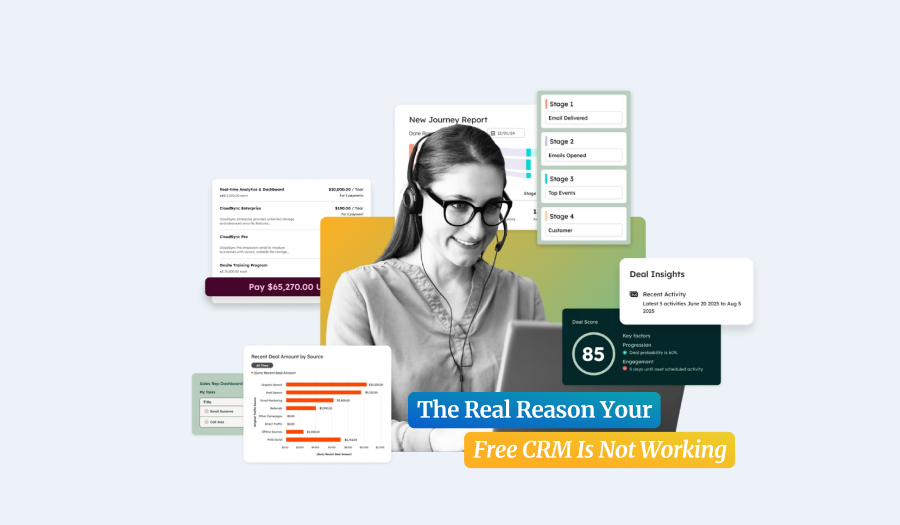
The ultimate cheat code for avoiding CRM failure isn't a better software choice; it is the implementation of a specialized "Human API”. By hiring a HubSpot virtual assistant, you can effectively bridge the gap between your strategic intent and the platform's execution without having to do the manual data entry yourself. This operational layer allows you to bypass the technical barriers and hidden growth taxes that typically punish scaling firms. Whether you choose HubSpot, Pipedrive, or Zoho, the success of the system depends on a dedicated specialist who lives in the data so you can live in the sales.
The "Human API": Bypassing the "DIY Architect" Trap
Introducing a specialized virtual assistant into your workflow provides the "Human API" that bridges the gap between your high-level strategy and the software’s technical requirements. Most founders know they need more sales, but few can translate that intent into the specific property mappings, deal stages, and lead rotation triggers required for a system to function properly. A specialist serves as this translator, ensuring that your strategic vision is accurately mirrored in the software's architecture from the very first login. By offloading the technical weight of "speaking software," the founder is free to focus on the high-value activities that actually build wealth.
Instead of falling into the trap of "self-onboarding" through trial and error, a specialized assistant allows you to bypass the months of technical debt and frustration that usually precede system abandonment. While most microbusinesses aren't looking to pay for an expensive consultant, they often pay a much higher price in wasted hours trying to be their own developer. A dedicated operator provides a professional-grade setup incrementally, tailoring the environment to your specific workflow while you are busy closing deals. This ensures your CRM is built correctly the first time, providing a scalable foundation that won't need to be torn down and rebuilt as your team expands.
Execution over Software: Why Hygiene Trumps Features
In the world of scalable systems, the integrity of the data—its hygiene—is far more important for long-term scaling than the specific feature set of the software. A CRM with a thousand automations is worthless if the records inside are outdated, duplicated, or missing critical context. Your assistant acts as the guardian of your "digital brain," assuming the relentless task of lead qualification and contact enrichment that founders consistently neglect. This consistent maintenance ensures that your sales decisions are driven by empirical data rather than fluctuating energy levels or gut feelings.
By assuming the role of data guardian, a specialized assistant reclaims the 4.5 hours of daily bandwidth currently lost by the founder to manual data entry and administrative "hand-cranking." This reclamation of time is not just a convenience; it is a strategic mandate for any founder who wants to transition from a job to a scalable asset. When the hygiene is handled by a professional, the CRM becomes a proactive intelligence engine that predicts your next move rather than a reactive chore that you dread opening. This is how you stop the 12% revenue hemorrhage and start realizing the true potential of your dormant prospect data.
"In a scalable system, relentless hygiene always trumps software features; a CRM with a thousand automations is worthless if the records inside are dead."
Strategic Leverage: The Path to Absolute Operational Freedom
The final evolution of the systemized firm occurs when the founder moves from the role of "data clerk" to the role of "strategic architect" through effective delegation. This shift is made possible by the strategic leverage of a specialist who ensures the revenue engine never stops, even when the founder is offline. With a dedicated operator managing the tactical execution, the business gains the "process persistence" required to achieve an 81% higher sales success rate. This isn't just a delegation of tasks; it is the construction of a scalable asset that functions independently of your willpower.
While our primary focus is the HubSpot virtual assistant, it is crucial to clarify that these operational specialists are platform-agnostic and capable of managing various systems. Whether your engine is Zoho, Pipedrive, or Monday.com, the requirement for a dedicated remote professional remains the same. The goal is to build a business that outlives your personal memory and scales beyond your physical capacity. By bridging the execution gap with a dedicated specialist, you transform your CRM from a neglected tool into the backbone of your wealth creation engine.
FAQ Section
- How do I know if I've hit the "SaaS Fatigue" wall?
If you find yourself avoiding your CRM dashboard, reverting to spreadsheets for "quick" notes, or noticing that your lead follow-ups are lagging beyond the critical 5-minute window that yields a 100x conversion rate, you have hit the wall. This is the signal that your manual effort has reached its limit and you need an operational specialist to assume the hygiene of the system. - Is a HubSpot virtual assistant only for HubSpot?
No. While "HubSpot" is the industry-standard term for these specialists, most are platform-agnostic and highly skilled in Pipedrive, Zoho, and other operational CRMs. The "Human API" concept refers to the talent’s ability to manage the architecture of any relational database, ensuring your "Source of Truth" remains accurate regardless of the software brand. - Why shouldn't I just use a regular virtual assistant for this?
A general VA often lacks the specific technical training required to understand property mapping, lifecycle stages, and automation logic. A specialized HubSpot virtual assistant from AbroadWorks is trained specifically in the architecture of revenue engines, ensuring they aren't just entering data, but are actively maintaining the integrity of your sales pipeline.
Conclusion: Activating the Execution Bridge
The 70% failure rate of CRM projects is not an indictment of the tools, but a reflection of the "human bottleneck" that plagues every un-systemized microbusiness. To avoid the 90-day SaaS fatigue wall, you must move from founder-led maintenance to a Human API model that prioritizes data hygiene over software novelty. By leveraging a HubSpot virtual assistant to handle the technical weight of your data, you stop the 12% revenue hemorrhage and start realizing the 81% success advantage that defines industry leaders. Reclaiming your strategic bandwidth is not a matter of working harder; it is a matter of hiring the execution required to make your systems work for you. Partner with AbroadWorks today to find the specialist who will turn your neglected CRM into the backbone of your wealth creation engine.
"Reclaiming your strategic bandwidth is not a matter of working harder; it is a matter of hiring the execution required to make your systems work for you."