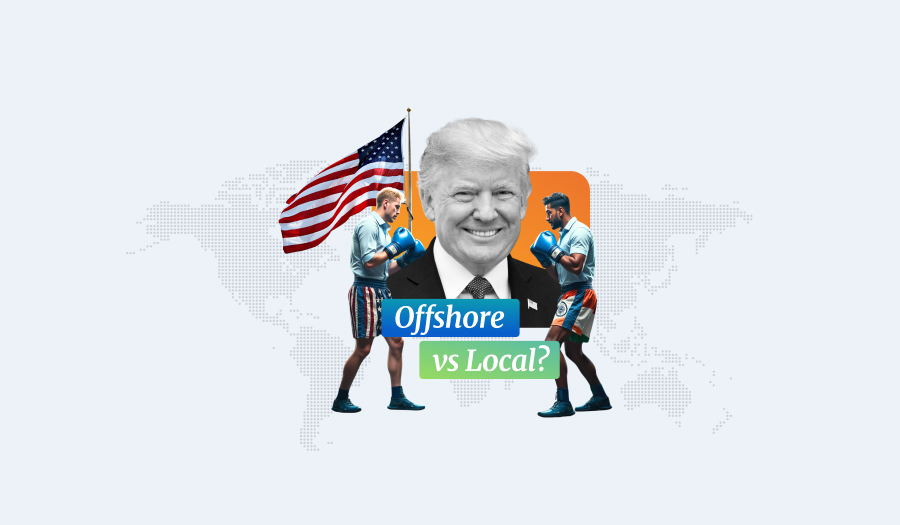
As Remote Work Grows, Should American Workers Worry About Offshore Hiring?

Key Takeaways:
- Offshore employees are full-time remote team members who help companies cut costs, scale faster, and access global talent.
- Global labor arbitrage has historically driven massive economic growth and lowered consumer prices worldwide.
- Remote work technology has expanded offshore hiring beyond manufacturing into accounting, design, engineering, IT, and other white collar roles.
- The Lump of Labor Fallacy shows that jobs do not simply disappear when work shifts offshore, but domestic workers still face challenges in adapting.
- Offshore hiring creates new opportunities but also increases global competition, requiring workers to upskill and reposition professionally.
- Companies can hire offshore responsibly by partnering with EORs, defining transparent processes, and building integrated global teams that complement domestic staff.
When discussing labor offshoring, we inevitably wind up asking ourselves about the effects of the practice on domestic employment. While the answer might appear rather clear-cut - labor offshoring reduces domestic employment - the answer is much more nuanced and heavily grounded in complex economic theory.
Today, offshore employees are full-time team members located outside a company’s home country who work remotely using digital collaboration tools. They operate as integrated parts of global teams rather than temporary contractors, which is why businesses across industries now rely on offshore labor for both specialized and operational roles. Businesses of any size can now hire offshore employees and build an offshore workforce using remote work tools and global hiring partners.
What Does “Offshore Employee” Mean?
Before we deep dive into the offshore labor practice, here’s a refresher of what an offshore employee is: an offshore employee refers to a full-time worker employed in another country who is integrated into a company’s operations, often through models like Employer of Record (EOR). EOR partners legally employ the worker on behalf of the client, making it easier to hire offshore staff without setting up a foreign entity. Offshore employees differ from contractors because they receive structured schedules, direct management, and long-term responsibilities, making them part of an offshore workforce rather than a temporary freelancer.
EOR and Compliance
Understanding the structure behind offshore employment ensures legal compliance. EORs help companies manage payroll, compliance, and contracts. They also help with company expansion anywhere in the world without setting up an entity, and let the offshore teams operate like local employees.
Offshore Employees vs Contractors
People can easily confuse offshore employees with contractors, but there are distinct differences. Offshore employees follow company processes, and contractors work independently. Offshore employees hired through EORs can also receive benefits such as paid time off and healthcare. With these added benefits, employees offer greater stability and continuity than contractors.
Offshore Workforce Integration
Any company can tap into offshore remote work now. Offshore labor functions as an extension of domestic teams and collaborates through remote tools. Teams can then share tasks and workflows across different time zones.
“Offshore employees are full-time workers who operate as fully integrated team members through EOR partners, giving companies global hiring capability without legal or administrative complexity.”
Why Businesses Hire Offshore Employees
Offshore employees, offshore workforce, offshore labor, and offshore employees all point to a simple idea: companies now build distributed teams across borders to reduce costs, expand talent access, and scale faster.
By hiring offshore employees, companies lower labor costs while maintaining high quality, and offshore labor enables firms to scale staff more quickly without sacrificing performance.
Cost Efficiency and Scaling
Companies often hire offshore employees to optimize expenses while improving output. By hiring offshore employees, companies lower labor costs while maintaining high quality. Hiring offshore also allows the companies to reinvest in their domestic growth. Companies can then expand their teams quickly without the high price.
Access to Global Talent
Businesses no longer rely solely on local labor markets. Offshore teams give companies broader skill coverage. Specialists can be hired faster from overseas, and niche skills are often more available offshore. This helps companies to have more flexibility and supports their business continuity.
Building Global Workforce Infrastructure
Offshore hiring is now a strategic workforce decision. Companies can build a blended team composed of both domestic and offshore team members. This also supports round-the-clock operations so companies can continue production at any time of the day. With the integration of remote work tools, it has also become easier to manage offshore remote staff alongside onshore teams.
“Companies hire offshore employees to lower costs, expand access to specialized skills, and build scalable global teams that support growth and round-the-clock operations.”
A History of Global Labor Arbitrage
Historically, labor offshoring began with cost-based decisions. Companies hired workers in lower-wage countries, which enabled them to achieve lower production costs. Companies then reinvested savings into expansion, which then accelerated global trade.
Understanding Wage Differentials
Global labor arbitrage refers to the practice of capitalizing on the differences in wages and labor costs between countries by relocating jobs, production, or services to locations where labor is cheaper. In simpler terms, businesses start using offshore workers instead of domestic ones because offshore workers are cheaper. For this article, we’ll simply call the practice labor offshoring.
Productivity Loop and Expansion
Labor offshoring is a popular practice because it allows businesses to increase their profit margins by reducing their expenses and potentially even increasing their productivity along the way. The process is almost cyclical – a business can hire workers for less, allowing them to hire more workers, which then results in increased productivity and greater income, which can then be reinvested in the business, which then perpetuates the cycle. In economic terms, it can be referred to as a feedback loop in productivity and reinvestment, and this loop is at the core of why businesses hire offshore workers.
Consumer Impact and Market Evolution
The effects of labor offshoring have been felt across the entire globe and have categorically changed how we as a society function. Goods that were once deemed a luxury have now gone down in price by vast margins thanks to the reduced costs of offshore labor. The prices of everything from clothing, furniture, and appliances have dropped by as much as 50% or more from their historical highs. The decision by businesses like Samsung and Sony to move production to lower-wage countries has caused the price of flat screen TVs to decline from over $2,000 in the early 2000s to under $300 today.
The countless goods and services that are constantly improving our lives today would likely have never existed if it hadn’t been for the power of offshore labor, and the story of offshore labor is far from complete.
“Labor offshoring began as a cost-saving strategy, but its long-term impact has reshaped global trade, increased productivity, and dramatically lowered consumer prices.”
The Shifting Landscape of Offshore Labor
While labor offshoring was once relegated to low-cost manufacturing, we have seen a massive shift in the nature of offshore labor in recent years.
Rise of Remote Work Infrastructure
The COVID pandemic created changes in nearly every aspect of how our world functions, including labor offshoring. COVID-19 opened up an entirely new realm of the workplace. The advancements in, and growing adoption of, remote work technologies meant that high-skilled workers could perform their jobs from anywhere, including different countries. With this came the possibility of using highly skilled offshore workers to accomplish the same tasks as their domestic counterparts, for less.
Expansion Beyond Manufacturing
The ubiquity and prevalence of remote work technologies mean that offshoring is no longer limited to just manufacturing. Despite offshore hiring challenges, white-collar roles in accounting, computer programming, marketing, and digital design can often be filled offshore for far less than their domestic equivalents. The ubiquity of these technologies also means that any business, not just massive corporations, can hire offshore workers to replace their domestic employees.
EOR and Offshore Hiring Boom
The rise of EOR (Employer of Record) companies should be more than enough evidence as to how effective the practice of offshoring is in the eyes of businesses around the world. By managing workers abroad for clients without them having to set up local entities or handle compliance, EOR businesses make it easier than ever to hire offshore employees for white-collar jobs. The astonishing rise of Deel – reaching $12 billion in valuation in just 5 years – proves that businesses are waking up to the viability of white-collar offshore labor.
Offshore workers can now replace almost any employee at almost any business, and the domestic worker will inevitably face new challenges.
“Offshore labor has moved far beyond manufacturing, as remote work technology now enables companies to hire skilled global professionals across accounting, design, engineering, IT, and more.”
The Lump of Labor Fallacy
So, can any job now move offshore? Does that now mean all domestic employees are going to be replaced by offshore workers? Not necessarily.
Misunderstanding Job Distribution
The lump of labor fallacy is the false belief that there’s a finite amount of work or jobs in an economy, meaning that any increase in productivity or the number of workers will only redistribute jobs, leaving fewer jobs for others.
So, how does the lump of labor fallacy apply to the debate around offshore labor? It means that the idea that offshore employees will replace domestic ones isn’t necessarily true. It means that even if jobs move offshore, there will still be work for domestic employees. It means that jobs don’t just move around; they get created.
Economic Growth and Job Creation
Economic growth creates jobs, and offshore labor creates economic growth the likes of which we have never seen. As we’ve already discussed, global labor arbitrage has resulted in a level of unprecedented economic growth and has shaped every aspect of our society.
So, the changing landscape of offshore labor, the new ability that any and every business has to replace its domestic white-collar workers with cheaper offshore ones, doesn’t necessarily mean that those jobs will be lost. History has shown that the shift to offshore labor spurs economic growth and creates new jobs, jobs that can replace the ones lost to offshore labor.
Historical Job Shifts
By moving manufacturing offshore, American electronics businesses have begun investing in and hiring workers specializing in research and development, product design, engineering, software development, and quality control. The increase in production has spurred increases in profits, allowing businesses to invest and create newer and better domestic jobs than what once would have existed had they retained onshore manufacturing.
History is littered with examples of offshoring creating countless high-quality, high-paying, top-tier jobs in the United States. This extends into countless fields, including electronics, avionics, research and development, and niche/high-tech manufacturing. History has shown that offshoring doesn’t simply take jobs, it creates newer and better ones.
“Offshoring doesn’t simply eliminate jobs; economic growth and innovation create new roles, making the relationship between offshore labor and domestic employment far more complex.”
The Flaw in the Fallacy of the Labor Lump
So, even if jobs move offshore, new ones will be created? Right?
Economic growth does mean job growth, and offshore labor has historically generated immense economic growth, and even job growth here in the US, but again, the reality is often more complicated.
Skill Gaps and Adaptation
New jobs require new skills, skills that not every white-collar employee who’s about to be replaced can adapt to. White-collar jobs often require a long and expensive education, and getting a new education is far from easy. Furthermore, the best white-collar jobs, the high-paying white-collar jobs, require a significant level of experience, experience that can’t be built up overnight.
Just like how new skills can’t be learned overnight, new jobs can’t be created overnight. Figuring out what new employees are required to maximize profits isn’t a simple thing. Businesses have to find a need, and that takes time. While there may be room for new jobs and domestic employees to fill them, what they are may be anybody’s guess, including the businesses. The offshore vs local labor question does have edge cases - niche marketing roles or R&D may still require domestic hires - but working it out is worth the effort.
Pace of Job Creation
Offshoring can also create a bit of an arms race. Every step forward a domestic worker takes to find a new job is going to be followed by an offshore worker, who is going to work just as hard to learn just as much and gain just as much experience as a domestic worker. This means that even the best new jobs that are created aren’t necessarily going to be around for long, and domestic workers are going to have to work even harder to remain ahead.
Global Skill Competition
For the workers who are just hanging on while the job market is shifting, even if they can keep the same job they’ve had for years, they’re going to be forced to compete with an offshore employee who can do the same job for less. Domestic workers won’t be able to compete with offshore workers unless they accept lower wages. Build this up to the scale of an entire nation’s economy, and what you get is wage stagnation, something that doesn’t bode well for anyone trying to make a living.
To top it off, the root of offshoring is increasing profits, not boosting economic growth. Offshoring helps businesses reduce expenses and increase profits, but those profits aren’t necessarily going to be reinvested back into the economy, or even into the business. Profits might go into the bank, to shareholders, or to executives. If firms don’t take the time to reinvest their earnings back into the business, which they may very well choose not to, then their business might not grow in a way that the economy will benefit from, and new jobs won’t be created.
The reality is that the lump of labor fallacy might not hold up in the real world. Labor offshoring could cause problems for domestic workers. They may have a tough time staying ahead, wages might stagnate, and economic growth isn’t always guaranteed.
“While offshoring can create new opportunities, American workers still face global competition, slow job transitions, and skill gaps that make adaptation challenging.”
How to Hire Offshore Staff Responsibly
Companies that want to hire offshore employees or hire offshore staff should follow a structured approach to minimize risk and ensure global team success. These steps also help clarify offshore hire compliance concerns.
Step-by-Step Guide
Hiring offshore employees requires a transparent and compliant process. You need to identify what your current needs are and decide whether you genuinely need to hire offshore employees. You also have to choose an EOR or global hiring partner, such as AbroadWorks, to make hiring offshore employees easier. Once you have hired and onboarded your team member, set clear expectations about the role and also provide the KPIs so you can set them up for success.
Setting Up Team Integration
Onboarding and aligning the team culture ensure productivity. Utilize remote work tools to manage your team, and also establish communication routines through communication channels if the team is based in different countries, sync time zones, and train all members on different collaboration tools.
Compliance and Long-Term Workforce Planning
Global hiring should be sustainable. By partnering with EORs to manage hiring and payroll, evaluate employee performance, and plan long-term growth for all team members, you will be able to make smarter offshore hiring decisions.
“Responsible offshore hiring requires transparent processes, compliance through EOR partners, and clear integration practices that create unified, productive global teams.”
The Bottom Line
It is fallacious to believe that by moving jobs offshore, there will be no more domestic employment opportunities. Jobs don’t disappear; they change. As the economy grows, new jobs are created, and the use of offshore labor has historically been an absolute boon to economic growth.
None of this means that the shift to offshore labor will be painless. People will have to learn new skills, and wages may decline, but workers are adaptable, and the labor market is a highly flexible and dynamic thing. No matter where the jobs go, American workers will be able to find employment. As is always the case, American workers are going to have to adapt, and nothing is as adaptable as the American worker.
If your company is exploring hiring offshore employees or offshore IT staff, now is the time to build an offshore workforce that complements your U.S. team. Partnering with a global hiring expert, like AbroadWorks, makes it easier than ever to scale your team responsibly while maintaining quality, compliance, and productivity.