How the Race to Artificial General Intelligence (AGI) Is Hurting Small Businesses

Key Takeaways
- The AGI race is reshaping the small business economy.
- AI infrastructure is driving higher energy and hardware costs.
- Rising operating expenses reduce customer purchasing power.
- Margin protection requires smarter operations and cost control.
- Offshore hiring helps businesses stay competitive amid rising costs.
- Businesses that adapt early will be better positioned for long-term growth.
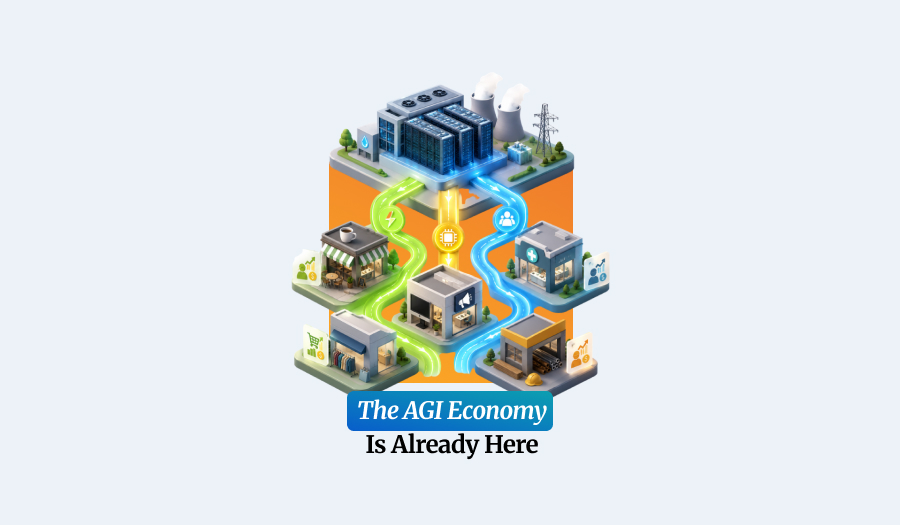
You didn't enter the race to AGI. You didn't fund the GPUs, you didn't authorize a single dollar of the buildout happening in counties you can't name, and you probably haven't spent more than ten minutes thinking about it. But the race to Artificial General Intelligence (AGI) has entered your space anyway. The same capital is locking up the planet's power and water. The same grids that run your shop are absorbing the load. The same labor pool your business depends on is being bid up by the people building the new infrastructure. You may not have made AGI a priority, but AGI made you a stakeholder.
Most of the people who will read this don't think of themselves as part of the AI conversation. They didn't adopt ChatGPT to write their invoices. They aren't training models. They aren't building chips. They read the headlines about the race, form a quick opinion, and move on. That instinct is reasonable, but it is a gap that needs to be closed because the race to AGI is no longer a story about Silicon Valley. It is a story about the cost of running a small business in 2026, and the price tag is on the bill you already pay. The question is whether you can see it yet.
The AGI Buildout: What's Happening Now
Most small business owners have no direct relationship to the AI industry. The connection between a hyperscale data center in Abilene and a 12-person HVAC company in Phoenix can feel abstract, but it isn't. The money being spent to build AGI is being spent in the same economy your business runs in, on the same physical resources, and the costs are about to reach your P&L in three concrete ways.
The Money: How Much Is $660 Billion, Really?
Hyperscale cloud providers and AI entities racing to build AGI have committed $660-$690 billion in capital expenditures for 2026, with mid-year forecasts pushing past $800 billion. To put that figure in context: it exceeds the combined 2023-2024 budgets of the Department of Education ($238 billion), the Department of Housing and Urban Development ($74 billion), and the Environmental Protection Agency ($70 billion) (CBO Consolidated Appropriations Act 2024). The question is what an $800 billion annual spend actually buys.
Most capital is being poured into a small number of gigantic campuses, not a distributed national cloud. The flagship Stargate project, the joint venture between OpenAI, SoftBank, and Oracle, has committed up to $500 billion through 2029 across seven active sites, with a planned total power draw equivalent to roughly seven million American homes running around the clock. The Abilene, Texas Flagship site alone is the size of a small city, and an xAI facility in Memphis was constructed in four months at a cost of roughly $18 billion (Wikipedia: Stargate LLC, Epoch AI). The buildout is a small number of gigantic industrial sites, and the local economic return is far thinner than the public investment underwriting it.
The employment math is the most damning part, and it gets worse the more closely you look at what the money actually produces. In Virginia, the state exempted $33.2 billion in data center equipment from sales taxes in fiscal year 2025 (a $1.94 billion tax revenue loss), and the industry generated only 1,610 net new jobs, a taxpayer-funded cost exceeding $1.2 million per job. Washington State's 2017 evaluation found the same pattern: data centers paid $22 million in property taxes while the state lost $57 million in sales tax revenue, a net revenue loss. Put against the average capital cost of $322,000 per job in non-data-center industries, the Virginia subsidy works out to roughly 168 times more public money per data center job than the same investment would have produced in a typical retail, manufacturing, or service-sector employer (Tech Policy Press). Even when governments subsidize the buildout aggressively, local employment returns are minimal, and the public cost is substantial.
What the Money Is Buying: Chips, Power, and Water
The single largest line item is compute: the advanced chips the data centers run on, and the chip manufacturing that builds them, has become the bottleneck. The world's advanced chip packaging capacity is fully booked through at least mid-2027, and NVIDIA has reportedly cut production of its consumer graphics cards by 30-to-40% to redirect factory capacity toward data center products (Spheron: GPU Shortage 2026). The result is a hard ceiling on how fast new AI capacity can be built, regardless of how much money is committed.
Power is the second binding constraint. The handful of giant companies building AGI (the same names that show up in every AI headline — Microsoft, Google, Amazon, Meta) have already locked up roughly 45 gigawatts of power contracts by mid-2026, equivalent to the year-round power demand of about 35 million American homes, and they are not letting go. The list of deals reads like a campaign to corner the power market: the restart of the Three Mile Island nuclear plant in Pennsylvania (the same plant that partially melted down in 1979), with a federal loan guarantee in hand and a planned 2028 reopening as the rebranded Crane Clean Energy Center; a long-term co-location at the Susquehanna nuclear plant in Pennsylvania, with Amazon's cloud division planning to draw up to 960 megawatts directly from the reactor. These are long-term locks on power that does not flow to commercial and industrial customers in those host regions, even as data center electricity demand rises from 4.4% of U.S. consumption in 2023 to a projected 6.7-12% by 2028 (EESI). The grid is being expanded to serve a narrow set of very large industrial customers, and the ratepayer cost of that expansion is the next resource pressure.
Water and land complete the picture. U.S. data centers will draw roughly 73 billion gallons of water annually by 2028, up from 17 billion in 2023, which is enough to supply every household in a state the size of Virginia for a year. Two-thirds of new facilities are in federally designated water-stressed regions, including southern Arizona, the Colorado River Basin, and Texas, and the resulting local competition is projected to push Texas data centers to consume 9% of the state's total water withdrawals by 2040. A mid-sized facility consumes as much water in a day as about 1,000 American households, and a large hyperscale campus can use as much as the daily water demand of a small city of 50,000 people, all while competing with the farmers and homeowners in the same county (WRI, Brookings).
Why This Is Different From Every Prior Tech Cycle
For three decades, every major tech investment cycle was demand-driven. The dot-com buildout of the late 1990s followed projected e-commerce adoption, the mobile internet infrastructure of the 2000s followed smartphone adoption, and the cloud data center buildout of the 2010s followed business software moving online. In each case, the question was whether demand would justify the capital, and the 2001 dot-com crash remains the canonical example of demand failing to materialize (FinancialContent). Most investors, regulators, and operators still default to a "build it and demand will follow" mental model.
The AGI buildout has inverted this pattern. Hardware is the bottleneck, not demand. Advanced chip packaging is fully allocated through mid-2027, gigawatts of baseload power are locked under long-term purchase agreements, and billions of gallons of cooling water are committed through local utility contracts. Even if enterprise AI demand softens, the buildout will continue, because the capital is already deployed, the power purchase agreements are signed, and the supply chain commitments are in place (Spheron: GPU Shortage 2026). The supply side of computing is the binding constraint for the first time.
The race to AGI, specifically, not just better AI products but the explicit goal of human-level or superhuman general intelligence, is what makes this cycle different from incremental AI investments that came before. The strategic bet is that the first company to achieve AGI captures a disproportionate share of long-term value, which is why Microsoft, OpenAI, Meta, and Google have committed capital at a scale no incremental AI ROI model could justify. Over 50% of the big four's 2026 capital spending is allocated to infrastructure coming online in 2027 and beyond (Tom's Hardware). The buildout is locked in, the spending is decoupled from near-term demand, and the next section examines how it reaches small business profit-and-loss statements through three concrete cost vectors.
The Three Cost Vectors
The data center buildout is upstream of small businesses. The cost is downstream. The transmission happens through three concrete channels, and all three are already in motion: the devices you buy, the electricity that runs them, and the customers whose purchasing power is being slowly squeezed. Each channel has a number, each number has a source, and each source is the kind of disclosure that companies would rather you not read. By the end of this section, the mechanism should be clear.
Devices and Services You Already Buy
The advanced chip supply that powers the AGI buildout is being diverted away from the devices you already buy. Data center customers are paying $25,000-$50,000 per top-end AI chip and getting priority in the manufacturing queue, while the same factories also produce the processors in your business laptop, phone, point-of-sale system, inventory scanner, printer, gaming PC, and the smart features in your mom's TV (SiliconAnalysts: AMD vs NVIDIA AI GPU Market Share). When scarce advanced chip manufacturing is pulled toward data center silicon, consumer and SMB products are manufactured in smaller volumes with longer lead times and higher unit prices.
For a small business owner, this contamination shows up in the price of devices you need to buy anyway. Workstations and laptops with discrete graphics, business phones, point-of-sale tablets, inventory management hardware, the smart TV in the break room, and even consumer electronics like gaming PCs are all drawing from the same constrained supply chain. Small businesses that refresh hardware on a three-to-five-year cycle are quietly absorbing these price increases as part of normal budgeting (EESI). The hardware bill is the first cost vector; the second is the electricity that runs the equipment and the building it sits in.
The Grid Is Yours and Theirs
Data centers are now co-tenants on the same electrical grid that powers your business, and they consume at a scale measured in entire neighborhoods. A single modern AI data center draws as much continuous electricity as 100,000 homes, and the U.S. data center fleet is on track to consume 6.7-12% of total U.S. electricity by 2028, up from 4.4% in 2023 (EESI). The industrial tail now rivals the residential head, and the buildout required to serve it at industrial scale is the next cost being socialized across ratepayers.
The bill is already showing up. Duke Energy in North Carolina is requesting an 18% rate increase driven primarily by data center power demand, which accounts for 80% of the state's projected new electricity load; in Mississippi, Entergy residential customers are already paying $10.60 per month more because of data center development, according to a Synapse Energy Economics report; in Virginia, the State Corporation Commission approved a Dominion rate increase adding $11.24 per month to typical residential bills in 2026, rising to roughly $13.60 by 2027, with the increase designed to be paid mostly by households rather than data centers (InsideClimateNews: Virginia Dominion Rates, IEEFA: PJM Capacity Prices, Belfer Center: Virginia and Texas).
Because most utilities charge standard commercial rate classes the same way they charge residential customers, the same increases flow through to your business's utility bill, and even where a new large-load rate class (effective January 2027 in Virginia) tries to shift the cost to data centers, individual ratepayers are still on the hook for roughly 61% of long-term grid upgrade costs after the 14-year data center contracts end. The next vector operates through your customers rather than your vendors.
Your Customers Are Facing the Same Squeeze
If your business is paying more for devices and equipment (as covered above) and higher utility bills (as covered above), so are your customers. Rising electricity acts as a direct tax on household disposable income, water scarcity drives up the cost of everything from food to landscaping to municipal services, and the combined effect is that the customers you depend on have less money to spend at your business every month. In the PJM region (the multistate power grid that covers 13 states and 65 million people from the mid-Atlantic to the Midwest), millions of households are footing $4.3 billion in approved transmission upgrades designed solely to connect private data centers, with over 95% of these costs passed directly to households (Tech Policy Press). The dynamic is the same customer, with a smaller monthly budget, deciding which line items to cut.
The pressure compounds through two further channels: housing affordability and wage stagnation. Academic research using shift-share instrumental variables (a statistical method that isolates data center effects from other local economic changes) at the University of Chicago's Becker Friedman Institute shows a 17.7% jump in local home prices in counties with major data center presence, enough to push a $300,000 starter home to roughly $353,000 in just a few years, directly contracting the discretionary income local businesses depend on. Data centers create high-wage technical roles during short construction phases, but long-term payroll is structurally small and profits flow back to corporate headquarters rather than circulating locally.
Local manufacturing plants, retail complexes, and family-owned services, which traditionally employ more people per dollar invested and keep wages circulating in the community, are crowded out by capital-intensive data center campuses that occupy 224 acres on average and exceed 1,000 acres at the largest scale, with most of that land fenced off and tax-favored rather than woven into the local economy (BFI Chicago: Data Centers and Local Economies, Baker Tilly: Data Center Impact). The data center boom is a net wealth transfer out of the local economy.
The compound effect is a triple squeeze. Customers have less disposable income from rising utility costs, housing inflation, and water-driven cost increases. Vendors and partners face higher operating costs from the same utility rate increases and land price pressure. And your own workforce becomes harder to retain, because data center technical roles compete for the same local labor pool at premium wages (Dallas Fed: PCE Inflation from Data Center Boom). This is fundamentally a local business disruption story, not a tech narrative; the race to build AGI is the upstream cause, and the wealth transfer from local economies to hyperscale technology companies is the downstream effect. The cost vectors are now mapped, and the question shifts from "what is happening to me" to "what do I do about it."
What Small Businesses Can Actually Do
There is little that individual small business owners can do to stop the data center buildout. The capital flows, the policy decisions, and the corporate strategies driving the AGI race are happening at a scale no single SMB can influence. But there are concrete operational moves that can protect margins, preserve customers, and create advantage.
Your Customer Base: The Retention Myth and What to Do About It
The advice that "retention is better than acquisition" is wrong as commonly applied. Research from the Wharton School has shown that the typical customer base breaks into three groups: about 20% of customers are highly profitable, 60% are break-even at best, and 20% are actively money-losing. Most retention budgets go to the middle and bottom groups, which is the equivalent of using a fire hose to fill a leaky bucket (Stratrix: Customer Analysis Strategy).
The rule of thumb that says retention is worth 5 to 7 times what acquisition costs is only true for the top fifth of customers, where every dollar of customer lifetime value is supported by at least three dollars of acquisition cost. The practical test is to look at the ratio of customer lifetime value to what you spent to acquire that customer, segment by segment, and apply a 3-to-1 floor. Anyone below that floor is not a retention investment; they are a value-destroying one, and in a shrinking local customer base, the businesses that retain the wrong customers fastest are the ones that disappear first.
The implications are practical. Don't go to sleep on your marketing efforts: yes, identify your most valuable customers and protect them, but also invest in acquiring more and expanding your market, because in a shrinking local customer base the businesses that stop acquiring disappear fastest. Recognize that you probably don't have the expertise, time, or energy to run your own sophisticated marketing campaign, which is why hiring a marketing expert is one of the highest-ROI moves a small business can make in this environment. Most local marketing talent is priced beyond SMB reach, however, which is why the question of how to access that expertise affordably is the one this section will return to in the workforce discussion below (U.S. Chamber: Small Business Index).
Operations: Inventory Discipline and Energy Lock-In
On the operational side, the highest-leverage moves for SMBs facing margin compression are inventory discipline and energy cost hedging:
- Address the Intensifying Energy Crisis: The energy crisis covered in our prior analysis of how oil prices are reshaping American small business has only intensified since publication.
- Switch from Variable to Fixed Costs: Switch your energy cost from variable to fixed before the next spike arrives. Energy-as-a-Service contracts bundle LED retrofits, smart HVAC, and on-site solar under fixed monthly fees with zero upfront capex.
- Audit Energy Contracts Quarterly: Audit your current energy contracts quarterly, because the 20-to-30% savings on a variable-to-fixed switch can be realized within 90 days.
- Leverage Commercial Solar Incentives: Consider rooftop solar, battery storage, and microgrids under service contracts, now accessible to small commercial subscribers through the Section 48E ITC's 30% base credit (stackable to 50% with energy community and domestic content adders).
- Renegotiate Fuel Surcharges: Renegotiate fuel surcharge clauses in any freight or supply contracts you carry; carriers expect the conversation.
- Position for Long-Term Resilience: The businesses that locked these levers in before the 2026 oil shock are now positioned to absorb the data center-driven energy squeeze without margin collapse (Nuwatt Energy: Commercial Solar in Texas 2026).
Inventory optimization tools such as Verve AI, Profitio, Forstock, and Rewize ($50-$500 per month depending on tier) deliver 15-to-25% reduction in inventory waste within 90 days. Audit-driven renegotiation of supplier payment terms, freight contracts, and recurring service agreements can recover 5-to-10% of annual operating cost without any operational change beyond a quarterly review of contracts you already have (The SMB Center: Inventory Management).
Workforce: Why Domestic Full-Time Is Infeasible and What Actually Works
The fully-loaded cost of a full-time in-house hire in the United States has moved out of reach for most small businesses across the roles that matter to them. A marketing manager runs $95,000 to $120,000 a year, once you add benefits, payroll taxes, and management time. A bookkeeper runs $50,000 to $65,000. An operations or office manager runs $80,000 to $110,000. These figures are not just the headline salary, they are the real cost of bringing someone on your payroll, and for most small businesses, the math simply does not work, which is why a marketing specialist (the role identified as the highest-ROI hire in the customer-base section above), a bookkeeper, or a fractional operations lead can be filled more affordably through international recruitment partners who handle vetting, employment contracts, payroll, benefits administration, and ongoing HR for a flat monthly fee per employee.
The geographic options for offshore talent have matured significantly. Technical specialists in the Philippines and South Africa are available at $10-$20 per hour for specialized roles such as bookkeeping, SEO, and customer service. Developers in Latin America and Eastern Europe are available at $25-$50 per hour, and high-end specialists such as fractional CTOs and AI implementation consultants at $45-$120 per hour.
A senior software engineer or fractional technologist based in Latin America commands an effective rate of $5,000-$15,000 per month, delivering a 50-to-70% cost reduction compared to equivalent domestic talent (ParallelStaff: LATAM Software Engineer Salaries, Fractional CTO Pricing Guide). The right geography depends on the role, the time-zone overlap required, and the English-language fluency needed. The right model depends on whether the SMB wants to manage the offshore relationship directly (cheaper but operationally complex) or work with a managed partner (more expensive per hour but the partner handles recruiting, onboarding, and ongoing management risk).
The transition from a fractional model to a full-time dedicated hire is driven by three straightforward trigger metrics:
- Consistently High Workload: Technical work consistently exceeds 20 hours per week on a regular basis.
- Proprietary Assets: The business develops specific proprietary IP or data assets that require dedicated, internal stewardship.
- Regulatory Compliance: Industry-specific requirements or data privacy regulations demand a named, responsible party.
Once these thresholds are met, the fractional model reaches its ceiling and full-time hiring becomes mathematically justified. To avoid the friction of recruiting from scratch, SMBs can follow a structured, staged progression:
- Fractional Engagements: Start with flexible, part-time support to address immediate technical needs.
- Managed Partner Relationship: Scale the relationship through the same international recruitment partner who managed the initial placement, maintaining consistency without rebuilding relationships from scratch.
- Full-Time Dedicated Hire: Graduate to a full-time dedicated hire using the partner's infrastructure for vetting, payroll, and HR compliance once velocity, IP, and compliance thresholds make the math work (Fractional CTO Experts: Pricing Guide).
This workforce decision is therefore not a high-risk binary choice between doing nothing and hiring a $260,000 domestic employee, but a staged progression. That progression is the final operational lever a small business can pull.
Frequently Asked Questions
- What is Artificial General Intelligence (AGI)? Artificial General Intelligence (AGI) refers to AI systems capable of performing a wide range of intellectual tasks at or above human levels. Unlike today's specialized AI tools, AGI is designed to reason, learn, and solve problems across multiple domains without task-specific programming.
- Why should small businesses care about the race to AGI? Even if your business doesn't use AI, the massive investment in AGI infrastructure is affecting energy prices, hardware availability, labor markets, and consumer spending. These indirect effects can increase operating costs and reduce profit margins.
- How does the AGI buildout increase business costs? The rapid expansion of AI data centers increases demand for electricity, advanced computer chips, land, and water. As these resources become more competitive, businesses may face higher utility bills, more expensive technology, and rising operational expenses.
- Will the AGI race affect businesses outside the technology industry? Yes. Retailers, healthcare providers, manufacturers, professional service firms, restaurants, and construction companies can all experience higher operating costs through increased energy prices, supply chain pressures, and reduced consumer purchasing power.
- How can small businesses reduce the financial impact of the AGI economy? Businesses can strengthen resilience by improving operational efficiency, reviewing supplier contracts, optimizing inventory, investing in energy-saving initiatives, focusing on high-value customers, and building cost-effective global teams for key business functions.
- Why is offshore hiring becoming more important during the AI infrastructure boom? As domestic labor costs continue to rise, offshore hiring gives businesses access to highly skilled professionals at significantly lower costs. This allows companies to maintain growth, improve efficiency, and protect margins without sacrificing talent quality.
- Is the AGI race a short-term trend or a long-term business challenge? Most experts view the AGI infrastructure buildout as a long-term investment that will continue for years. Businesses that adapt early by controlling costs, improving operations, and building flexible teams will be better positioned to remain competitive as the economy evolves.
Conclusion
Ultimately, the race to AGI is not a distant tech narrative, but an immediate economic squeeze draining local margins through shared utilities, chip shortages, and reduced consumer spending. To survive this silent wealth transfer, small businesses must transition from passive observers to proactive tacticians—hedging power rates, auditing inventory waste, and leveraging global, fractional staffing. By treating the AGI buildout as a pressing operational headwind rather than a future novelty, local enterprises can protect their cash flow and sustain their communities.