Contractor Termination Letter Templates: The Complete Guide for Employers


Key Takeaways
- Always document contractor terminations in writing to create a clear record
- Review the contract first before issuing any termination notice
- Follow the notice period and delivery method your contract requires
- Include essential details like termination date, payment terms, and property return
- Keep the tone professional, factual, and free of emotion
- Contractor and employee termination letters follow different legal frameworks
- Clear communication reduces disputes and protects your business
Ending a contractor relationship isn’t fun. Still, business moves fast. Projects stall. Budgets shift. Expectations change. When that happens, you need a clear, professional contractor termination letter that protects your company and preserves your reputation.
This guide gives you more than a basic template. You’ll learn when to use a termination letter for contractor agreements, what to include, how to avoid legal trouble, and how to adapt your letter for different situations. You’ll also get multiple customizable templates you can use right away.
Let’s get into it.
Why a Contractor Termination Letter Matters
A handshake may start a project. A written notice should end it.
Even if your agreement allows verbal termination, it’s still good practice to document the decision in writing. Here’s a look at the range of different purposes a termination letter serves:
- Creates a formal record of termination
- Outlines final payment terms
- Confirms the end date of the contract
- Reduces the risk of disputes
- Protects intellectual property and confidential data
Foster Swift stresses the importance of written agreements in contractor relationships because documentation reduces liability and confusion
Without a written letter of termination contract, misunderstandings multiply. That’s when small issues turn into expensive ones.

When Should You Send a Termination Letter?
You don’t send an independent contractor termination letter casually. You send it when:
- The project is complete
- The contract term expires
- The contractor breaches terms
- Performance issues are recurring
- You restructure or cut budgets
- You invoke a termination for convenience clause
Most contractor agreements outline termination rights. The U.S. Department of Labor explains that independent contractors operate under different legal standards than employees. This affects how you structure a termination letter that independent contractor relationships require.
Read your agreement first. Always.
Key Elements of a Contractor Termination Letter
A strong contract employee termination letter follows a predictable structure. You don’t need legal poetry, you need clarity.
1. Basic Information
- Date of notice
- Contractor’s name
- Business name
- Address
2. Reference to the Contract
In order to anchor the letter be sure to state the contract title and date signed.
For example: “This letter serves as formal notice of termination of the Independent Contractor Agreement dated [MM/DD/YYYY]”
3. Effective Termination Date
Be precise and avoid vague language like “immediately” unless your contract allows it.
4. Reason for Termination
You can include:
- Completion of services
- Mutual agreement
- Breach of contract
- Termination for convenience
Remember to keep it factual and refrain from making it emotional.
5. Final Payment Details
Make sure you clarify the following:
- Outstanding invoices
- Payment schedule
- Return of deposits
- Expense reimbursements
6. Return of Property
You also need to include if anything needs to be returned such as:
- Equipment
- Access credentials
- Documents
- Confidential materials
7. Confidentiality Reminder
Reinforce existing non-disclosure clauses.
8. Closing
Keep your tone professional throughout. Do not show any hostility, this is strictly business.
Contractor vs Employee Termination Letters
Don’t mix them up.
An employee termination letter involves labor laws, notice periods, and benefits obligations. An independent contractor termination letter focuses on contract terms.
Here’s a quick comparison:
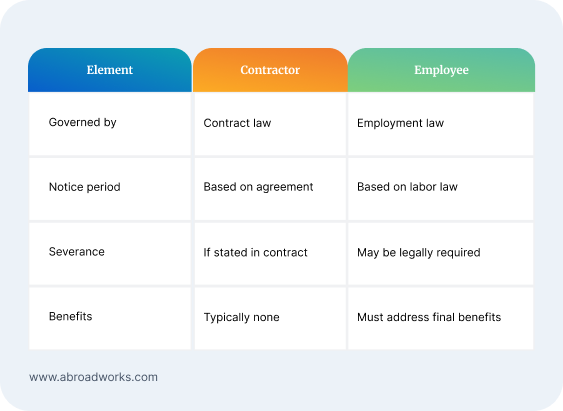
If you confuse the two, you risk misclassification issues. The IRS outlines what makes contractors different to employees.
Written Notice Requirements for Terminating a Contractor
Most contractor agreements don’t end the day you decide to end them. They end after a notice period.
A notice period is the time between when you deliver written notice and when the contract actually ends. Your contract sets it, not employment law. That’s one of the biggest differences from terminating an employee.
Immediate Termination vs a Notice Period
- Immediate termination: The contract ends on the day notice is delivered. This is usually reserved for termination for cause, like a serious breach, and only works if your agreement allows it.
- Termination with notice: You give the contractor a set number of days before the end date. 15 and 30 days are common. During that window, the contractor keeps working, finishes deliverables, and hands over work in progress.
What Counts as Proper Written Notice
Check the notice clause in your agreement. It usually spells out:
- How many days of notice you must give
- How notice must be delivered (email, certified mail, courier, or hand delivery)
- Who must receive it (a named person or a specific address)
- When notice counts as received (on sending, on delivery, or a set number of days after mailing)
- Whether the contractor gets a “cure period” to fix a breach before termination takes effect
If the contract requires 30 days and your letter gives 14, you may owe the contractor for the difference. Count the days carefully.
If your contract has no notice clause, the rules depend on where you operate. In the U.S., it varies by state and by contract type. In Canada, courts can treat a long-term contractor who relies on one client as a “dependent contractor” entitled to reasonable notice (see McKee v. Reid’s Heritage Homes Ltd., 2009 ONCA 916). If your agreement is silent, talk to counsel before you set an end date.
Sample Written Notice Clause
Use this short clause when you’re giving notice rather than ending the contract immediately:
“This letter serves as written notice that [Company Name] is terminating the [Agreement Name] dated [MM/DD/YYYY], in accordance with Section [X]. As required under that section, this letter provides [15/30] days’ notice. The agreement will end at the close of business on [Effective Date]. Until that date, please continue to perform services under the agreement and coordinate the handover of all work in progress with [Contact Name].”
Keep proof of delivery. A certified mail receipt, courier tracking, or a written reply confirming receipt all work.
Contractor Termination Letter Template (Standard)
Below is a simple termination contract agreement sample you can customize.
Subject: Notice of Contract Termination
Dear [Contractor Name],
This letter serves as formal notice that we are terminating the Independent Contractor Agreement dated [MM/DD/YYYY], between [Your Company Name] and [Contractor Name].
In accordance with Section [X] of the agreement, the termination will be effective on [Effective Date].
As of the termination date, all services under the agreement must cease. Please submit any outstanding invoices by [MM/DD/YYYY]. We will process final payment within [X] days, subject to contract terms.
Kindly return all company property, documents, and access credentials no later than [MM/DD/YYYY]. Your confidentiality and non-disclosure obligations remain in effect.
We appreciate your contributions and wish you success in your future projects.
Sincerely,
[Your Name]
[Title]
[Company Name]
Termination Letter Sample Service Contract (For Performance Issues)
When performance triggers the termination, it’s important to be clear.
Subject: Termination of Service Contract
Dear [Contractor Name],
We refer to the Service Agreement dated [MM/DD/YYYY]. After careful review, we have determined that performance expectations outlined in Section [X] have not been met.
Pursuant to the termination clause in Section [Y], this letter provides [X] days’ notice. The agreement will end on [MM/DD/YYYY].
Please submit all deliverables completed through the termination date. Final payment will reflect approved work only.
All confidential information must be returned or deleted in writing.
We regret that this step became necessary.
Sincerely,
[Name]
Cancellation of Contract Letter Template (For Convenience)
Subject: Cancellation of Contract
Dear [Contractor Name],
Due to strategic business changes, we are exercising our right to terminate the contract dated [Insert Date].
This cancellation of contract letter provides notice as required under Section [X]. The agreement will conclude on [MM/DD/YYYY].
We will compensate all approved work completed prior to termination.
Thank you for your cooperation during this transition.
Regards,
[Name]
Construction & Subcontractor Termination Letter Sample
Construction terminations move faster and carry more risk than most. Crews are on site. Materials are ordered. Unpaid subs and suppliers may be able to file liens. Your letter needs to stop work cleanly and protect the project.
Before you send anything, check:
- The termination clause in the subcontract, and whether it flows down from the prime contract
- Whether you’re terminating for cause or for convenience
- Any cure period the subcontractor gets to fix a default
- Your state’s lien laws and deadlines
Standard industry forms, like the AIA A201 General Conditions, have their own termination and suspension procedures. Federal contracts often use a standard stop-work order clause (FAR 52.242-15). If your contract is built on one of these forms, follow its steps exactly.
Construction Termination Checklist
- Stop work directive: State the exact date and time all work must stop
- Site safety: Require the site to be left safe and secure before crews leave
- Site access: Revoke keys, gate codes, badges, and system logins
- Materials and equipment: Spell out what stays on site, what gets removed, and who owns materials already paid for
- Work documentation: Request photos, daily logs, and a status report of completed work
- Permits and inspections: Clarify who handles open permits and pending inspections
- Final payment: Tie payment to completed work, retainage terms, and signed lien waivers
- Warranties: Confirm warranties on completed work still apply
Sample Subcontractor Termination and Stop Work Letter
Subject: Notice of Subcontract Termination and Stop Work Order
Dear [Subcontractor Name],
This letter serves as formal notice that [Company Name] is terminating the Subcontract Agreement dated [MM/DD/YYYY] for work at [Project Name / Site Address], pursuant to Section [X] of the agreement.
Stop work: Effective [Date] at [Time], all work on the project must stop, except work needed to leave the site safe and secure.
Site access: Your access to the site ends on [Date]. Please return all keys, access cards, and gate codes to [Contact Name] by that date.
Materials and equipment: Please remove your tools and equipment by [Date]. Materials paid for by [Company Name] must remain on site.
Documentation: Please provide a written status report of completed work, with photos and daily logs, by [Date].
Final payment: Submit your final invoice for work completed through the stop work date by [Date]. Final payment will be processed under Section [Y], subject to inspection of completed work, applicable retainage terms, and receipt of signed lien waivers from you and your suppliers.
Your warranties and obligations for completed work remain in effect.
Sincerely,
[Name]
[Title]
[Company Name]
Stop work notice vs termination: A stop work notice pauses the job. It doesn’t end the contract on its own. If you only need a pause, like waiting on permits, funding, or design changes, send a stop work notice. If you’re ending the relationship, say so clearly in the letter.
How to Terminate a Vendor or Service Provider Contract
People use “contractor,” “vendor,” and “service provider” interchangeably. But ending a contract with an agency or business isn’t the same as ending one with an individual freelancer.
With a B2B vendor, you’re often dealing with longer terms, auto-renewals, recurring billing, and your data sitting on their systems. Here’s what to cover.
1. Check the Term and Renewal Dates
Many service agreements renew automatically unless you cancel within a set window before the renewal date. Miss it and you could be locked in for another term. Check for early termination fees too.
2. Stop Recurring Billing
Confirm the last billing date in writing. Cancel auto-pay, open purchase orders, and stored payment methods. Ask the vendor to confirm no charges will be made after the termination date.
3. Request a Final Invoice
Ask for one final invoice covering all services through the end date. Reconcile it against prepaid fees and credits. If the contract allows, ask about refunds for any unused prepaid period.
4. Plan the Data and Service Transition
Request an export of your data in a usable format before access ends. Get written confirmation that your data has been returned or deleted as the agreement requires. Line up a replacement vendor or internal team so there’s no gap in service, and check whether the contract includes transition support.
5. Revoke Access Both Ways
Remove the vendor’s access to your systems, shared drives, and accounts. Make sure you keep admin access to anything they set up for you, like domains, ad accounts, and software licenses.
Sample Vendor Termination Letter
Subject: Notice of Termination of Services Agreement
Dear [Vendor Contact Name],
This letter serves as formal notice that [Company Name] is terminating the [Services Agreement] dated [MM/DD/YYYY] with [Vendor Company Name], in accordance with Section [X]. The agreement will end on [Effective Date]. This letter also serves as notice that we will not renew the agreement.
Please confirm the following in writing by [Date]:
- No further charges will be made after [Effective Date]
- A final invoice for services through [Effective Date]
- Delivery of all [Company Name] data in [format] by [Date]
- Return or deletion of our data and confidential information after the transfer
- Transfer of admin access for any accounts created on our behalf
We appreciate your work with our team and want to make this transition as smooth as possible.
Sincerely,
[Name]
[Title]
[Company Name]
Writing Tips That Reduce Legal Risk
If you make small wording mistakes, they can leave room for misinterpretation. Keep these principles in mind when writing:
- Stick to facts
- Avoid accusations
- Reference contract clauses
- Avoid emotional language
- Don’t admit liability unless advised by counsel
Clear documentation is vital in order to prevent contract disputes which will prolong the termination process.
Think of the letter as a seatbelt. You hope you never need it. Still, you’re glad it’s there.
What About a “No Longer Employed Letter”?
A no longer employed letter usually applies to employees. However, contractors can sometimes request a written confirmation that their engagement has ended.
It’s recommended that you keep it simple:
- Confirm contract end date
- Confirm completion of obligations
- Avoid employment language
Never state that the contractor was “employed.” Words matter.
Common Mistakes to Avoid
Even experienced managers slip up. Watch for these:
- Skipping written notices
- Ignoring notice periods
- Improperly withholding final payment
- Failing to collect company assets
- Being hostile or having an aggressive tone
- Forgetting confidentiality reminders
You need to be very careful as one missed detail can snowball into a dispute.
Special Scenarios
1. Immediate Termination for Breach of Contract
If the current contract allows you to terminate for cause without notice, document the breach clearly referencing specific clauses, and avoid vague claims at all costs.
2. Expiration of Fixed-Term Contract
If the contract simply expires, then send a short letter confirming non-renewal. This avoids any and all sorts of drama.
3. Mutual Termination
When both parties agree, draft a mutual termination agreement, and both sides should sign it.
Protecting Intellectual Property After Termination
Contractors often create valuable assets. Code, designs, marketing copy, strategy documents, etc.
Your termination letter should remind them that:
- Ownership remains with your company if the contract says so
- All materials must be returned upon termination
- Access credentials must be revoked immediately
If IP ownership matters then review the U.S. Copyright Office guidance on work-for-hire principles.
Payment Considerations
Money can create problems very quickly, so be very clear on the following:
- Invoice deadlines
- Payment method
- Deductions for incomplete work
- Refund obligations
Never withhold payment without a contract that supports that decision as courts rarely favor surprise deductions.
Tone Matters More Than You Think
You can end a contract without burning a bridge. Keep the tone neutral, maybe even appreciative if applicable. Contractors move between companies quite often and today’s exit could become tomorrow’s partnership, so be wary of that.
Short sentences help and direct statements help more. Avoid sarcasm, threats, etc. Just keep it clean and professional.
Can You Terminate a Contractor via Email?
Usually, yes.
Email works in most modern contracts. Still, confirm your agreement allows electronic notice.
If the contract requires certified mail, follow it. Documentation beats convenience every time.
In the U.S., the E-SIGN Act gives electronic records the same legal effect as paper ones, and most states have adopted the Uniform Electronic Transactions Act (UETA). But these laws don’t override your contract. If your notice clause names a specific delivery method or address, that’s the one that counts.
If the contract doesn’t say how notice must be sent, email is generally fine. Send it to the address the contractor normally uses for business and keep proof. When in doubt, do both: email for speed and a mailed copy to cover the contract.
Tips for Sending a Termination Email
- Use a clear subject line so it doesn’t get missed or filtered
- Send it from a company account, not a personal one
- Attach the signed letter as a PDF and include the key details in the body
- Ask the contractor to reply and confirm receipt
- Save the sent email and any replies with your records
Contract Termination Email Template
Subject: Notice of Termination: [Agreement Name] Dated [MM/DD/YYYY]
Hi [Contractor Name],
Please accept this email as formal written notice that [Company Name] is terminating the [Agreement Name] dated [MM/DD/YYYY], under Section [X].
The agreement will end on [Effective Date]. Please submit your final invoice by [Date] and return all company property and access credentials by [Date]. Your confidentiality obligations remain in effect.
A signed copy of this notice is attached. Please reply to confirm you received it.
Thank you for your work with us.
Best,
[Name]
[Title]
[Company Name]
Frequently Asked Questions
- Is a termination letter legally required for contractors? Not always, but most contracts require written notice. Sending a termination letter for contractor agreements protects both parties and creates a clear paper trail.
- Can I terminate an independent contractor immediately? Only if your contract allows it. Many agreements include termination for cause clauses. Review your independent contractor termination letter requirements before acting.
- What should I include in a contract employee termination letter? Include contract reference, termination date, payment details, property return instructions, and confidentiality reminders.
- What’s the difference between an independent contractor termination letter and an employee termination letter? An independent contractor termination letter follows the contract terms. An employee termination letter must follow labor laws.
- Do I have to pay a contractor after termination? Yes, for approved work completed before the termination date.
- How much notice do I need to give to terminate an independent contractor? Whatever your contract requires. 15 or 30 days is common. If the contract doesn’t set a notice period, the rules vary by location, so check with counsel before you pick an end date.
- Can I terminate a contract by email? Usually, yes. Email notice is generally valid unless your contract requires a different method, like certified mail or hand delivery.
- How do I write a stop work notice for a subcontractor? Name the project and the contract, state the exact date and time work must stop, give site safety and access instructions, and explain how final payment and lien waivers will be handled.
- How is terminating a vendor contract different from terminating a freelancer? Vendor contracts often include auto-renewals, recurring billing, and your data on their systems. Your notice should cover the final invoice, billing cancellation, and data return or deletion.
Final Thoughts
A well-written termination letter does more than end a relationship. It protects your business. It clarifies expectations. It prevents conflict.
Use the templates above as starting points, adjust them to your agreement, stay professional and precise.
Business relationships begin with optimism. Sometimes they end with paperwork. When that moment arrives, you’ll be ready with the right contractor termination letter template.